
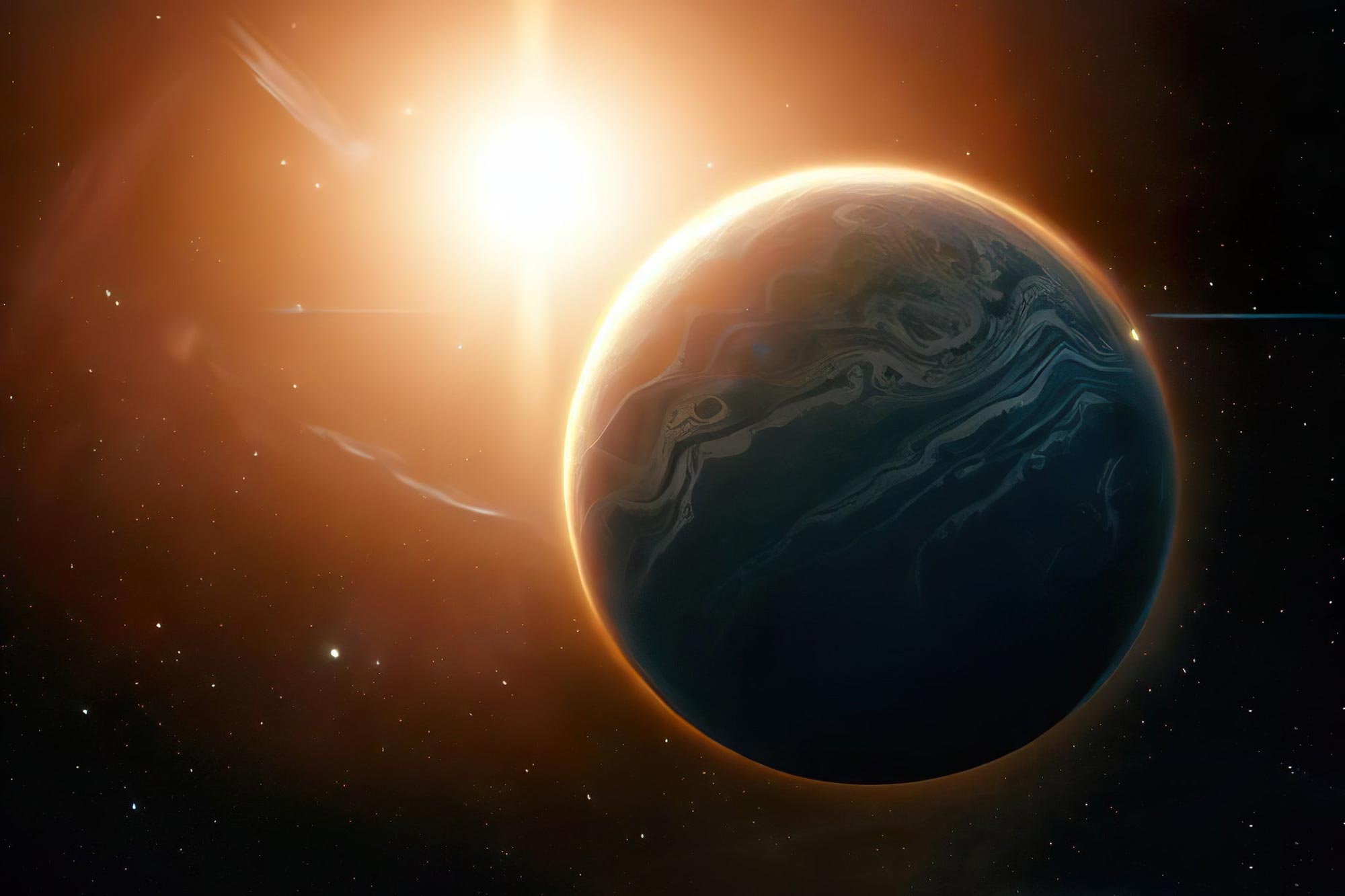
High-tech telescopes search for chemicals necessary for life on Earth.
The next generation of advanced telescopes could sharpen the hunt for potential extraterrestrial life by closely scrutinizing the atmospheres of nearby exoplanets, new research suggests.
Published recently in The Astronomical Journal, a new paper details how a team of astronomers from The Ohio State University examined upcoming telescopes’ ability to detect chemical traces of oxygen, carbon dioxide, methane, and water on 10 rocky exoplanets. These elements are biosignatures also found in Earth’s atmosphere that can provide key scientific evidence of life.
Potential Biosignatures on Exoplanets
The study found that for a pair of these nearby worlds, Proxima Centauri b and GJ 887 b, these telescopes are highly adept at detecting the presence of potential biosignatures. Of the two, findings show that only for Proxima Centauri b would the machines be able to detect carbon dioxide if it were present. Though no exoplanet has been found to precisely twin Earth’s early conditions for life, this work suggests that if examined in greater detail, such unique Super Earths – planets more massive than Earth but smaller than Neptune – could make a suitable target for future research missions.
Imaging Techniques and Instrument Testing
To further the search for habitable planets, Huihao Zhang, lead author of the study and a senior in astronomy at Ohio State, and his colleagues also sought to determine the effectiveness of specialized imaging instruments like the James Webb Space Telescope (JWST) and other Extremely Large Telescopes (ELTs) such as the European Extremely Large Telescope, the Thirty-Meter-Telescope, and the Giant Magellan Telescope at directly imaging exoplanets.
“Not every planet is suitable for direct imaging, but that’s why simulations give us a rough idea of what the ELTs would have delivered and the promises they’re meant to hold when they are built,“ said Zhang.
The direct method of imaging exoplanets involves using a coronagraph or starshade to block a host star’s light, allowing scientists to capture a faint image of the new world in orbit. But because locating them in this way can be difficult and time-consuming, the researchers aimed to see how well the ELT telescopes might handle the challenge. To do this, they tested each telescope’s instruments’ abilities to differentiate universal background noise from the planetary noise they aimed to capture while detecting biosignatures; called the signal-to-noise ratio, the higher it is, the easier a planet’s wavelength is able to be detected and analyzed.
Results showed that the direct imaging mode of one of the European ELT’s instruments, called the Mid-infrared ELT Imager and Spectrograph, performed better for three planets (GJ 887 b, Proxima b and Wolf 1061 c) in discerning the presence of methane, carbon dioxide, and water, while its High Angular Resolution Monolithic Optical and Near-infrared Integral field spectrograph instrument could detect methane, carbon dioxide, oxygen, and water, but needed a great deal more exposure time.
Additionally, since these conclusions were about instruments that will have to peer through the chemical fog of Earth’s atmosphere to progress the search for cosmic life, they were compared to JWST’s current outer space capabilities, said Zhang.
Comparative Analysis of Space and Ground-Based Telescopes
“It’s hard to say whether space telescopes are better than ground-based telescopes, because they’re different,” he said. “They have different environments, different locations, and their observations have different influences.”
In this case, findings revealed that while GJ 887 b is one of the most suitable targets for ELT direct imaging as its location and size result in an especially high signal-to-noise ratio, for some transiting planets, such as the TRAPPIST-1 system, JWST’s techniques for studying planetary atmospheres are more suitable for detecting them than direct imaging from the ELTs on Earth.
Future Directions and Simulation Importance
Because the study took on a more conservative assumption with the data, Zhang said, the true effectiveness of future astronomical tools could still surprise scientists. And subtle contrasts in performance aside, these powerful technologies serve to widen our understanding of the universe and are meant to complement each other, said Ji Wang, co-author of the study and an assistant professor in astronomy at Ohio State. It’s why studies like this one, that assess the limitations of those technologies, is necessary, he said.
“The importance of simulation, especially for missions that cost billions of dollars, cannot be stressed enough,” said Wang. “Not only do people have to build the hardware, they also try really hard to simulate the performance and be prepared to achieve those glorious results.”
In all likelihood, as the ELTs won’t be completed until the tail end of the decade, researchers’ next steps will settle around simulating how well future ELT instruments will take to investigating the intricacies of our own planet’s rampant proofs of life.
“We want to see to what extent we can study our atmosphere to exquisite detail and how much information we can extract from it,” said Wang. “Because if we cannot answer habitability questions with Earth’s atmosphere, then there’s no way we can start to answer these questions around other planets.”
Reference: “Detecting Biosignatures in Nearby Rocky Exoplanets Using High-contrast Imaging and Medium-resolution Spectroscopy with the Extremely Large Telescope” by Huihao Zhang, Ji Wang and Michael K. Plummer, 28 December 2023, The Astronomical Journal.
DOI: 10.3847/1538-3881/ad109e
Never miss a breakthrough: Join the SciTechDaily newsletter.
Follow us on Google and Google News.