
Close Menu
    Facebook X (Twitter) Instagram
    SciTechDaily
    • Biology
    • Chemistry
    • Earth
    • Health
    • Physics
    • Science
    • Space
    • Technology
    Facebook X (Twitter) Pinterest YouTube RSS
    SciTechDaily
    Home»Chemistry»Scientists Create a New Graphene-Type Material
    Chemistry

    Scientists Create a New Graphene-Type Material

    By University of LiverpoolMay 22, 2014No Comments3 Mins Read
    Facebook Twitter Pinterest Telegram LinkedIn WhatsApp Email Reddit
    Share
    Facebook Twitter LinkedIn Pinterest Telegram Email Reddit
    Scientists Create a New Graphene Type Material TGCN
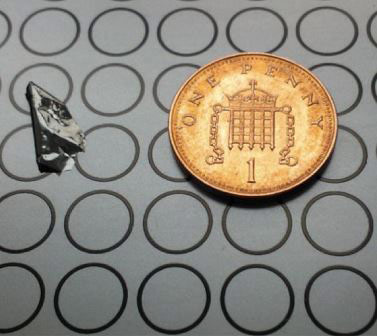
    A single macroscopic flake of TGCN. Credit: University of Liverpool

    Researchers created triazine-based graphitic carbon nitride (TGCN), a new material that was predicted theoretically in 1996 with the potential to improve transistors used in electronic devices.

    Scientists at the University of Liverpool have created a new material, related to graphene, which has the potential to improve transistors used in electronic devices.

    The new material, ‘triazine-based graphitic carbon nitride’, or TGCN, was predicted theoretically in 1996, but this is the first time that it has been made.

    Graphene is one atom thick, strong and conducts heat and electricity highly efficiently. The new TGCN material is also two-dimensional, but it has an electronic band gap, making it potentially suitable for use in transistors.

    Carbon-based

    At present, transistors are made of expensive silicon that generates heat when used in electronic devices. Scientists have been looking for a material that is carbon-based and that has the electronic band gap needed for use as a semiconductor.

    Chemist, Professor Andrew Cooper, from the University’s Department of Chemistry, said: “This is an exciting result because there are relatively few ordered two-dimensional organic solids. Finding a new member of the ‘graphene family’ is very significant.”

    Starting with the inexpensive molecule dicyandiamide, the team prepared crystals of graphitic carbon nitride, a two-dimensional layered material that is similar to graphene, but which contains nitrogen.

    TGCN

    They combined these ingredients in a quartz tube and heated them for 62 hours at up to 600°C. The result is a liquid containing flakes of TGCN that can be removed by filtering or peeling them off the quartz tube.

    The material is at an early stage of development and Professor Cooper believes the next stage in the research is to explore its properties.

    He said: “The creation and analysis of this material is just the first step. We now have a lot more work to do to scale it up and prove function in electronic devices.”

    The research project, funded by an Engineering and Physical Sciences Research Council (EPSRC) Program Grant at Liverpool, also involved chemistry, physics, and materials science researchers from across Europe. This team included scientists at Technical University Berlin, Ulm University, Aalto University, Humboldt University Berlin, University College London, University of East Anglia, University of Helsinki, and the Max Planck Institute for Colloids and Interfaces.

    Reference: “Triazine-Based, Graphitic Carbon Nitride: a Two-Dimensional Semiconductor” by Gerardo Algara-Siller, Dr. Nikolai Severin, Samantha Y. Chong, Dr. Torbjörn Björkman, Dr. Robert G. Palgrave, Andrea Laybourn, Prof. Dr. Markus Antonietti, Prof. Yaroslav Z. Khimyak, Dr. Arkady V. Krasheninnikov, Prof. Dr. Jürgen P. Rabe, Prof. Dr. Ute Kaiser, Prof. Andrew I. Cooper, Prof. Dr. Arne Thomas and Dr. Michael J. Bojdys, 18 May 2014, Angewandte Chemie International Edition.
    DOI: 10.1002/anie.201402191


    Never miss a breakthrough: Join the SciTechDaily newsletter.
    Follow us on Google and Google News.

    Graphene Materials Science University of Liverpool
    Share. Facebook Twitter Pinterest LinkedIn Email Reddit

    Related Articles

    Measuring the “Wettability” of Graphene and Other 2D Materials at the Molecular Level

    Enhanced Energy Storage Capacity of Graphene Supercapacitors via Solar Heating

    New Inorganic Material Discovered With Lowest Thermal Conductivity Ever Reported

    Breakthrough Means a Sustainable, Powerful Micro-Supercapacitor May Be on the Horizon

    What Happens Between the Sheets? Extremely-Promising Superconductor Surprises Everyone

    Chemists Achieve Breakthrough in the Synthesis of Graphene Nanoribbons

    Frustrating Catch 22 in Graphene Based Molecular Devices Solved

    UJI Patents New Graphene-Based Catalysts

    Researchers Identify a New Form of Carbon: Grossly Warped ‘Nanographene’

    Leave A Reply Cancel Reply

    • Facebook
    • Twitter
    • Pinterest
    • YouTube

    Don't Miss a Discovery

    Subscribe for the Latest in Science & Tech!

    Trending News

    Scientists May Have Discovered How To Heal Damaged Kidneys

    Interstellar Visitor 3I/ATLAS Is Bursting With an Unexpected Chemical

    Scientists Just Found All 5 Genetic “Letters” of DNA and RNA on an Asteroid

    The 4,000-Year-Old City That Defied History’s Rules on Wealth and Power

    The World’s Biggest Population Fear Has Flipped – and It Could Change Everything

    This “Fake” Pill Improved Memory and Physical Performance in Just 3 Weeks

    Scientists Say Frequent Ejaculation May Improve Sperm Quality and Fertility

    Scientists Have Found “The Heaven Sword” After Years of Looking

    Follow SciTechDaily
    • Facebook
    • Twitter
    • YouTube
    • Pinterest
    • Newsletter
    • RSS
    SciTech News
    • Biology News
    • Chemistry News
    • Earth News
    • Health News
    • Physics News
    • Science News
    • Space News
    • Technology News
    Recent Posts
    • Watch What Happened When a Lost Elephant Calf Returned to Her Family
    • 17,000 Brain Scans Reveal Surprising Ethnic Differences in Alzheimer’s Biology
    • New Autism Treatment Strategy Restores Key Brain Receptor Function
    • Younger Generations Are Aging Faster – and It May Be Fueling a Surge in Cancer
    • Scientists Turn Ordinary Sunlight Into UV Light in Major Energy Breakthrough
    Copyright © 1998 - 2026 SciTechDaily. All Rights Reserved.
    • Science News
    • About
    • Contact
    • Editorial Board
    • Privacy Policy
    • Terms of Use

    Type above and press Enter to search. Press Esc to cancel.