
Close Menu
    Facebook X (Twitter) Instagram
    SciTechDaily
    • Biology
    • Chemistry
    • Earth
    • Health
    • Physics
    • Science
    • Space
    • Technology
    Facebook X (Twitter) Pinterest YouTube RSS
    SciTechDaily
    Home»Chemistry»Frustrating Catch 22 in Graphene Based Molecular Devices Solved
    Chemistry

    Frustrating Catch 22 in Graphene Based Molecular Devices Solved

    By University of WarwickSeptember 22, 2019No Comments3 Mins Read
    Facebook Twitter Pinterest Telegram LinkedIn WhatsApp Email Reddit
    Share
    Facebook Twitter LinkedIn Pinterest Telegram Email Reddit
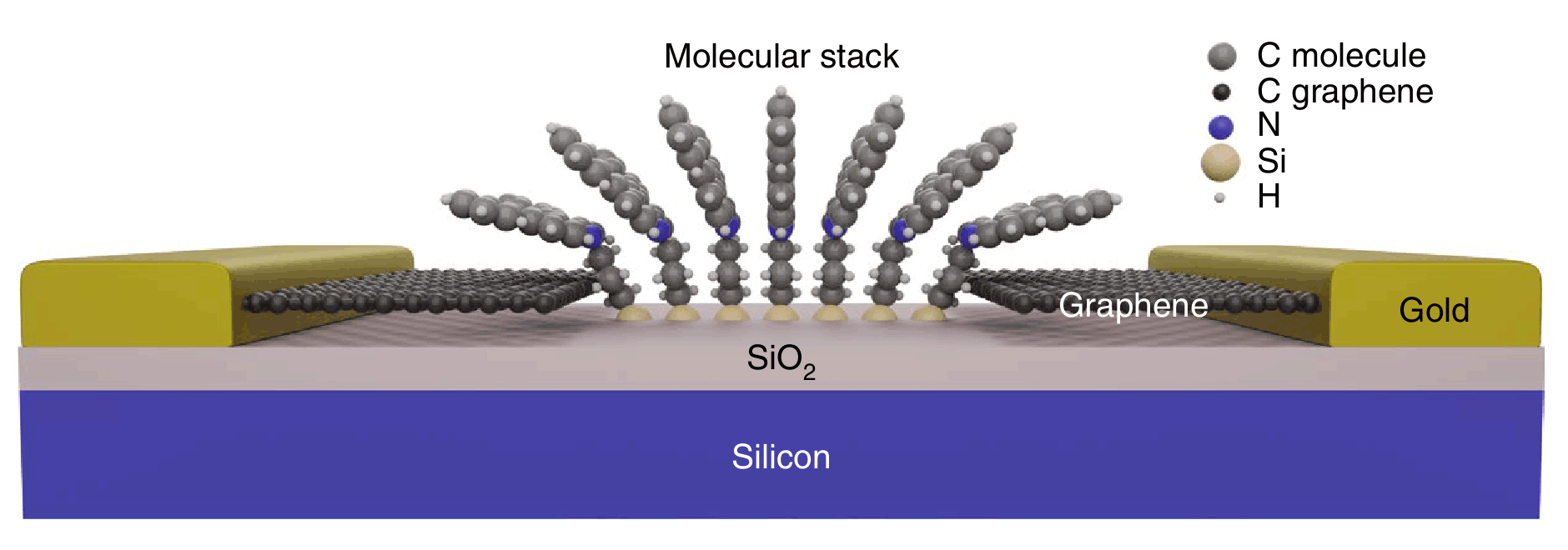
    Anchoring the Graphene-Like Molecule Stack to the Substrate Using a Silanization Reaction
    The researchers produced an electrically effective structure by building a graphene-like molecule stack to form an electron path through the graphene-like molecules P orbitals (these are dumbbell-shaped electron clouds within which an electron can be found, within a certain degree of probability) This would open new avenues to use fascinating molecular properties such as quantum interference which occurs at such a small scale provided a sufficiently mechanical robust structures achieved. For this, the research team also created bonds between each molecule and a silicon-oxide substrate. This gave the structure significant mechanical stability by effectively anchoring the graphene-like molecule stack to the substrate using a silanization reaction. Credit: University of Warwick

    The conductivity of Graphene has made it a target for many researchers seeking to exploit it to create molecular-scale devices and now a research team jointly led by the University of Warwick and EMPA have found a way past a frustrating catch-22 issue of stability and reproducibility that meant that graphene-based junctions were either mechanically stable or electrically stable but not both at the same time.

    Graphene and graphene-like molecules were an attractive choice as an electronic component in molecular devices, but up till now, it has proven very challenging to use them in large-scale production of molecular devices that will work and be robust at room temperatures. In a joint effort research teams from the University of Warwick, EMPA, and Lancaster and Bern Universities have reached both electrical and mechanical stability in graphene-based junctions million times smaller than the diameter of human hair. They published their findings in a paper entitled “Robust graphene-based molecular devices” in the journal Nature Nanotechnology.

    Simple mechanically stable structures such as graphene-like molecules are easy to produce by chemical synthesis but at this very small scale these are subject to a range of limits when they are placed in a junction to form an electronic device such as variations in molecule electrode interface. The researchers overcome these limits by separating the requirements for mechanical and electronic stability at the molecular level.

    They produced an electrically effective structure by building a graphene-like molecule stack to form an electron path through the graphene-like molecules P orbitals (these are dumbbell-shaped electron clouds within which an electron can be found, within a certain degree of probability) This would open new avenues to use fascinating molecular properties such as quantum interference which occurs at such a small scale provided a sufficiently mechanical robust structures achieved. For this, the research team also created bonds between each molecule and a silicon-oxide substrate. This gave the structure significant mechanical stability by effectively anchoring the graphene-like molecule stack to the substrate using a silanization reaction.

    Dr. Hatef Sadeghi from the University of Warwick’s School of Engineering who led the theoretical modeling of this work said:

    “This method allowed us to design and produce graphene-based molecular devices that are electronically and mechanically stable over a large temperature range. This was achieved by decoupling the mechanical anchoring from the electronic pathways by combining a covalent binding of the molecules to the substrate and large π-conjugated head groups. The junctions were reproducible over several devices and operated from 20 Kelvin up to room temperature. Our approach represents a simple but powerful strategy for the future integration of molecule-based functions into stable and controllable nanoelectronic devices.”

    Reference: “Robust graphene-based molecular devices” by Maria El Abbassi, Sara Sangtarash, Xunshan Liu, Mickael Lucien Perrin, Oliver Braun, Colin Lambert, Herre Sjoerd Jan van der Zant, Shlomo Yitzchaik, Silvio Decurtins, Shi-Xia Liu, Hatef Sadeghi and & Michel Calame, 16 September 2019, Nature Nanotechnology.
    DOI: 10.1038/s41565-019-0533-8

    Never miss a breakthrough: Join the SciTechDaily newsletter.
    Follow us on Google and Google News.

    Graphene Materials Science Nanotechnology University of Warwick
    Share. Facebook Twitter Pinterest LinkedIn Email Reddit

    Related Articles

    Thomas Edison May Have Created a Miracle Material Before Physics Knew It Existed

    White Graphene: The One-Atom Wonder Driving Greener Energy and Faster Tech

    Measuring the “Wettability” of Graphene and Other 2D Materials at the Molecular Level

    What Happens Between the Sheets? Extremely-Promising Superconductor Surprises Everyone

    Chemists Achieve Breakthrough in the Synthesis of Graphene Nanoribbons

    Researchers Identify a New Form of Carbon: Grossly Warped ‘Nanographene’

    Scientists Examine Platinum-Based Catalyst Design

    Electron-Electron Interactions are Critical to Graphene’s Extraordinary Properties

    Olympicene, the Smallest Possible Five-Ringed Structure

    Leave A Reply Cancel Reply

    • Facebook
    • Twitter
    • Pinterest
    • YouTube

    Don't Miss a Discovery

    Subscribe for the Latest in Science & Tech!

    Trending News

    Scientists Discover 132-Million-Year-Old Dinosaur Tracks on South Africa’s Coast

    Scientists Uncover the Secret Ingredient Behind the Spark That May Have Started Life on Earth

    Physicists Observe Matter in Two Places at Once in Mind-Bending Quantum Experiment

    Stanford Scientists Discover Hidden Brain Circuit That Fuels Chronic Pain

    New Study Reveals Why Ozempic Works Better for Some People Than Others

    Climate Change Is Altering a Key Greenhouse Gas in a Way Scientists Didn’t Expect

    New Study Suggests Gravitational Waves May Have Created Dark Matter

    Scientists Discover Why the Brain Gets Stuck in Schizophrenia

    Follow SciTechDaily
    • Facebook
    • Twitter
    • YouTube
    • Pinterest
    • Newsletter
    • RSS
    SciTech News
    • Biology News
    • Chemistry News
    • Earth News
    • Health News
    • Physics News
    • Science News
    • Space News
    • Technology News
    Recent Posts
    • Surprise RNA Discovery Challenges Long-Held Beliefs About How Genes Work
    • Your IQ at 23 Could Predict Your Wealth at 27, Study Finds
    • 320 Light-Years Away, a Planet Confirms a Fundamental Cosmic Assumption
    • Astronomers Solve Decades-Long Mystery About Saturn’s Spin – “Something Strange Was Happening”
    • Scientists Uncover Strange New State of Matter Inside Uranus and Neptune
    Copyright © 1998 - 2026 SciTechDaily. All Rights Reserved.
    • Science News
    • About
    • Contact
    • Editorial Board
    • Privacy Policy
    • Terms of Use

    Type above and press Enter to search. Press Esc to cancel.