
Close Menu
    Facebook X (Twitter) Instagram
    SciTechDaily
    • Biology
    • Chemistry
    • Earth
    • Health
    • Physics
    • Science
    • Space
    • Technology
    Facebook X (Twitter) Pinterest YouTube RSS
    SciTechDaily
    Home»Space»Hubble Views Young Star IRAS 14568-6304
    Space

    Hubble Views Young Star IRAS 14568-6304

    By Hubble Space TelescopeMay 26, 2014No Comments2 Mins Read
    Facebook Twitter Pinterest Telegram LinkedIn WhatsApp Email Reddit
    Share
    Facebook Twitter LinkedIn Pinterest Telegram Email Reddit
    New Hubble Image Shows IRAS 14568 6304
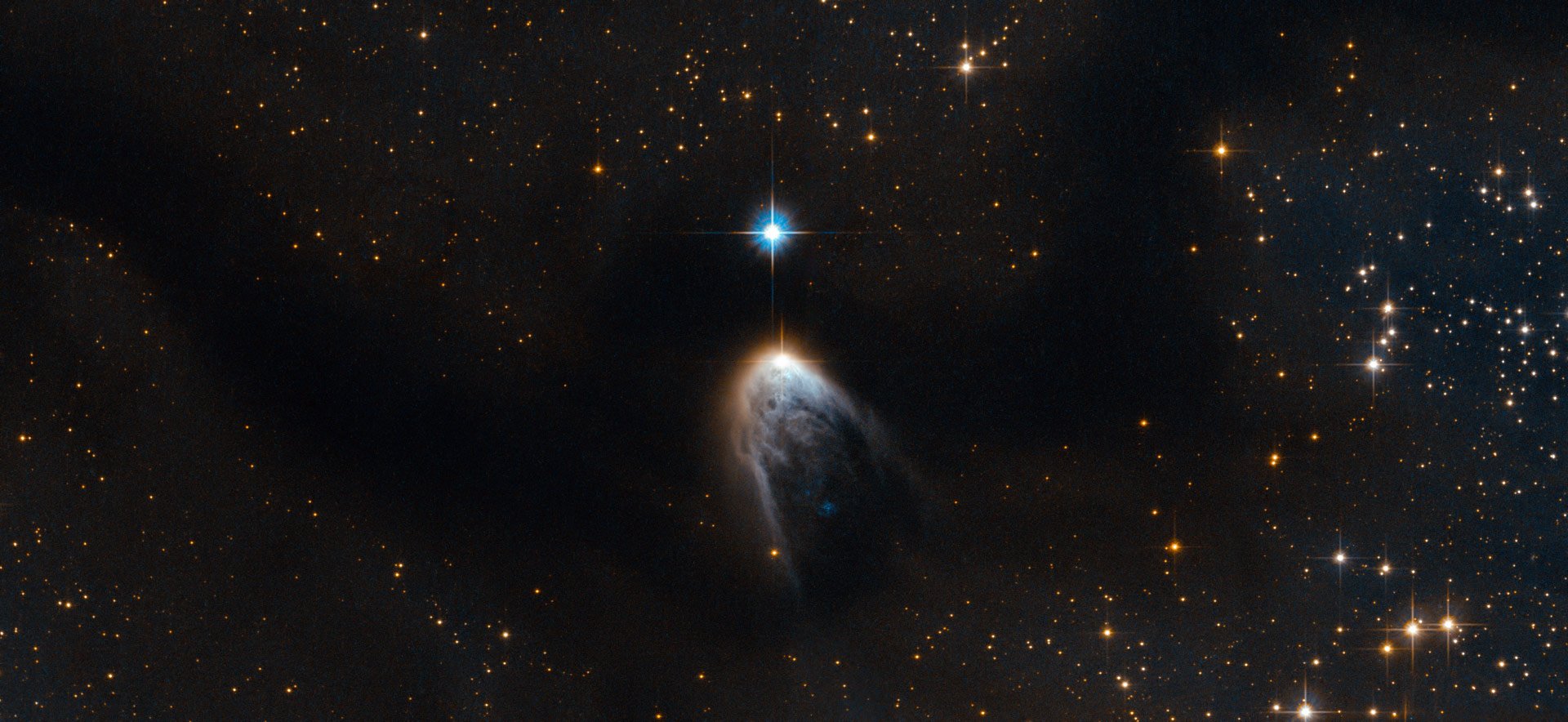
    This Hubble image reveals IRAS 14568-6304, a young star shrouded in a golden haze of gas and dust. Credit: ESA/Hubble & NASA; Acknowledgments: R. Sahai (Jet Propulsion Laboratory), Serge Meunier

    This newly released Hubble images shows the young star IRAS 14568-6304.

    This new Hubble image shows IRAS 14568-6304, a young star that is cloaked in a haze of golden gas and dust. It appears to be embedded within an intriguing swoosh of dark sky, which curves through the image and obscures the sky behind.

    This dark region is known as the Circinus molecular cloud. This cloud has a mass around 250,000 times that of the Sun, and it is filled with gas, dust and young stars. Within this cloud lie two prominent and enormous regions known colloquially to astronomers as Circinus-West and Circinus-East. Each of these clumps has a mass of around 5,000 times that of the Sun, making them the most prominent star-forming sites in the Circinus cloud. The clumps are associated with a number of young stellar objects, and IRAS 14568-6304, featured here under a blurry fog of gas within Circinus-West, is one of them.

    IRAS 14568-6304 is special because it is driving a protostellar jet, which appears here as the “tail” below the star. This jet is the leftover gas and dust that the star took from its parent cloud in order to form. While most of this material forms the star and its accretion disc — the disc of material surrounding the star, which may one day form planets — at some point in the formation process the star began to eject some of the material at supersonic speeds through space. This phenomenon is not only beautiful, but can also provide us with valuable clues about the process of star formation.

    IRAS 14568-6304 is one of several outflow sources in the Circinus-West clump. Together, these sources make up one of the brightest, most massive, and most energetic outflows ever reported. Scientists have even suggested calling Circinus-West the “nest of molecular outflows” in tribute to this activity.

    A version of this image was entered into the Hubble’s Hidden Treasures image processing competition by contestant Serge Meunier.

    Never miss a breakthrough: Join the SciTechDaily newsletter.
    Follow us on Google and Google News.

    Astronomy Hubble Space Telescope Popular
    Share. Facebook Twitter Pinterest LinkedIn Email Reddit

    Related Articles

    NASA Hubble Cold Case: A Dead Star May Have Given Birth to a New Planet

    Astronomers Expected More Tiny Worlds Beyond Neptune – Webb Found Something Else

    Hubble Discovers a Mysterious 10-Sided Wave Forming on Saturn

    Hubble Views Globular Cluster Messier 56

    Hubble Captures a New Image of Messier 107

    Hubble Views the Needle Galaxy, NGC 4565

    NASA Data Reveals Significant Changes in Exoplanet’s Atmosphere

    Lonestar Supercomputer Helps Explore Dark Matter

    Atmosphere of Super-Earth GJ1214b Possibly Includes Abundant Water Vapor

    Leave A Reply Cancel Reply

    • Facebook
    • Twitter
    • Pinterest
    • YouTube

    Don't Miss a Discovery

    Subscribe for the Latest in Science & Tech!

    Trending News

    Aging’s “Zombie Cell” Problem May Have a Solution, Scientists Discover

    Scientists Discover a Surprising Dental Benefit of Cranberry Juice

    Scientists Discover That Eating Peanuts Every Day May Help Protect the Aging Brain

    Scientists Discover Mysterious 150,000-Year-Old Bone From an Extinct Human Relative in Chinese Cave

    Why Do We Have Necks? Scientists Uncover a 380-Million-Year-Old Evolutionary Twist

    “Strangest of Its Kind”: Scientists Uncover a Bizarre Bacterial Self-Destruct Switch

    Scientists Reverse 60 Years of Aging in Human Cells, Turning 80-Year-Old Cells Into 20-Year-Olds

    A Solar Storm Heading Toward Earth Suddenly Changed in Ways Scientists Didn’t Predict

    Follow SciTechDaily
    • Facebook
    • Twitter
    • YouTube
    • Pinterest
    • Newsletter
    • RSS
    SciTech News
    • Biology News
    • Chemistry News
    • Earth News
    • Health News
    • Physics News
    • Science News
    • Space News
    • Technology News
    Recent Posts
    • A Hidden Molecular Pathway Could Change How a Deadly Disease Is Treated
    • The Brain Is More Capable of Healing Itself Than Scientists Thought
    • Scientists Discover Never-Before-Seen Molecules With Cancer-Fighting Potential
    • The Future of Electromagnetic Shields Could Be Lighter, Stronger, and Greener
    • Scientists Discover 3 Strange Quantum Materials That Could Finally Reveal Dark Matter
    Copyright © 1998 - 2026 SciTechDaily. All Rights Reserved.
    • Science News
    • About
    • Contact
    • Editorial Board
    • Privacy Policy
    • Terms of Use

    Type above and press Enter to search. Press Esc to cancel.