
Close Menu
    Facebook X (Twitter) Instagram
    SciTechDaily
    • Biology
    • Chemistry
    • Earth
    • Health
    • Physics
    • Science
    • Space
    • Technology
    Facebook X (Twitter) Pinterest YouTube RSS
    SciTechDaily
    Home»Space»Hubble Views Young Star IRAS 14568-6304
    Space

    Hubble Views Young Star IRAS 14568-6304

    By Hubble Space TelescopeMay 26, 2014No Comments2 Mins Read
    Facebook Twitter Pinterest Telegram LinkedIn WhatsApp Email Reddit
    Share
    Facebook Twitter LinkedIn Pinterest Telegram Email Reddit
    New Hubble Image Shows IRAS 14568 6304
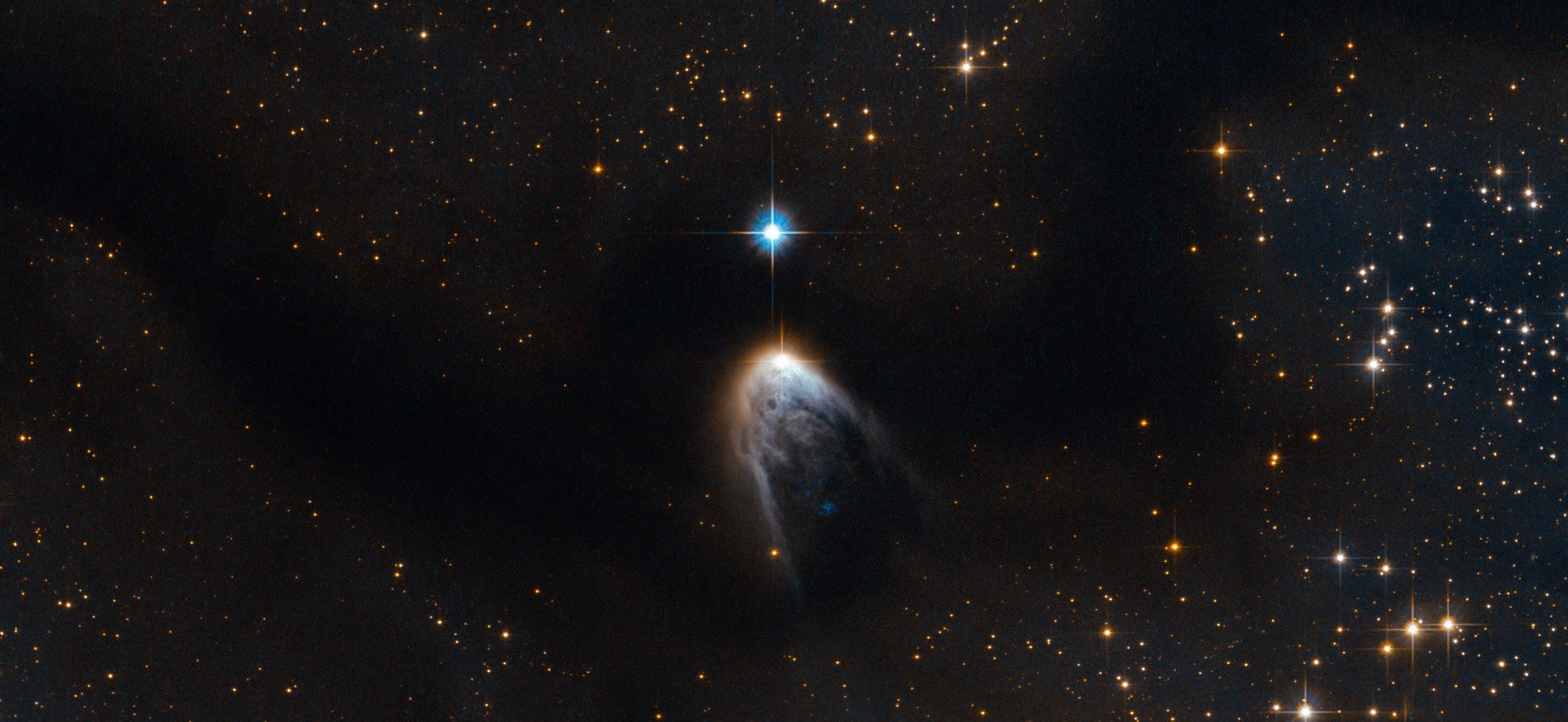
    This Hubble image reveals IRAS 14568-6304, a young star shrouded in a golden haze of gas and dust. Credit: ESA/Hubble & NASA; Acknowledgments: R. Sahai (Jet Propulsion Laboratory), Serge Meunier

    This newly released Hubble images shows the young star IRAS 14568-6304.

    This new Hubble image shows IRAS 14568-6304, a young star that is cloaked in a haze of golden gas and dust. It appears to be embedded within an intriguing swoosh of dark sky, which curves through the image and obscures the sky behind.

    This dark region is known as the Circinus molecular cloud. This cloud has a mass around 250,000 times that of the Sun, and it is filled with gas, dust and young stars. Within this cloud lie two prominent and enormous regions known colloquially to astronomers as Circinus-West and Circinus-East. Each of these clumps has a mass of around 5,000 times that of the Sun, making them the most prominent star-forming sites in the Circinus cloud. The clumps are associated with a number of young stellar objects, and IRAS 14568-6304, featured here under a blurry fog of gas within Circinus-West, is one of them.

    IRAS 14568-6304 is special because it is driving a protostellar jet, which appears here as the “tail” below the star. This jet is the leftover gas and dust that the star took from its parent cloud in order to form. While most of this material forms the star and its accretion disc — the disc of material surrounding the star, which may one day form planets — at some point in the formation process the star began to eject some of the material at supersonic speeds through space. This phenomenon is not only beautiful, but can also provide us with valuable clues about the process of star formation.

    IRAS 14568-6304 is one of several outflow sources in the Circinus-West clump. Together, these sources make up one of the brightest, most massive, and most energetic outflows ever reported. Scientists have even suggested calling Circinus-West the “nest of molecular outflows” in tribute to this activity.

    A version of this image was entered into the Hubble’s Hidden Treasures image processing competition by contestant Serge Meunier.

    Never miss a breakthrough: Join the SciTechDaily newsletter.
    Follow us on Google and Google News.

    Astronomy Hubble Space Telescope Popular
    Share. Facebook Twitter Pinterest LinkedIn Email Reddit

    Related Articles

    Astronomers Puzzled by Dark Storm’s U-Turn on Neptune, Appearance of New Dark Spot

    Rings of Relativity: A Truly Strange and Very Rare Phenomenon

    Hubble Discovers a Strange Exoplanet That Resembles the Long-Sought “Planet Nine”

    Ethereal Orange Glow Radiates From Heart of Stellar Forge

    Hubble Captures Unprecedented Fading of Stingray Nebula – “This Is Very, Very Dramatic, and Very Weird”

    Hubble Space Telescope Explains Oddball Galaxy’s Missing Dark Matter

    ULLYSES: Hubble Embarks on Largest Observing Program of Its Career

    Hubble Spots a Gorgeous Waterfall of Stars

    Hubble Spots Giant Space “Pumpkin” [Video]

    Leave A Reply Cancel Reply

    • Facebook
    • Twitter
    • Pinterest
    • YouTube

    Don't Miss a Discovery

    Subscribe for the Latest in Science & Tech!

    Trending News

    Why Popular Diabetes Drugs Like Ozempic Don’t Work for Everyone: The “Genetic Glitch”

    Scientists Stunned After Finding Plant Thought Extinct for 60 Years

    Scientists Discover Tiny New Spider That Hunts Prey 6x Its Size

    Natural Component From Licorice Shows Promise for Treating Inflammatory Bowel Disease

    Scientists Warn: Popular Sweetener Linked to Dangerous Metabolic Effects

    Monster Storms on Jupiter Unleash Lightning Beyond Anything on Earth

    Scientists Create “Liquid Gears” That Spin Without Touching

    The Simple Habit That Could Help Prevent Cancer

    Follow SciTechDaily
    • Facebook
    • Twitter
    • YouTube
    • Pinterest
    • Newsletter
    • RSS
    SciTech News
    • Biology News
    • Chemistry News
    • Earth News
    • Health News
    • Physics News
    • Science News
    • Space News
    • Technology News
    Recent Posts
    • 100,000-Year-Old Neanderthal Fossils in Poland Reveal Unexpected Genetic Connections
    • Unexpected Hormone Discovery Could Change How We Treat Arthritis
    • Scientists Supercharge “Natural Killer” Cells To Break Through Cancer’s Defenses
    • Simple “Gut Reset” May Prevent Weight Gain After Ozempic or Wegovy
    • 2.8 Days to Disaster: Scientists Warn Low Earth Orbit Could Suddenly Collapse
    Copyright © 1998 - 2026 SciTechDaily. All Rights Reserved.
    • Science News
    • About
    • Contact
    • Editorial Board
    • Privacy Policy
    • Terms of Use

    Type above and press Enter to search. Press Esc to cancel.