
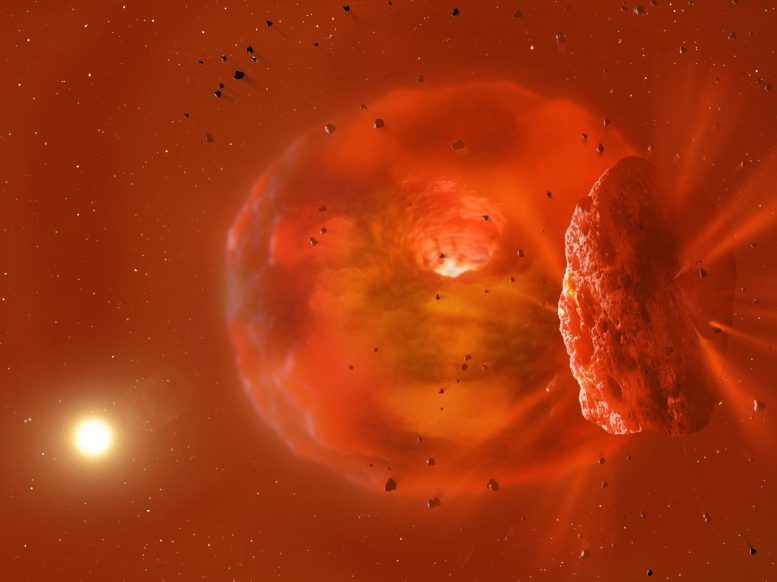
Researchers observed two ice giant exoplanets colliding around a sun-like star, causing an intense burst of light and dust. This discovery, made by an international team of astronomers, could lead to the formation of new moons around a newly-formed planet in the future.
The study, published today (October 11) in Nature, reports the sighting of two ice giant exoplanets colliding around a sun-like star, creating a blaze of light and plumes of dust. Its findings show the bright heat afterglow and resulting dust cloud, which moved in front of the parent star dimming it over time.
A Collaborative Observation Effort
The international team of astronomers was formed after an enthusiast viewed the light curve of the star and noticed something strange. It showed the system doubled in brightness at infrared wavelengths some three years before the star started to fade in visible light.
Co-lead author Dr. Matthew Kenworthy, from Leiden University, said: “To be honest, this observation was a complete surprise to me. When we originally shared the visible light curve of this star with other astronomers, we started watching it with a network of other telescopes.
“An astronomer on social media pointed out that the star brightened up in the infrared over a thousand days before the optical fading. I knew then this was an unusual event.”
A simulation of a collision between two ice giant bodies showing the simulation particles (top) and density (bottom) in a slice through the midplane of the impact. The scale bar expands during the simulation to follow the expanding post-impact body and debris. Credit: University of Bristol
Star Monitoring and Interpretation
The network of professional and amateur astronomers studied the star intensively including monitoring changes in the star’s brightness over the next two years. The star was named ASASSN-21qj after the network of telescopes that first detected the fading of the star at visible wavelengths.
The researchers concluded the most likely explanation is that two ice giant exoplanets collided, producing the infrared glow detected by NASA’s NEOWISE mission, which uses a space telescope to hunt for asteroids and comets.
Insights from Co-Lead Researchers
Co-lead author Dr. Simon Lock, Research Fellow in Earth Sciences at the University of Bristol, said: “Our calculations and computer models indicate the temperature and size of the glowing material, as well as the amount of time the glow has lasted, is consistent with the collision of two ice giant exoplanets.”
The resultant expanding debris cloud from the impact then traveled in front of the star some three years later, causing the star to dim in brightness at visible wavelengths.
Future Observations and Predictions
Over the next few years, the cloud of dust is expected to start smearing out along the orbit of the collision remnant, and a tell-tale scattering of light from this cloud could be detected with both ground-based telescopes and NASA’s largest telescope in space, known as JWST.
The astronomers plan on watching closely what happens next in this system.
Co-author Dr. Zoe Leinhardt, Associate Professor of Astrophysics at the University of Bristol, added: “It will be fascinating to observe further developments. Ultimately, the mass of material around the remnant may condense to form a retinue of moons that will orbit around this new planet.”
Reference: “A planetary collision afterglow and transit of the resultant debris cloud” by Matthew Kenworthy, Simon Lock, Grant Kennedy, Richelle van Capelleveen, Eric Mamajek, Ludmila Carone, Franz-Josef Hambsch, Joseph Masiero, Amy Mainzer, J. Davy Kirkpatrick, Edward Gomez, Zoë Leinhardt, Jingyao Dou, Pavan Tanna, Arttu Sainio, Hamish Barker, Stéphane Charbonnel, Olivier Garde, Pascal Le Dû, Lionel Mulato, Thomas Petit and Michael Rizzo Smith, 11 October 2023, Nature.
DOI: 10.1038/s41586-023-06573-9
Never miss a breakthrough: Join the SciTechDaily newsletter.
Follow us on Google and Google News.