
Close Menu
    Facebook X (Twitter) Instagram
    SciTechDaily
    • Biology
    • Chemistry
    • Earth
    • Health
    • Physics
    • Science
    • Space
    • Technology
    Facebook X (Twitter) Pinterest YouTube RSS
    SciTechDaily
    Home»Space»Astronomers Use Telescopes to Track Laws of Nature 10 Billion Years Ago
    Space

    Astronomers Use Telescopes to Track Laws of Nature 10 Billion Years Ago

    By Swinburne UniversityOctober 7, 20141 Comment3 Mins Read
    Facebook Twitter Pinterest Telegram LinkedIn WhatsApp Email Reddit
    Share
    Facebook Twitter LinkedIn Pinterest Telegram Email Reddit
    Eyes on the Sky Track Laws of Nature 10 Billion Years Ago
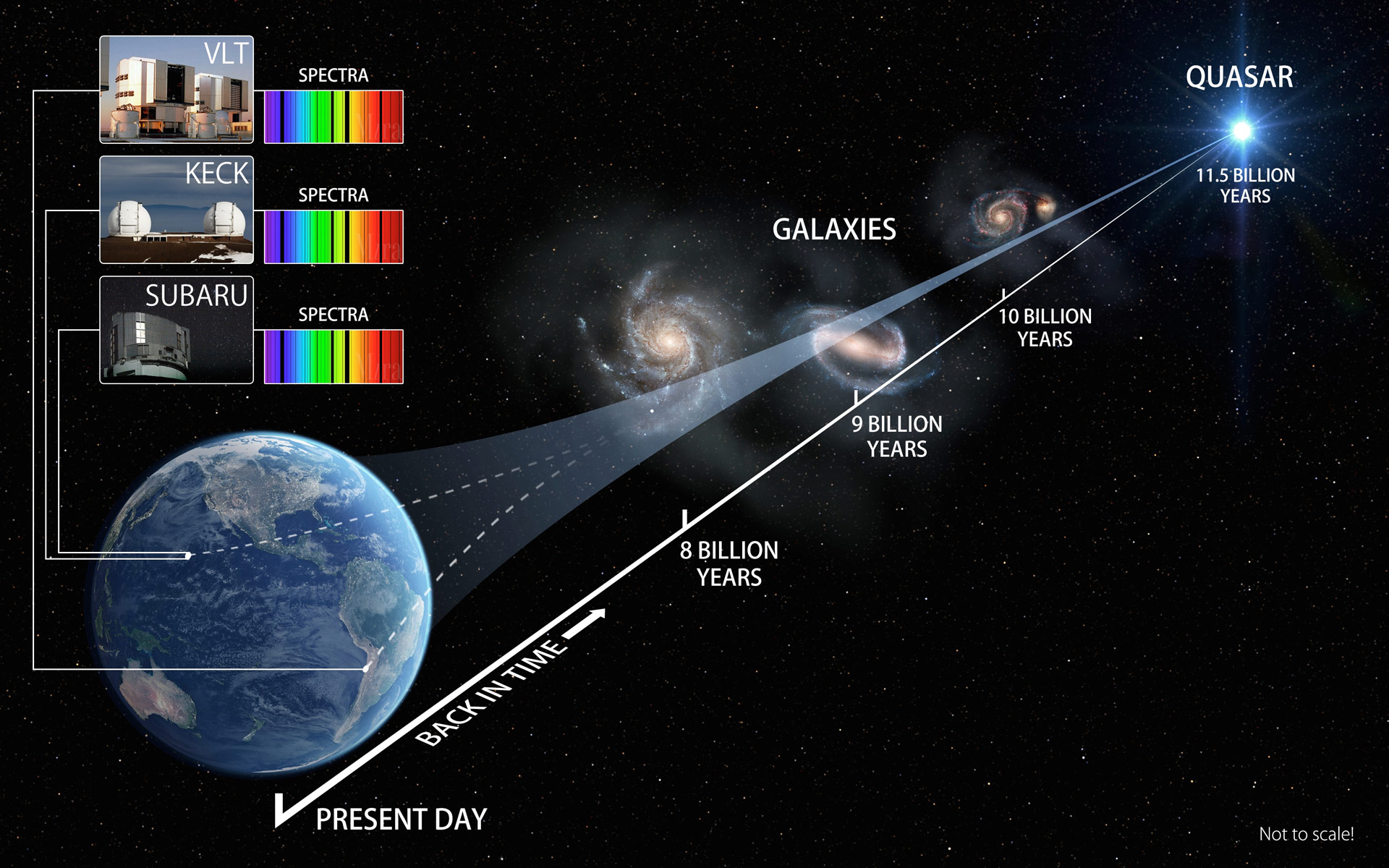
    Three telescopes testing nature’s laws in 3 distant galaxies. Credit: Swinburne Astronomy Productions

    Using the three most powerful optical telescopes in the world, astronomers from Swinburne University have focused on a single point in the sky to test one of Nature’s fundamental laws.

    An international team, led by researchers from Swinburne University of Technology, observed a quasar – the extremely bright surroundings of a supermassive black hole – using the Very Large Telescope in Chile and the W M Keck Observatory and Subaru Telescope, both in Hawaii.

    The quasar light passed through three different galaxies, some 10, 9, and 8 billion years ago, on its way to Earth. These galaxies absorbed a characteristic pattern of colors out of the quasar light, revealing the strength of electromagnetism – one of Nature’s four fundamental forces – in the early and distant Universe.

    “We spread the light very finely into its component colors, producing a rainbow with a `barcode’ pattern of missing colors. We can then measure electromagnetism by `reading’ this barcode,” said Tyler Evans, Swinburne PhD student and lead author of the new study.

    “We need to compare the barcode patterns from three telescopes to be sure they’re right.”

    Previous studies, using a large number of quasars, had found hints that electromagnetism might be different in the distant reaches of the Universe – slightly weaker or slightly stronger than on Earth.

    “If that’s true, we’d need a completely new understanding of fundamental physics,” Mr Evans said.

    “So it’s crucial to triple check whether and how the telescopes are distorting the barcodes.”

    By comparing the barcodes, the researchers found small differences between the telescopes.

    “The beauty of our method is that we can also use the barcodes themselves to correct each telescope accurately,” said Swinburne Associate Professor Michael Murphy, who co-authored the work.

    “Once corrected, all three telescopes gave the same answer: electromagnetism hasn’t changed, within a few parts per million, over 10 billion years. I think this is the most reliable measurement of its kind so far”.

    The team is now making similarly careful measurements in many other galaxies.

    “With our new techniques and new quasar observations recently completed, we can make the most accurate check to see whether electromagnetism’s strength really is changing or not,” Associate Professor Murphy said.

    Reference: “The UVES Large Program for testing fundamental physics – III. Constraints on the fine-structure constant from three telescopes” by T. M. Evans, M. T. Murphy, J. B. Whitmore, T. Misawa, M. Centurion, S. D’Odorico, S. Lopez, C. J. A. P. Martins, P. Molaro, P. Petitjean, H. Rahmani, R. Srianand and M. Wendt, 23 September 2014, MNRAS.
    DOI: 10.1093/mnras/stu1754
    arXiv: 1409.1923

    The study forms part of Tyler Evans’ PhD work and uses Swinburne’s collaborative agreement with Caltech (USA) to access the Keck Observatory in Hawaii.

    Never miss a breakthrough: Join the SciTechDaily newsletter.
    Follow us on Google and Google News.

    Astronomy Astrophysics Swinburne University of Technology
    Share. Facebook Twitter Pinterest LinkedIn Email Reddit

    Related Articles

    “Beyond What’s Possible” – Webb Space Telescope Discovers Mysterious Ancient Galaxies

    10 Times This Year the Webb Telescope Blew Astronomers Away With Stunning New Images of Our Universe

    Why Double Neutron Star Systems – Hulse-Taylor Binary Pulsars – Are So Rare

    Misbehaving Pulsars: Unexpected Changes in the Most Predictable of Stars

    New Research Implies That Current Theories of Star Formation are Incomplete

    Astronomers Find Evidence That Galaxies in Groups are Running Out of Fuel

    Astrophysicists Discover a New Class of Star Cluster

    New Study Suggests That Black Holes Are Growing Faster Than Previously Thought

    Understanding How Reionization Moved Through the Universe

    1 Comment

    1. Peter on October 7, 2014 5:02 pm

      Scientists seem so sure that the fundamental physical laws are transient. I know they SEEM arbitrary but I don’t think they’ll ever prove this universe is just a chance happenstance. The Big Bang theory (standard model) suggests that some basic tenets have changed but I think we’ll find the culprit and that will prove that matter and energy work in predictable ways across any universe.

      Reply
    Leave A Reply Cancel Reply

    • Facebook
    • Twitter
    • Pinterest
    • YouTube

    Don't Miss a Discovery

    Subscribe for the Latest in Science & Tech!

    Trending News

    Popular Weight-Loss Drugs Like Ozempic Linked to Lower Breast Cancer Risk

    AI Learned the Rules of the Universe and That Became a Problem

    Scientists Found a Hidden Brain Signal That Predicts Social Behavior

    Even GPT-5 Failed This Human Attention Test

    Scientists Discover a Biological Clock Unlike Anything Seen Before

    The Brain May Not Need Full Sleep To Recover, New Research Finds

    Your Gut Microbes May Decide How Many Calories You Really Absorb

    Millions Take This Joint Supplement but Scientists Found a Concerning Alzheimer’s Link

    Follow SciTechDaily
    • Facebook
    • Twitter
    • YouTube
    • Pinterest
    • Newsletter
    • RSS
    SciTech News
    • Biology News
    • Chemistry News
    • Earth News
    • Health News
    • Physics News
    • Science News
    • Space News
    • Technology News
    Recent Posts
    • Scientists Discovered a Fly That Sheds Its Wings and Sacrifices Its Sight
    • Researchers Capture the First Atomic-Level Images of a Critical Human DNA Repair Enzyme
    • Scientists Just Discovered a Cellular Survival System That Was Never Supposed To Exist
    • Scientists Discover Brain-Protecting Peptide That Could Change Parkinson’s Treatment
    • This Copper Drug Clears Alzheimer’s Brain Toxins and Boosts Memory
    Copyright © 1998 - 2026 SciTechDaily. All Rights Reserved.
    • Science News
    • About
    • Contact
    • Editorial Board
    • Privacy Policy
    • Terms of Use

    Type above and press Enter to search. Press Esc to cancel.