
Close Menu
    Facebook X (Twitter) Instagram
    SciTechDaily
    • Biology
    • Chemistry
    • Earth
    • Health
    • Physics
    • Science
    • Space
    • Technology
    Facebook X (Twitter) Pinterest YouTube RSS
    SciTechDaily
    Home»Space»Misbehaving Pulsars: Unexpected Changes in the Most Predictable of Stars
    Space

    Misbehaving Pulsars: Unexpected Changes in the Most Predictable of Stars

    By Matthew Miles, Swinburne UniversityMarch 11, 20221 Comment3 Mins Read
    Facebook Twitter Pinterest Telegram LinkedIn WhatsApp Email Reddit
    Share
    Facebook Twitter LinkedIn Pinterest Telegram Email Reddit
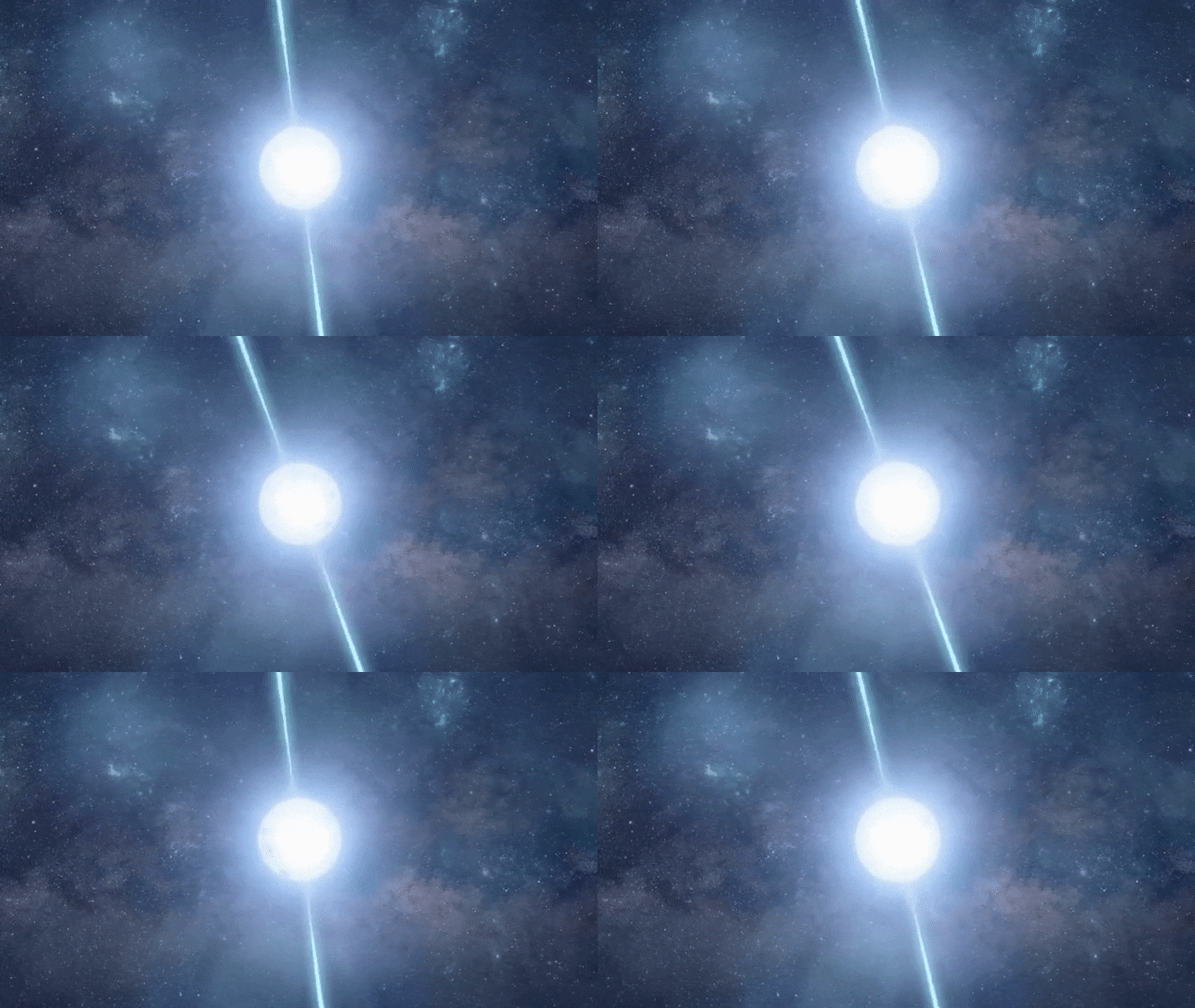
    Animation Pulsar Spinning Neutron Star
    Artist’s concept of a pulsar.

    Researchers improved pulsar timing precision after unexpected behavior in J1909-3744, aiding future gravitational wave detection.

    Pulsars, a class of neutron stars, are extremely predictable stars. They are formed from the hearts of massive stars that have since collapsed in on themselves, no longer able to burn enough fuel to fend off the crushing gravity the star possesses. If the conditions are right, the star will continue to collapse in on itself until what’s left is a remnant of what was there before, usually only about the size of the Melbourne CBD, but 1-2 times as heavy as our Sun, making these some of the densest objects in the Universe.

    These stars don’t produce much visible light, but from their magnetic poles, they emit surprisingly bright beams of radio waves. If we’re lucky, as the star rotates, those beams will wash over the Earth and we observe ‘pulses’. While most pulsars spin around in about a second, there is a subclass of these stars that spin around in just a few thousandths of a second—they’re called ‘millisecond’ pulsars.

    Detecting Gravitational Waves with Pulsar Timing Arrays

    Observing the pulses from these millisecond pulsars gives physicists clues to many questions, including testing General Relativity and understanding the densest states of matter. But one of the main goals of observing these incredibly fast, dense stars is to detect ultra-long wavelength gravitational waves. And by long, we mean many light-years long. These gravitational waves distort space-time between us and the pulsars, causing the pulses to arrive earlier or later than expected. It’s likely that these gravitational waves come from a background produced by all the binary supermassive black holes in the Universe, which form from galaxies crashing into one another.

    As part of OzGrav, we try and detect this gravitational wave background by looking at collections of the most predictable stars (called pulsar timing arrays) and measuring how they change over time. We did this by using the world’s most sensitive radio telescopes, including the Australian Murriyang telescope (also known as the Parkes telescope) and the ultra-sensitive MeerKAT array telescope in South Africa.

    But it’s not quite that simple. From our observations with MeerKAT we found that the most precisely timed (read: predictable) pulsar, J1909-3744, was misbehaving. We found that the pulses were changing shape, with bright pulses arriving earlier and narrower than faint ones. This leads to greater uncertainty in its predicted emission. Fortunately, we were able to establish a method to account for this change and time tag the pulsar more precisely than ever before. This method could be of use for other pulsars and will be important when more advanced telescopes are available in the future.

    ​Written by OzGrav PhD student Matthew Miles, Swinburne University.

    Never miss a breakthrough: Join the SciTechDaily newsletter.
    Follow us on Google and Google News.

    Astronomy Astrophysics Gravitational Waves OzGrav Stars Swinburne University of Technology
    Share. Facebook Twitter Pinterest LinkedIn Email Reddit

    Related Articles

    Ripples in the Fabric of Space and Time Offer New Clues to the Shape of Black Holes

    Stellar Evolution Code “METISSE” Offers New Insights Into the Lives of Massive Stars

    Elusive Continuous Gravitational Waves — Long-Lasting Ripples in Space-Time — In X-ray Star Systems

    Earth-Shaking Science at Cryogenic Temperatures: Next Generation Vibration Sensors

    Dancing Stars and Black Holes in a Cosmic Cloud of Gas: Investigating the “Common Envelope Phase”

    Massive, Never-Before-Seen Star System Puzzles Scientists

    Supercomputer Simulations of Core-Collapse Supernovae Reveal Complicated Physics of Exploding Massive Stars

    Future Gravitational Wave Detectors to Detect Millions of Black Holes & the Evolution of the Universe

    Radio and Gravitational Wave Signatures of Double Neutron Stars – Accurate Clocks to Test Einstein’s Theory of General Relativity

    1 Comment

    1. ardj on March 12, 2022 12:29 am

      Cor ‘strewth, mate, that’s a giant leap for the wallaby, eh. But might not mean much to those in the wastes of Western Australia.

      While I could look up what was meant by “Melbourne CBD”, would it not have been more helpful to use an established scientific measurement such as 15 blue whales ?

      Reply
    Leave A Reply Cancel Reply

    • Facebook
    • Twitter
    • Pinterest
    • YouTube

    Don't Miss a Discovery

    Subscribe for the Latest in Science & Tech!

    Trending News

    First-of-Its-Kind Discovery: Homer’s Iliad Found Embedded in a 1,600-Year-Old Egyptian Mummy

    Beyond Inflammation: Scientists Uncover New Cause of Persistent Rheumatoid Arthritis

    A Simple Molecule Could Unlock Safer, Easier Weight Loss

    Scientists Just Built a Quantum Battery That Charges Almost Instantly

    Researchers Unveil Groundbreaking Sustainable Solution to Vitamin B12 Deficiency

    Millions of People Have Osteopenia Without Realizing It – Here’s What You Need To Know

    Researchers Discover Boosting a Single Protein Helps the Brain Fight Alzheimer’s

    World-First Study Reveals Human Hearts Can Regenerate After a Heart Attack

    Follow SciTechDaily
    • Facebook
    • Twitter
    • YouTube
    • Pinterest
    • Newsletter
    • RSS
    SciTech News
    • Biology News
    • Chemistry News
    • Earth News
    • Health News
    • Physics News
    • Science News
    • Space News
    • Technology News
    Recent Posts
    • New Research Challenges Long-Held Beliefs About How the Brain Makes Decisions
    • Breakthrough Technology Reveals New Treatment Targets for Cancer
    • Scientists Discover New Way To Make Drug-Resistant Cancer Treatable Again
    • This Simple Exercise Trick Builds Muscle With Less Effort, Study Finds
    • Middle Age Is Becoming a Breaking Point in America, Study Reveals
    Copyright © 1998 - 2026 SciTechDaily. All Rights Reserved.
    • Science News
    • About
    • Contact
    • Editorial Board
    • Privacy Policy
    • Terms of Use

    Type above and press Enter to search. Press Esc to cancel.