
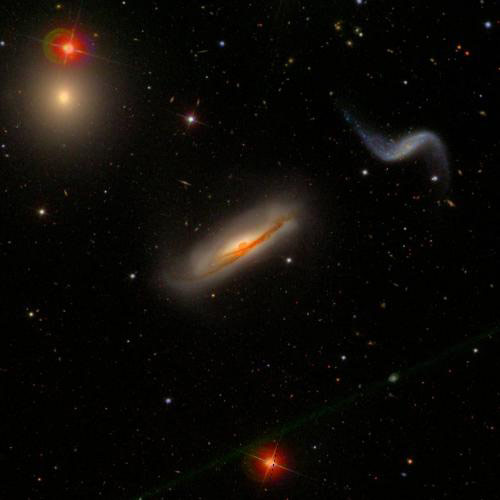
Using the Arecibo telescope, the largest radio telescope in the world, an international team of astronomers have found evidence that galaxies that are located in groups might be running out of fuel.
Astronomers at Swinburne University of Technology and their international collaborators have found evidence that galaxies that are located in groups might be running out of gas.
Galaxies like our own Milky Way possess large reservoirs of hydrogen gas, which is the fuel out of which new stars are formed. Accurate measurements of the gas content, in addition to the stellar properties, are critical in predicting how a galaxy will evolve.
Taking advantage of the sensitivity of the Arecibo telescope, the largest radio telescope in the world, the research team measured the hydrogen content of a large number of galaxies located in different environments, from isolated systems to large groups. These new observations showed that galaxies in groups have, on average, less gas and star formation than similar systems found in isolation.
“What drives the gas in and out of galaxies is one of the most outstanding open questions in extragalactic astronomy,” lead researcher Dr Barbara Catinella, an Australian Research Council Future Fellow at Swinburne’s Center for Astrophysics and Supercomputing (CAS), said.
Astronomers have known for decades that spiral galaxies located in clusters have less gas and star formation than similar, isolated galaxies. Clusters are much larger density concentrations, containing several hundred or even thousands of galaxies immersed in the so-called intergalactic medium.
“When a galaxy moves through this hot medium, most of its hydrogen gas can be easily removed,” Dr Luca Cortese, co-author of the new study and a postdoctoral fellow at CAS, said.
“We know that gas is removed from galaxies that are located in the harsh cluster environment, but this is the first time that we witness similar effects in the more friendly groups.”
Dr Catinella said this was an exciting result, which opened up more questions than it solved.
“It is unclear which physical process is responsible for the observed gas deficit in group galaxies. The milder intergalactic medium in groups might not suffice,” she said.
Although observations of stars in galaxies do indicate that star formation is less efficient in groups (and more so in clusters), a clear link with the gas hadn’t been established until now.
“The observed decrease of gas content in the group environment would naturally explain why those galaxies are less efficient at forming stars,” Dr Catinella said. “They are simply running out of fuel.”
Future surveys of the gas content of galaxies, such as those planned for the Australian SKA Pathfinder, will help astronomers to better characterize the still largely unknown group environment, and will shed light on the physical processes that drive the evolution of galaxies in the local Universe.
The results of this work have been published in the latest edition of the Monthly Notices of the Royal Astronomical Society. This research was partly supported under the Australian Research Council’s Future Fellowship funding scheme.
Reference: “The GALEX Arecibo SDSS Survey – VIII. Final data release. The effect of group environment on the gas content of massive galaxies” by Barbara Catinella, David Schiminovich, Luca Cortese, Silvia Fabello, Cameron B. Hummels, Sean M. Moran, Jenna J. Lemonias, Andrew P. Cooper, Ronin Wu, Timothy M. Heckman and Jing Wang, 26 September 2013, Monthly Notices of the Royal Astronomical Society.
DOI: 10.1093/mnras/stt1417
arXiv:1308.1676
Never miss a breakthrough: Join the SciTechDaily newsletter.
Follow us on Google and Google News.