
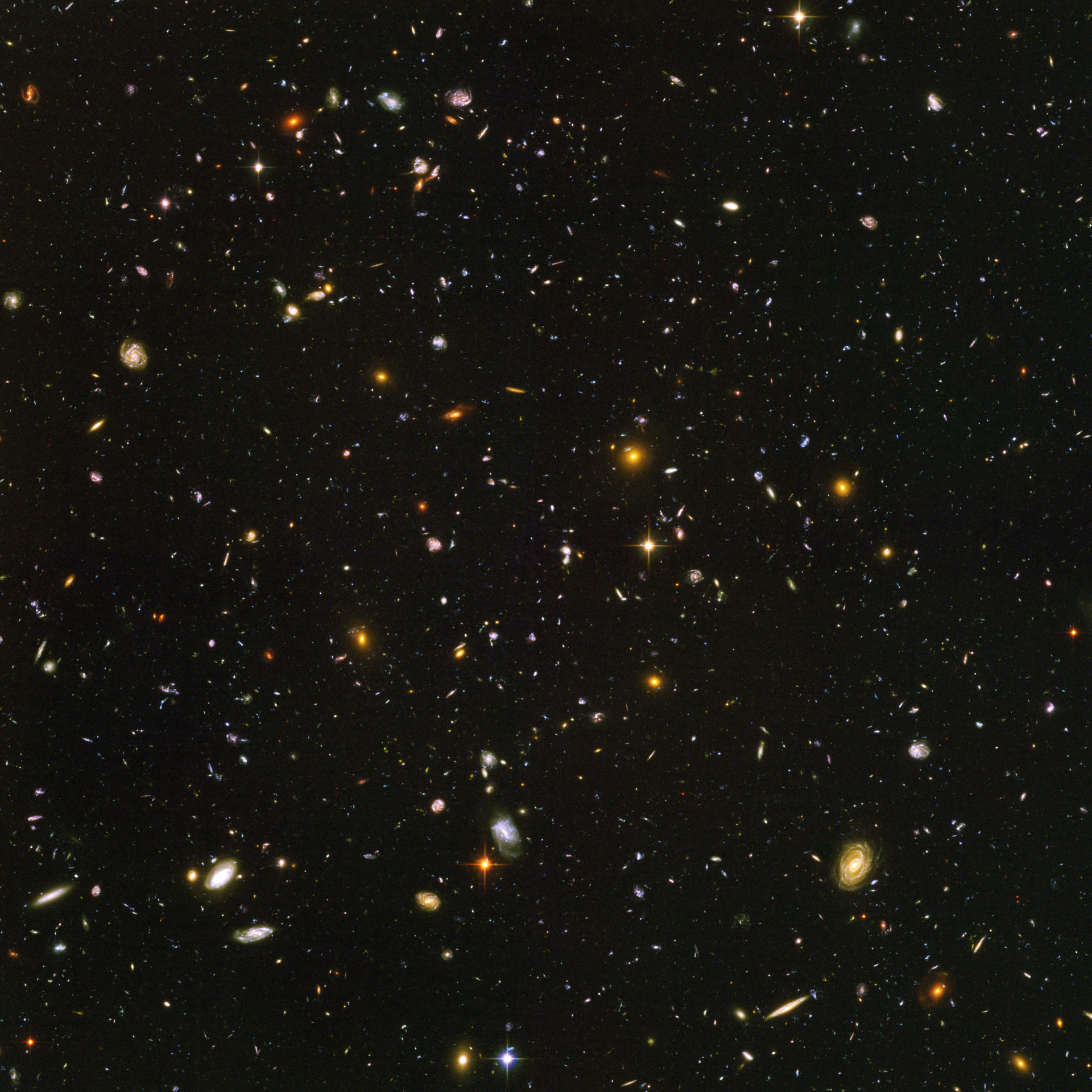
By examining nearby galaxies for signs of reionization, international researchers gained important insight about the Universe and how it emerged from the “dark ages.”
An international team of astronomers have uncovered an important clue about how the Universe emerged from its ‘dark ages’ some 13 billion years ago. By looking at nearby galaxies, they can infer what may have happened to the first galaxies of our Universe.
For some time astronomers have known that following the Big Bang, a dense hydrogen ‘fog’ settled over the Universe. During this time, a lot of the light produced by the first stars could only travel short distances before it was absorbed by the fog. They call this period the ‘dark ages’ of the Universe, but little is known about what was happening at this time.
“During the dark ages, the hydrogen fog condensed in certain places, which allowed the formation of stars, black holes, and the first galaxies,” said Swinburne University of Technology astrophysicist Dr. Lee Spitler.
“These objects were the first significant sources of ultraviolet radiation, which eventually started to burn off the hydrogen fog much like the Sun burns off a morning fog on Earth. We call this process reionization, because the hydrogen atoms are ionized by the ultraviolet light.
“But what was happening during the Universe’s dark ages is somewhat of a mystery because there are few light sources embedded in the hydrogen fog.
“Obtaining information about reionization is quite challenging as it occurred so long ago. Since light takes time to reach us, astronomers can observe what was happening at that time, but it is very difficult and pushes modern telescopes to their limits.”
To address this problem, an international research team, led by Dr. Spitler, tried a different approach: they looked for signs of reionization in nearby galaxies, which are easier to observe.
“We used nearby galaxies to understand something that happened long ago, in much the same way fossils are used to understand Earth’s history,” said Swinburne Professor Duncan Forbes.
“We can see regions around galaxies where reionization has just finished and use that information to understand important questions about the dark ages: What were the first stars like; how were the first galaxies formed; and were there many supermassive black holes?”
When reionization occurs in a galaxy and clears out the hydrogen fog, it also disrupts the condensation of the fog into locations of new star formation.
The research team looked for signs of this stalled star formation in ancient star clusters and was able to measure when reionization passed through the region around a galaxy.
By measuring when reionization took place around three galaxies, including the Milky Way, the researchers found evidence that the hydrogen fog burned off first in isolated, low-density regions of the Universe. A few hundred million years later, reionization took place in the dense, crowded regions of the Universe.
This suggests that galaxies in crowded regions of the Universe were more likely to be shrouded in very dense pockets of hydrogen fog. Such dense regions would therefore require larger numbers of light sources and more time to burn off the fog compared to regions with relatively light fog.
“Understanding how reionization moved through the Universe is very challenging but of enormous importance in astronomy. Our technique provides a novel way to tackle this problem,” Dr. Spitler said.
The research has been published in the Monthly Notices of the Royal Astronomical Society.
Reference: “Evidence for inhomogeneous reionization in the local Universe from metal-poor globular cluster systems” by Lee R. Spitler, Aaron J. Romanowsky, Jürg Diemand, Jay Strader, Duncan A. Forbes, Ben Moore and Jean P. Brodie, 1 May 2012, Monthly Notices of the Royal Astronomical Society.
DOI: 10.1111/j.1365-2966.2012.21029.x
The researchers used the Keck and Subaru telescopes in Hawaii for this work, which has been published in the Monthly Notices of the Royal Astronomical Society. In addition to Dr. Spitler and Professor Forbes at Swinburne, the research team included: Dr Aaron Romanowsky and Professor Jean Brodie at the University of California at Santa Cruz and Professor Jürg Diemand and Professor Ben Moore at the University of Zurich, Switzerland.
Never miss a breakthrough: Join the SciTechDaily newsletter.
Follow us on Google and Google News.