

Close Menu
    Facebook X (Twitter) Instagram
    SciTechDaily
    • Biology
    • Chemistry
    • Earth
    • Health
    • Physics
    • Science
    • Space
    • Technology
    Facebook X (Twitter) Pinterest YouTube RSS
    SciTechDaily
    Home»Physics»Unlocking the Secrets of Friction: Groundbreaking Study Reveals New Insights
    Physics

    Unlocking the Secrets of Friction: Groundbreaking Study Reveals New Insights

    By Kanazawa UniversityNovember 8, 20232 Comments3 Mins Read
    Facebook Twitter Pinterest Telegram LinkedIn WhatsApp Email Reddit
    Share
    Facebook Twitter LinkedIn Pinterest Telegram Email Reddit
    Knife Sharpening Heat
    Recent advancements in friction research by an international team have clarified the behavior of molecules on surfaces, furthering our understanding of static and dynamic friction through innovative microscope techniques and calculations.

    Friction, an everyday phenomenon, has perplexed scientists for centuries. Despite thorough investigation, knowledge of it is still incomplete, largely because it involves complex interactions at different levels. Achieving an accurate grasp of the precise contact conditions between objects has been a longstanding challenge, a feat recently made possible through advancements in scanning probe microscopy.

    Technological Progress and Persistent Mysteries

    Yet, even with these technological breakthroughs, the intricacies of dynamic friction – the force needed to maintain the movement of a molecule – have remained elusive. While scientists could measure static friction by moving a single molecule on a surface, both the measurement and theoretical understanding of dynamic friction have yet to be fully unveiled.
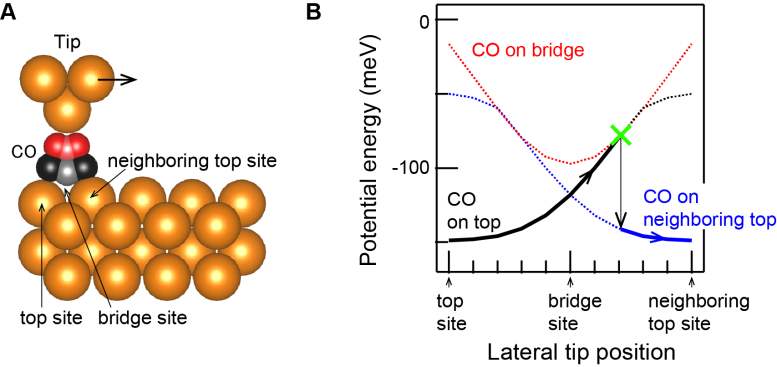
    Dynamic Friction at an Atomic Level Graph
    Figure 1: Dynamic friction at an atomic level. (A) Illustration of the CO molecule being manipulated on a copper surface by a metal tip. (B) Changes in the CO molecule’s adsorption states while the tip moves horizontally across the surface. The interaction energies between the tip and CO are represented by different lines: CO on the top site (black curve), on the bridge site (red curve), and on the neighboring top site (blue curve). As the tip progresses, the actual adsorption state of CO follows the solid lines. The transitions between different adsorption sites (green cross) provide key insights into the intricacies of dynamic friction. Credit: American Physical Society

    A Breakthrough Study

    Now, writing in Physical Review Letters and Physical Review B, a collaborative team from Kanazawa University (Japan), the Donostia International Physics Center (Spain), and the University of Regensburg (Germany) report their groundbreaking study that dives deep into this challenge. They meticulously examined the manipulation of a carbon monoxide (CO) molecule on a single-crystal copper surface using an atomic force microscope. Backed by ab initio calculations, their findings shed light on:

    • How the CO molecule positions relative to the microscope tip and surface.
    • The relationship between the motion of the molecule induced by the tip, energy dissipation, and both static and dynamic friction.

    This research stands out for its unequivocal clarity on the friction process. Not only does it provide fresh insights into a long-studied phenomenon, but it also paves the way for future studies on energy dissipation relaxation processes.

    References:

    “Dynamic Friction Unraveled by Observing an Unexpected Intermediate State in Controlled Molecular Manipulation” by Norio Okabayashi, Thomas Frederiksen, Alexander Liebig and Franz J. Giessibl, 2 October 2023, Physical Review Letters.
    DOI: 10.1103/PhysRevLett.131.148001

    “Energy dissipation of a carbon monoxide molecule manipulated using a metallic tip on copper surfaces” by Norio Okabayashi, Thomas Frederiksen, Alexander Liebig and Franz J. Giessibl, 2 October 2023, Physical Review B.
    DOI: 10.1103/PhysRevB.108.165401

    Never miss a breakthrough: Join the SciTechDaily newsletter.
    Follow us on Google and Google News.

    Friction Heat Microscopy Spectroscopy
    Share. Facebook Twitter Pinterest LinkedIn Email Reddit

    Related Articles

    Physicist Solves 120-Year-Old Thermodynamics Puzzle and Corrects Einstein

    Researchers Resolve Decades-Old Mystery of AlCl Dipole Moment

    Record-Breaking: Scientists Create Shortest Hard X-Ray Laser Pulses Yet

    Fusion Breakthrough: Engineers Uncover Hidden Reactor Weaknesses

    At the Magic Angle, a Mysterious Vibration Emerges – And It Might Explain Superconductivity

    The Quantum Zoo Just Got Wilder: Magnet-Free States Discovered in Twisted Crystals

    A Quantum Metal Just Changed What We Know About Heat

    Scientists Cracked the Code to Capturing Ultrafast Electron Motion in Real Time

    Physicists Stunned: Lead-208’s Shape Just Broke a Fundamental Rule of Nuclear Physics

    2 Comments

    1. Bao-hua ZHANG on November 9, 2023 12:58 am

      The essence of friction is the interaction of topological vortices. According to topological vortex gravitational field theory, wave particle duality applies not only to light, but also to almost all objects. The main difference lies in the properties of particles and waves. Which is more obvious, or both. Implicit variables always persist in material interactions.

      Reply
    2. Ralph Johnson on November 10, 2023 6:09 am

      My idea of Leave no stone unturned, the important part of this research is the greater understanding at the quantum level, that friction is a fundamental, to move and to collide is a function of reaction and combining, the universe in action.

      Reply
    Leave A Reply Cancel Reply

    • Facebook
    • Twitter
    • Pinterest
    • YouTube

    Don't Miss a Discovery

    Subscribe for the Latest in Science & Tech!

    Trending News

    JWST Finds a “Star” 100 Billion Times Brighter Than Any Star Should Be

    Scientists Find a Hidden Biological Link Across Different Forms of Autism

    Astronomers Discover a Ghostly River of Stars That Could Reveal Dark Matter

    Why Is Colorectal Cancer Rising in People Under 50? New Clues Point to the Environment

    Quantum Fluctuations Break a Crystal’s Symmetry Rules

    Why Does an Irregular Heartbeat Strike 40 Years Early in Some People?

    Scientists Reveal How ADHD Could Fuel Creative Thinking

    Scientists Find Just 3 Minutes of Sprinting Can Transform Blood Chemistry

    Follow SciTechDaily
    • Facebook
    • Twitter
    • YouTube
    • Pinterest
    • Newsletter
    • RSS
    SciTech News
    • Biology News
    • Chemistry News
    • Earth News
    • Health News
    • Physics News
    • Science News
    • Space News
    • Technology News
    Recent Posts
    • Hidden Brain Wiring May Help Preserve Thinking As Gray Matter Shrinks
    • Dual Stem Cell Treatment Restores Vision in First Human Trial
    • Your Waist Size May Reveal More About Your Health Than You Think
    • AI Decodes a Hidden DNA Signal Linked to Disease-Causing Mutations
    • Billions of Invasive Fish Have Taken Over the Great Lakes. Scientists Say We Can Still Stop Their Next Invasion
    Copyright © 1998 - 2026 SciTechDaily. All Rights Reserved.
    • Science News
    • About
    • Contact
    • Editorial Board
    • Privacy Policy
    • Terms of Use

    Type above and press Enter to search. Press Esc to cancel.