

Researchers used powerful XFELs to trigger strong inner-shell lasing, producing attosecond hard X-ray pulses. Filamentation and Rabi cycling helped explain these effects.
Lasers, once confined to the realm of science fiction, are now widely used in research, medicine, and even everyday entertainment. Originally limited to low-energy light, they can now operate across a broad spectrum of wavelengths, from microwaves to X-rays, enabling a wide range of new applications.
In a study recently published in Nature, an international team led by researchers at the University of Wisconsin-Madison successfully produced the shortest hard X-ray pulses ever recorded. This achievement marks the first demonstration of strong lasing phenomena in this range and could pave the way for advances in quantum X-ray optics and the ability to observe electron movement within molecules.
“We have observed strong lasing phenomena in inner-shell X-ray lasing and been able to simulate and calculate how it evolves,” says Uwe Bergmann, physics professor at UW–Madison, and senior author on the study. “When you calculate the X-ray pulses that come out, they can be incredibly short — shorter than 100 attoseconds.”
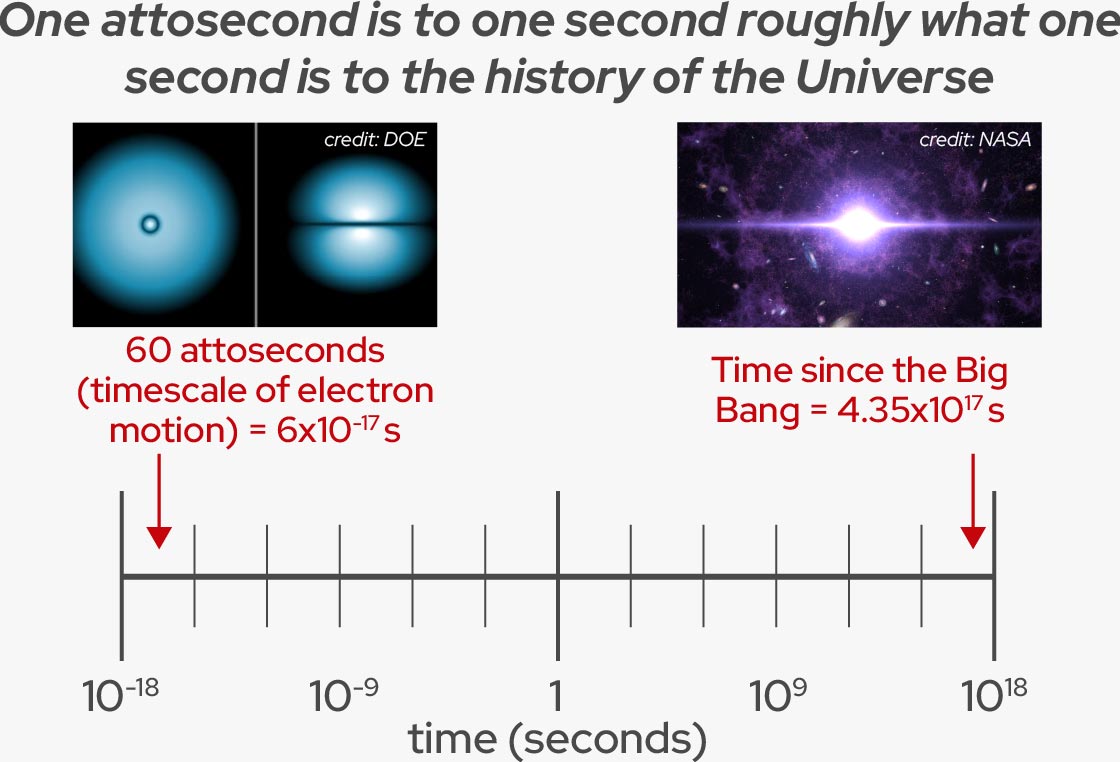
An attosecond is one quintillionth of a second. This incredibly brief duration is what makes the pulses so promising for new and advanced LASER applications.
Understanding inner-shell X-ray lasing
The inner-shell X-ray lasing process works much like optical lasing, but at much shorter wavelengths. It begins with a pulse of X-ray photons that excites the inner-shell electrons of atoms. As these electrons return to their original state, they emit photons at various X-ray wavelengths. Sometimes, these emitted photons strike another excited atom, triggering a chain reaction of stimulated emission radiation—the SER in LASER—moving in one direction.

Because inner-shell electrons are tightly bound, very powerful X-ray pulses, such as those from X-ray free-electron lasers (XFEL), are needed to excite enough electrons at once to create lasing. The resulting photons are also in the X-ray range. However, XFEL pulses are typically “dirty,” consisting of several brief, intense spikes that vary in both timing and wavelength. This irregularity can limit their usefulness for certain applications.
“They’re just not clean, beautiful pulses (like visible lasers),” says Thomas Linker, joint postdoctoral researcher at UW–Madison and the Stanford PULSE Institute at SLAC and lead author of the publication. “But it’s the only thing we have. We have to live with it.”
Simulating spectral anomalies
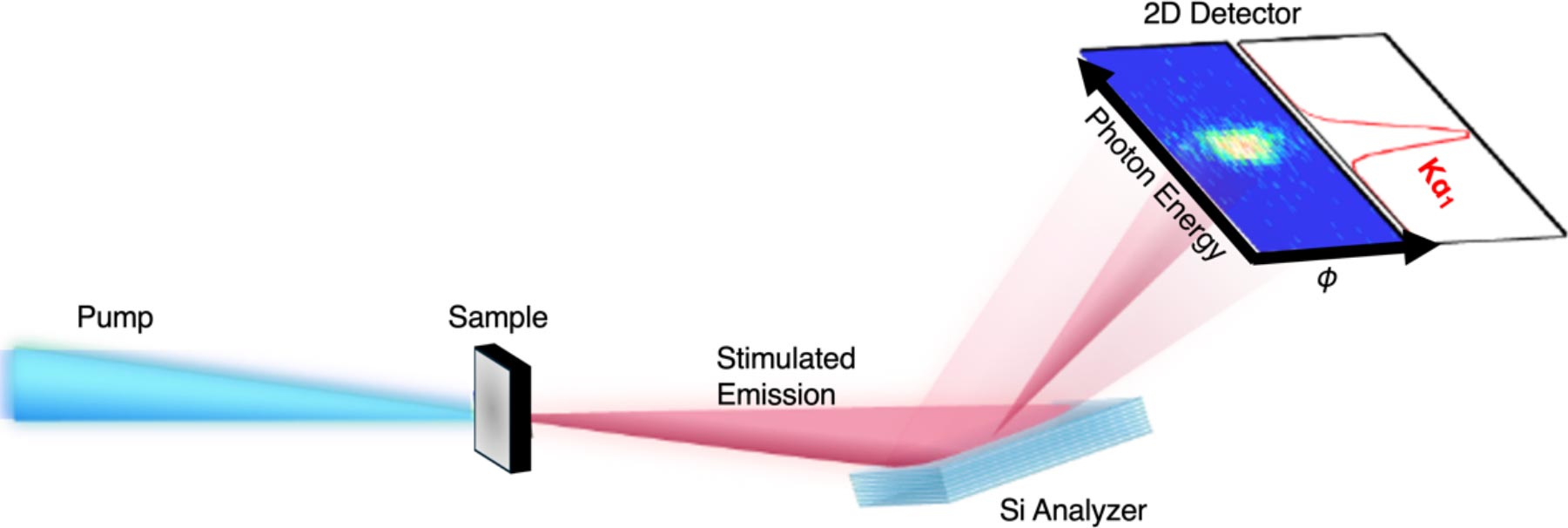
In this study, the researchers tightly focused XFEL pulses onto a sample made of copper or manganese. The input pulse is still dirty, but very short and incredibly powerful: the equivalent of focusing all the sunlight that hits the Earth into one square millimeter. The X-ray photons that the sample emits in the same forward direction as the input pulse hit a piece of instrumentation that disperses them by wavelength, much like a prism disperses visible light into a rainbow, and reflects it based on its angle. This dispersed X-ray light is next read by a detector, which measures its properties.
First, the researchers confirmed that stimulated emission is occurring in their sample by measuring a strong signal in the detector.
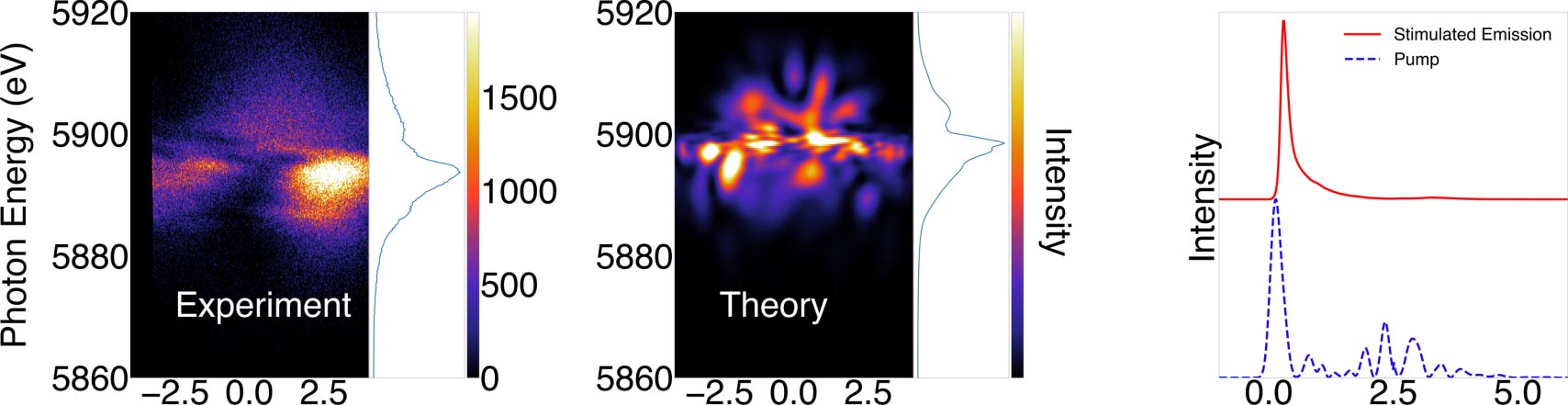
They noticed something else about the emitted light. In terms of its light spectrum, it contained all of the expected wavelengths. Spatially, however, the team sometimes detected a few hotspots instead of the expected smooth signal. Applying a 3D simulation, Linker was able to show what was happening to lead to these results. His calculations illustrated that the emitted X-rays underwent a process that created filaments when moving through the samples.

“This is filamentation, a strong lasing phenomenon which, in optical science, is when the index of refraction changes because of this very, very strong field,” Linker says. “You get spatial phenomena leading to the observed hotspots.”
Rabi cycling and attosecond pulses
When the team further increased the intensity of their input pulse, they saw another unexpected result: instead of seeing hotspots of one wavelength, they observed spectral broadening and sometimes multiple spectral lines. They ran the simulation on this new data and realized that this result can only be explained by another lasing phenomenon called Rabi cycling, where the pulse is so strong that the sample will cyclically absorb photons and emit them by stimulated emission. They used their simulation to plot the emitted pulse intensity over time and found that their dirty input pulses resulted in extremely short, stimulated emission pulses that were sometimes 60-100 attoseconds in length — the shortest hard X-ray pulses observed by anyone to date.
“We have generated hard X-ray attosecond pulses with this strong lasing phenomenon,” Linker says. “The timescale at which chemical bonds are formed and broken is the femtosecond (1,000 times longer than attosecond) timescale. But if you want to see electron dynamics, how they move inside their orbitals, that’s the attosecond timescale.”
XFELs have only been around for about 15 years, so scientists are still learning about them and how to apply them. This study is not the first to “clean up” hard X-ray pulses, but it is the first to achieve emitted pulses on this timescale and to show evidence of strong lasing phenomenon.
“There are so many nonlinear technologies and phenomena that the laser community uses now, but very few of those have dared to have been tried with hard X-rays,” Bergmann says. “Hard X-rays are very powerful: they have Angstrom wavelengths that provide atomic spatial resolution, and they are sensitive to different elements. This work is a step towards pushing the exciting field of real laser science into this powerful hard X-ray regime.”
Reference: “Attosecond inner-shell lasing at ångström wavelengths” by Thomas M. Linker, Aliaksei Halavanau, Thomas Kroll, Andrei Benediktovitch, Yu Zhang, Yurina Michine, Stasis Chuchurka, Zain Abhari, Daniele Ronchetti, Thomas Fransson, Clemens Weninger, Franklin D. Fuller, Andy Aquila, Roberto Alonso-Mori, Sébastien Boutet, Marc W. Guetg, Agostino Marinelli, Alberto A. Lutman, Makina Yabashi, Ichiro Inoue, Taito Osaka, Jumpei Yamada, Yuichi Inubushi, Gota Yamaguchi, Toru Hara, Ganguli Babu, Devashish Salpekar, Farheen N. Sayed, Pulickel M. Ajayan, Jan Kern, Junko Yano, Vittal K. Yachandra, Matthias F. Kling, Claudio Pellegrini, Hitoki Yoneda, Nina Rohringer and Uwe Bergmann, 11 June 2025, Nature.
DOI: 10.1038/s41586-025-09105-9
This work was largely supported by the U.S. Department of Energy (DOE), Office of Science, Basic Energy Sciences (BES) under contract Nos. DE-SC0023270 and DEAC02-76SF00515. The experiments were performed at the Linac Coherent Light Source at SLAC National Accelerator Laboratory and the SACLA X-ray laser at the Japan Synchrotron Radiation Research Institute.
Never miss a breakthrough: Join the SciTechDaily newsletter.
Follow us on Google and Google News.
5 Comments
“An attosecond is one quintillionth of a second”
Gee, thanks. Are you ever going to give up on this stupid nomenclature?
The progress of physics cannot be separated from innovation. However, some so-called peer-reviewed publications are not like this. They insist on that two sets of cobalt-60 rotating in opposite directions—whether symmetrical or not—constitute mirror images of each other. Is this scientific and logical? The initiator is Physical Review. Those who vigorously defend and promote it are Physical Review Letters (PRL), Science, Proceedings of the National Academy of Sciences (PNAS), Nature,Science Bulletin, etc. Let us continue to witness with facts the dirtiest and ugliest epoch in the history of science and humanities.
There are so many nonlinear technologies and phenomena that the laser community uses now, but very few of those have dared to have been tried with hard X-rays.
VERY GOOD! The progress of physics cannot be separated from innovation.
However, some so-called peer-reviewed publications are not like this. They insist on that two sets of cobalt-60 rotating in opposite directions—whether symmetrical or not—constitute mirror images of each other. Is this scientific and logical? The initiator is Physical Review. Those who vigorously defend and promote it are Physical Review Letters (PRL), Science, Proceedings of the National Academy of Sciences (PNAS), Nature,etc. Let us continue to witness with facts the dirtiest and ugliest epoch in the history of science and humanities.
If researchers are interested in this, please browse https://zhuanlan.zhihu.com/p/1918614826130838141, https://zhuanlan.zhihu.com/p/1915292792520966679, and https://zhuanlan.zhihu.com/p/1906678707730506847.
Scientific ideas and methods are not worth a penny for these so-called peer-reviewed publications, including Physical Review Letters (PRL), Science, Proceedings of the National Academy of Sciences (PNAS), Nature,Science Bulletin, etc.. Their only concern is whether it harms their interests and violates the pseudo scientific rules they have established.
The author’s article was published in the journal Nature only indicates that the author did not violate their pseudoscientific rules.