
Close Menu
    Facebook X (Twitter) Instagram
    SciTechDaily
    • Biology
    • Chemistry
    • Earth
    • Health
    • Physics
    • Science
    • Space
    • Technology
    Facebook X (Twitter) Pinterest YouTube RSS
    SciTechDaily
    Home»Physics»X-Rays Reveal More of Fossil Record
    Physics

    X-Rays Reveal More of Fossil Record

    By SciTechDailyDecember 27, 2012No Comments3 Mins Read
    Facebook Twitter Pinterest Telegram LinkedIn WhatsApp Email Reddit
    Share
    Facebook Twitter LinkedIn Pinterest Telegram Email Reddit
    X-Rays Reveal More of Fossil Record
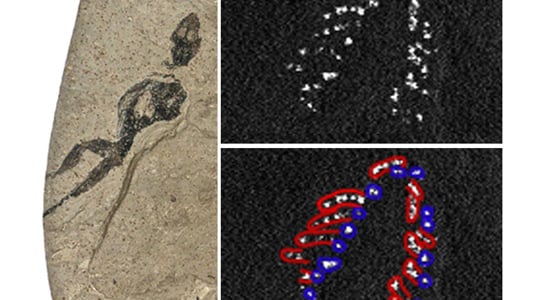
    When researchers shone x-rays of certain wavelengths on what was thought to be merely a 50-million-year-old fossil of lizard skin (left), they discovered spots with high concentrations of phosphorus (dots, upper right) that they interpret as the chemical vestiges of teeth (teeth of separate jaws are outlined in blue and red, lower right). Credit: Edwards et al., Applied Physics A: Materials Science & Processing (2012)

    Soft tissues, like skin and feathers, aren’t usually part of the fossil record, but a new technique has found a way to bring some of them back into the record. The technique was used to resurrect the teeth and recognize the carcass of a 50-million-year-old fossil of a lizard, long thought to be merely preserved remnants of skin shed from the reptile.

    The scientists published their findings in the journal Applied Physics A: Materials Science & Processing¹. The lizard fossil was discovered in the 1980s and is one of only two known examples of reptile skin unearthed from the Green River Formation of the western USA, best known for its fish fossils. Soft tissues are very rare in the fossil record, being preserved only in unusual environmental circumstances.

    The skin makes it easy to see individual scales, but the rock doesn’t include any other visible remains of bones or other hard tissue. This led the scientists to believe that the skin had been shed by a living creature and then preserved.

    To learn more, the researchers used X-ray analysis, dubbed synchrotron rapid scanning X-ray fluorescence. Intense X-rays produced by this new caused particular elements or compounds to fluoresce, revealing previously unrecognized chemical remnants that are invisible to the naked eye. When the fossils were illuminated with X-rays that cause sulfur and copper to fluoresce, the skin remnants showed up in remarkable detail. They were even able to pinpoint the chemical remains of teeth.

    The fossil’s state of preservation reveals a lot about the environmental conditions where the carcass ended up. The researchers believe that the carcass was probably washed into the lake soon after it died, where there was little or no oxygen, allowing the skin to be preserved while the acidic water dissolved the creature’s bones.

    This X-ray technique will allow paleontologists a new way of studying extinct animals and the conditions in which they lived and died. This technique was previously used to reveal the chemical residues of pigments in feathers, providing scientists with insight into the color patterns of ancient birds. It also allows the opportunity to discern soft tissues that are only rarely preserved, like the pigment-filled retinas of eyes, ink sacs of ancient quid, and other tissues like muscles.

    Reference: “Mapping prehistoric ghosts in the synchrotron” by N. P. Edwards, R. A. Wogelius, U. Bergmann, P. Larson, W. I. Sellers and P. L. Manning, 11 December 2012, Applied Physics A.
    DOI: 10.1007/s00339-012-7484-3

    Never miss a breakthrough: Join the SciTechDaily newsletter.
    Follow us on Google and Google News.

    Fossils Paleontology X-ray
    Share. Facebook Twitter Pinterest LinkedIn Email Reddit

    Related Articles

    27-Foot Long Crocodylus Thorbjarnarsoni Roamed Kenya

    Carbonemys Was a Giant Turtle From Late Paleocene

    Mysterious “Godzillus” Fossil Discovered by Amateur Paleontologist

    Cretaceous Period Sankofa Pyrenaica Fossilized Eggs Are Unusually Shaped

    Burtele Foot Points to Other Past Hominins

    Microraptor Feathers Were Black With Iridescent Sheen

    Jurassic Period Super-Sized Fleas Had Armored Mouthparts to Attack the Thick Hide of Dinosaurs

    Drexel University Researchers to 3D-Print Dinosaur Bones

    Hundreds of Lost Fossils From the Darwin Collection Rediscovered by the British Geological Survey

    Leave A Reply Cancel Reply

    • Facebook
    • Twitter
    • Pinterest
    • YouTube

    Don't Miss a Discovery

    Subscribe for the Latest in Science & Tech!

    Trending News

    The Universe Is Expanding Too Fast and Scientists Can’t Explain Why

    “Like Liquid Metal”: Scientists Create Strange Shape-Shifting Material

    Early Warning Signals of Esophageal Cancer May Be Hiding in Plain Sight

    Common Blood Pressure Drug Shows Surprising Power Against Deadly Antibiotic-Resistant Superbug

    Scientists Uncover Dangerous Connection Between Serotonin and Heart Valve Disease

    Scientists Discover a “Protector” Protein That Could Help Reverse Hair Loss

    Bone-Strengthening Discovery Could Reverse Osteoporosis

    Scientists Uncover Hidden Trigger Behind Stem Cell Aging

    Follow SciTechDaily
    • Facebook
    • Twitter
    • YouTube
    • Pinterest
    • Newsletter
    • RSS
    SciTech News
    • Biology News
    • Chemistry News
    • Earth News
    • Health News
    • Physics News
    • Science News
    • Space News
    • Technology News
    Recent Posts
    • Scientists Overcome Major Quantum Bottleneck, Potentially Transforming Teleportation and Computing
    • Quantum Physics’ Strangest Problem May Hold the Key to Time Itself
    • Scientists Create “Liquid Gears” That Spin Without Touching
    • The Simple Habit That Could Help Prevent Cancer
    • Forgotten Medicinal Plant Shows Promise in Fighting Dangerous Superbugs
    Copyright © 1998 - 2026 SciTechDaily. All Rights Reserved.
    • Science News
    • About
    • Contact
    • Editorial Board
    • Privacy Policy
    • Terms of Use

    Type above and press Enter to search. Press Esc to cancel.