
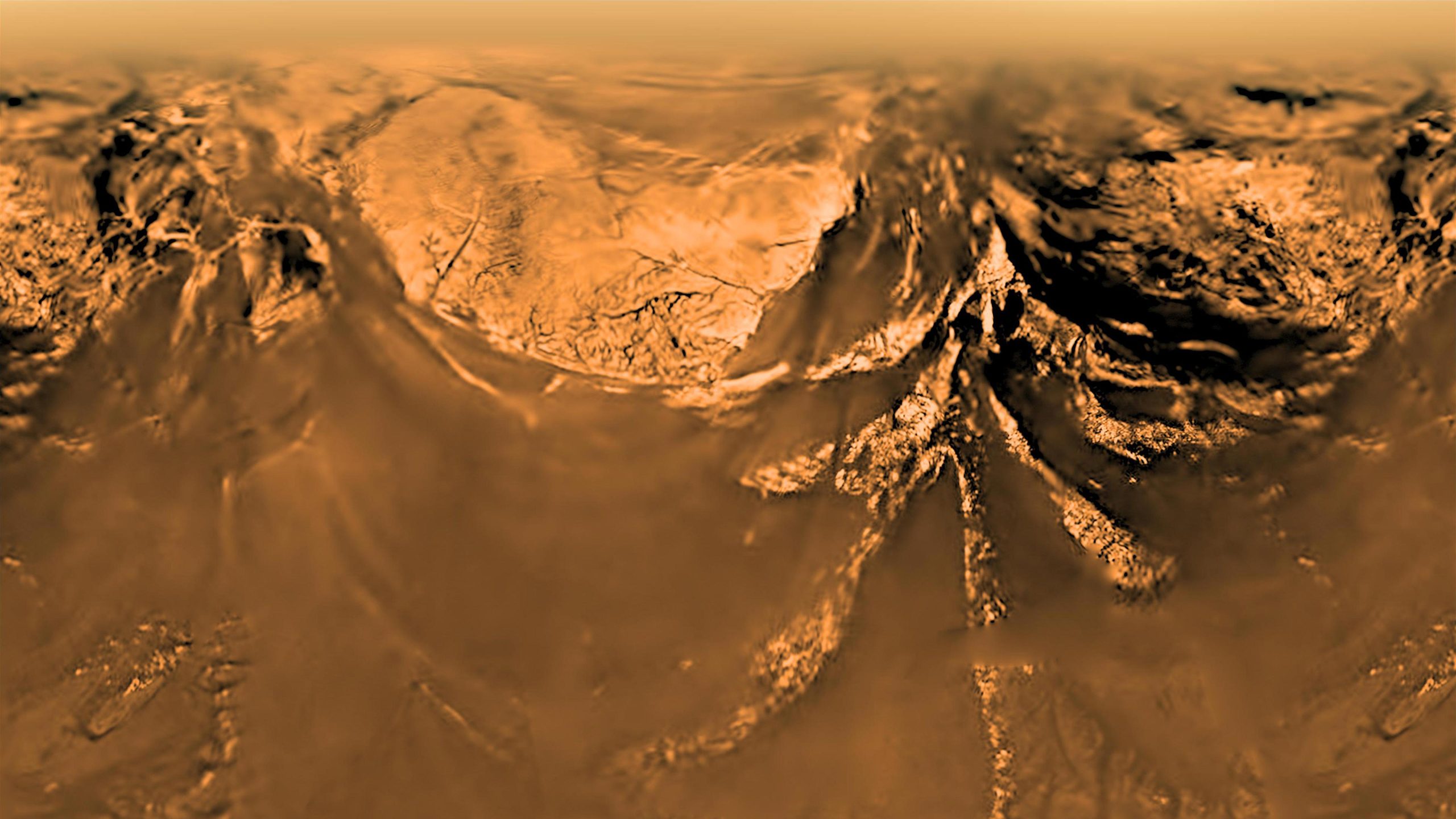
Astrobiologist finds Titan may not have enough amino acids for life to emerge.
A study led by Western astrobiologist Catherine Neish shows the subsurface ocean of Titan – the largest moon of Saturn – is most likely a non-habitable environment, meaning any hope of finding life in the icy world is dead in the water.
This discovery means it is far less likely that space scientists and astronauts will ever find life in the outer solar system, home to the four ‘giant’ planets: Jupiter, Saturn, Uranus and Neptune.
“Unfortunately, we will now need to be a little less optimistic when searching for extraterrestrial lifeforms within our own Solar System,” said Neish, an Earth sciences professor. “The scientific community has been very excited about finding life in the icy worlds of the outer solar system, and this finding suggests that it may be less likely than we previously assumed.”
Impact on Extraterrestrial Life Search
The identification of life in the outer Solar System is a significant area of interest for planetary scientists, astronomers, and government space agencies like NASA, largely because many icy moons of the giant planets are thought to have large subsurface oceans of liquid water. Titan, for example, is thought to have an ocean beneath its icy surface that is more than 12 times the volume of Earth’s oceans.

“Life as we know it here on Earth needs water as a solvent, so planets and moons with lots of water are of interest when looking for extraterrestrial life,” said Neish, a member of Western’s Institute for Earth and Space Exploration.
In the study, published in the journal Astrobiology, Neish and her collaborators attempted to quantify the amount of organic molecules that could be transferred from Titan’s organic-rich surface to its subsurface ocean, using data from impact cratering.
Comets impacting Titan throughout its history have melted the surface of the icy moon, creating pools of liquid water that have mixed with the surface organics. The resulting melt is denser than its icy crust, so the heavier water sinks through the ice, possibly all the way to Titan’s subsurface ocean.
Using the assumed rates of impacts on Titan’s surface, Neish and her collaborators determined how many comets of different sizes would strike Titan each year over its history. This allowed the researchers to predict the flow rate of water carrying organics that travel from Titan’s surface to its interior.
Neish and the team found the weight of organics transferred in this way is quite small, no more than 7,500 kg/year of glycine – the simplest amino acid, which makes up proteins in life. This is approximately the same mass as a male African elephant. (All biomolecules, like glycine, use carbon – an element – as the backbone of their molecular structure.)
“One elephant per year of glycine into an ocean 12 times the volume of Earth’s oceans is not sufficient to sustain life,” said Neish. “In the past, people often assumed that water equals life, but they neglected the fact that life needs other elements, in particular carbon.”
Other icy worlds (like Jupiter’s moons Europa and Ganymede and Saturn’s moon Enceladus) have almost no carbon on their surfaces, and it is unclear how much could be sourced from their interiors. Titan is the most organic-rich icy moon in the Solar System, so if its subsurface ocean is not habitable, it does not bode well for the habitability of other known icy worlds.
“This work shows that it is very hard to transfer the carbon on Titan’s surface to its subsurface ocean – basically, it’s hard to have both the water and carbon needed for life in the same place,” said Neish.
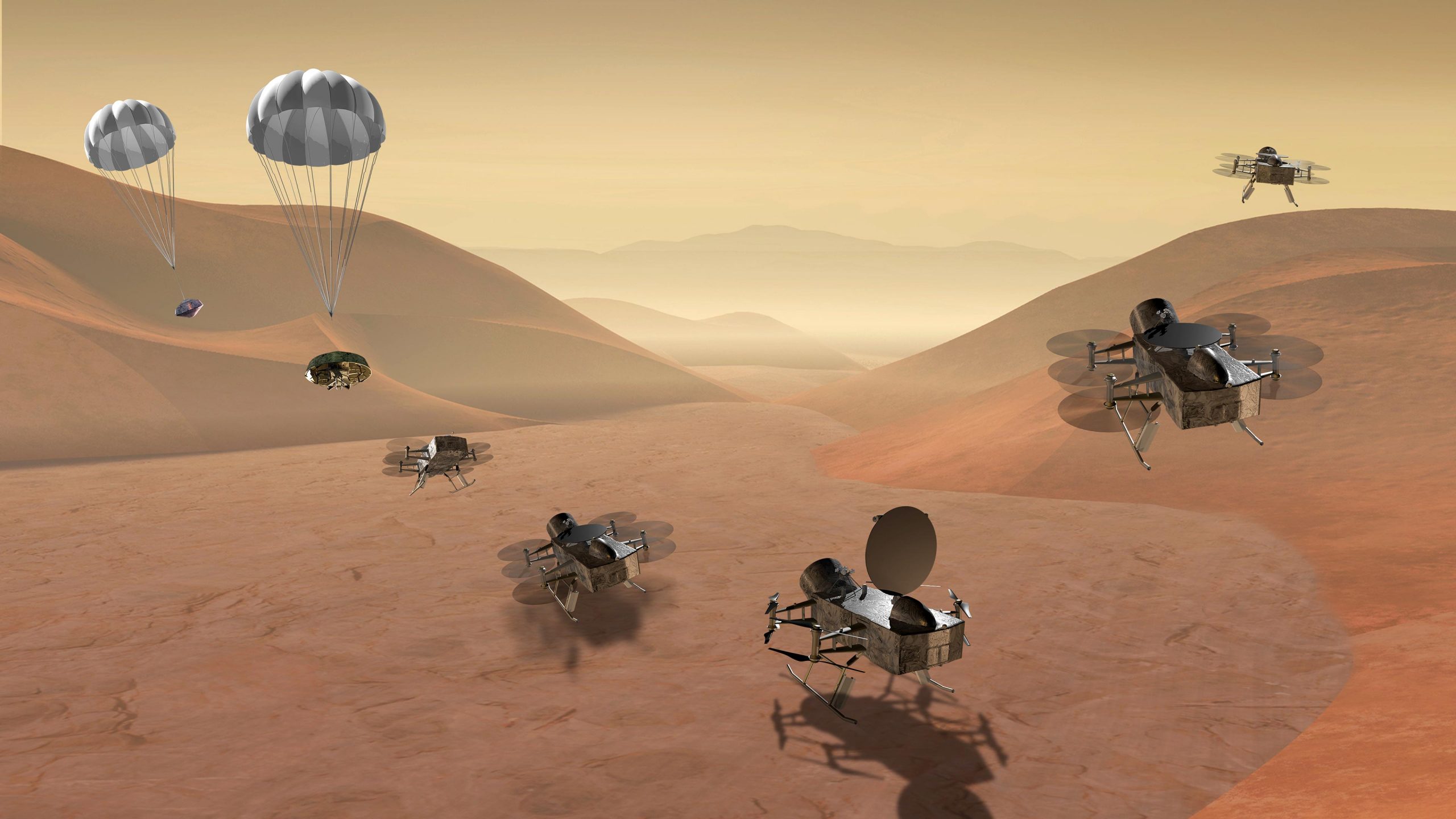
Flight of the Dragonfly
Despite the discovery, there is still much more to learn about Titan, and for Neish, the big question is, what is it made of?
Neish is a co-investigator on the NASA Dragonfly project, a planned 2028 spacecraft mission to send a robotic rotorcraft (drone) to the surface of Titan to study its prebiotic chemistry, or how organic compounds formed and self-organized for the origin of life on Earth and beyond.
“It is nearly impossible to determine the composition of Titan’s organic-rich surface by viewing it with a telescope through its organic-rich atmosphere,” said Neish. “We need to land there and sample the surface to determine its composition.”
To date, only the Cassini–Huygens international space mission in 2005 has successfully landed a robotic probe on Titan to analyze samples. It remains the first spacecraft to land on Titan and the farthest landing from Earth a spacecraft has ever made.
“Even if the subsurface ocean isn’t habitable, we can learn a lot about prebiotic chemistry on Titan, and Earth, by studying the reactions on Titan’s surface,” said Neish. “We’d really like to know if interesting reactions are occurring there, especially where the organic molecules mix with liquid water generated in impacts.”
When Neish started her latest study, she was worried it would negatively impact the Dragonfly mission, but it has actually led to even more questions.
“If all the melt produced by impacts sinks into the ice crust, we wouldn’t have samples near the surface where water and organics have mixed. These are regions where Dragonfly could search for the products of those prebiotic reactions, teaching us about how life may arise on different planets,” said Neish.
“The results from this study are even more pessimistic than I realized with regards to the habitability of Titan’s surface ocean, but it also means that more interesting prebiotic environments exist near Titan’s surface, where we can sample them with the instruments on Dragonfly.”
Reference: “Organic Input to Titan’s Subsurface Ocean Through Impact Cratering” by Catherine Neish, Michael J. Malaska, Christophe Sotin, Rosaly M.C. Lopes, Conor A. Nixon, Antonin Affholder, Audrey Chatain, Charles Cockell, Kendra K. Farnsworth, Peter M. Higgins, Kelly E. Miller and Krista M. Soderlund, 2 February 2024, Astrobiology.
DOI: 10.1089/ast.2023.0055
Never miss a breakthrough: Join the SciTechDaily newsletter.
Follow us on Google and Google News.
3 Comments
You don’t see too many microbes below -10C on Earth, and when you do they’ve likely evolved in warmer conditions. The temp on Titan is -180C and has never been warmer. Life has its limits, I guess.
The reality of this situation is scientists and astronomers know jack squat about Titan or any other celestial body because we havent been there!!!!
Think about it, we are still discovering life in places we didnt know it could exist ON OUR OWN PLANET!
And they want to make an assumption about a moon millions of miles away that we’ve never been to?
Yes. They want to make assumptions… with the keyword being assumptions (or in science – hypotheses). Then they will test out those hypotheses by doing experiments. This is how science works. That’s nothing for you to get your panties in a twist about.