
Researchers have simplified a highly complex quantum imaging technique, 2DES, used to observe ultrafast electron interactions.
By refining an existing interferometer design, they improved control over laser pulses, unlocking new capabilities for studying energy transfer in materials.
Unveiling the Ultrafast World of Electrons
The ultrafast movements and interactions of electrons in molecules and solids have long been difficult to observe directly. In recent years, scientists have developed methods to study these quantum processes, such as chemical reactions, solar energy conversion, and quantum computing operations, in real-time with extreme precision.
One of the most advanced techniques for this is two-dimensional electronic spectroscopy (2DES), which can track electron dynamics with a resolution of just a few femtoseconds (quadrillionths of a second). However, 2DES is highly complex and has only been used by a few research teams worldwide.
Now, a German-Italian research team, led by Prof. Dr. Christoph Lienau from the University of Oldenburg, has found a way to significantly simplify the experimental setup. “We hope that 2DES will go from being a methodology for experts to a tool that can be widely used,” explains Lienau.
Making 2DES More Accessible
Two doctoral students from Lienau’s Ultrafast Nano-Optics research group, Daniel Timmer and Daniel Lünemann, played a crucial role in this breakthrough. The team has detailed their method in a recently published paper in the renowned journal Optica.
The 2DES technique involves using three ultrashort laser pulses to excite a material and track its response. The first two pulses are identical and initiate the electron excitation process, such as lifting electrons to a higher energy state in semiconductors or dyes. This alters the material’s optical properties. The third pulse, called the “probe pulse,” then interacts with the excited system, changing as a result and revealing key information about the system’s state.
The Time Sequence Becomes Visible
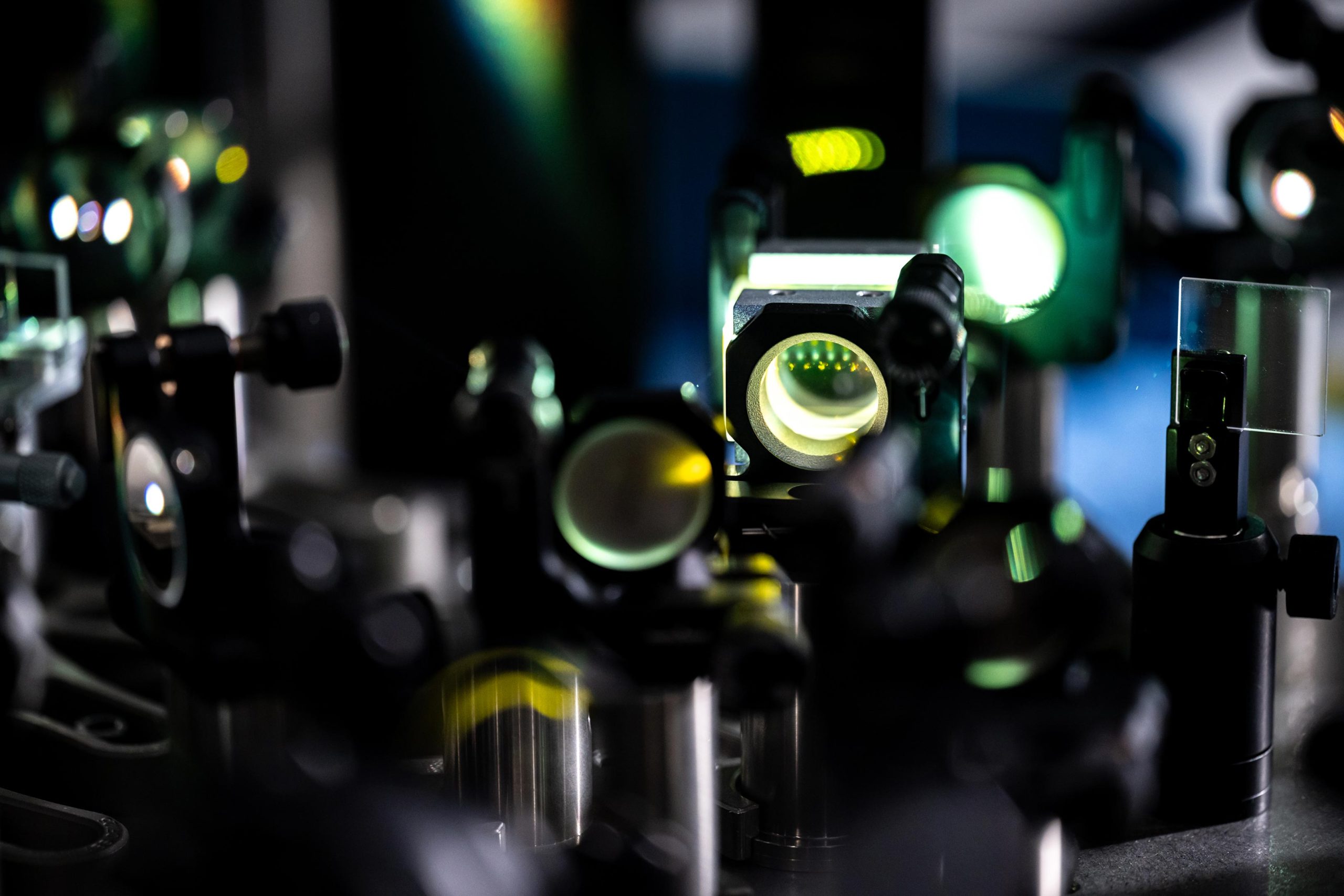
By varying the time intervals between the three pulses, different sets of information about the system under investigation can be obtained. When the interval between the two excitation pulses and the probe pulse is altered, the process can be recorded at different stages so that the time sequence becomes visible, as if one were watching a film. The interval between the two excitation pulses can also be varied. This allows to selectively excite certain optical transitions in the material, the key for studying particularly complex processes such as energy transfer during photosynthesis.
“The experimental implementation of the 2DES technique is very challenging,” Lienau emphasizes. The main problem is precise control of the time interval between the first two identical laser pulses, as well as of their shape, he explains.
A Simplified Solution to a Complex Problem
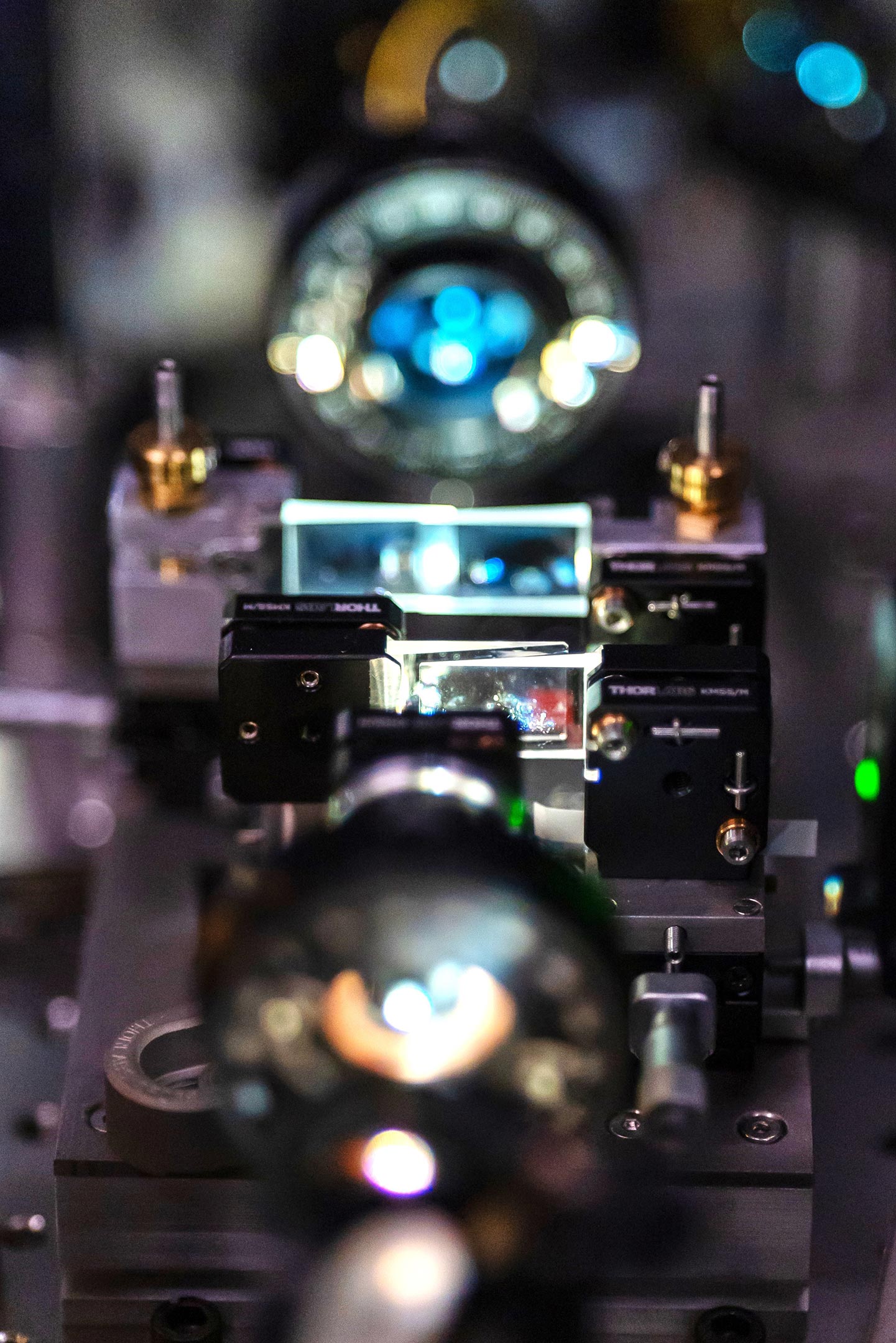
In their new study, Lienau and his team describe a potential solution to the problem. The approach devised by the Oldenburg doctoral students Daniel Timmer and Daniel Lünemann is based on a method called TWINS that was introduced a few years ago by the Italian physicist Professor Giulio Cerullo from the Politecnico di Milan. Cerullo, who also co-authored the current study, developed a device called an interferometer that uses birefringent crystals to create two identical replicas of an input pulse. These are then used for excitation of the material under study. Although this method is considerably easier to implement than other solutions for generating pulses, it has certain limitations.
“This procedure has so far failed to attain the full functionality of a multidimensional electronic spectrometer,” says Lienau. Experts in the field assumed that the technique developed by Cerullo would not be able to achieve that level of functionality, he adds.
Precision Control Through a Simple Enhancement
However, Timmer and Lünemann came up with the idea of adding an optical component to Cerullo’s interferometer, a so-called delay quarter wave plate which delays any light signal that passes through it by a predetermined fraction of a wavelength. Thanks to this relatively simple extension to the procedure the two researchers were able to control the two laser pulses far more precisely than with the original TWINS interferometer.
Experimental Success and a New Patent
The researchers implemented their idea in experiments and demonstrated the enhanced possibilities of this method by using it to investigate the charge dynamics in an organic dye. The team also provided a theoretical explanation for the new method. Timmer, Lünemann and Lienau have now been granted a patent for the extended interferometry procedure.
Reference: “Phase-cycling and double-quantum two-dimensional electronic spectroscopy using a common-path birefringent interferometer” by Daniel C. Lünemann, Moritz Gittinger, Antonietta De Sio, Christoph Lienau, Daniel Timmer, Cristian Manzoni and Giulio Cerullo, 19 December 2024, Optica.
DOI: 10.1364/OPTICA.543007
Never miss a breakthrough: Join the SciTechDaily newsletter.
Follow us on Google and Google News.
3 Comments
By varying the time intervals between the three pulses, different sets of information about the system under investigation can be obtained. When the interval between the two excitation pulses and the probe pulse is altered, the process can be recorded at different stages so that the time sequence becomes visible, as if one were watching a film.
VERY GOOD!
Any scientific research cannot exist without time and space. Space is not only a backdrop but also a protagonist in the cosmic narrative. The topological phase transition based on the ideal fluid characteristics of space has always dominated the formation and evolution of all things in the universe.
All things in space are related to the ideal fluid properties of space. Just as all living organisms in the ocean cannot do without the vast ocean,humans need air, air needs space, and everything needs space.
Topological spin create all things. Topological spin shaping world, rather than two sets of cobalt-60 reverse rotations forming mirror images of each other.