
When Light and Atoms Share a Common Vibe
An especially counter-intuitive feature of quantum mechanics is that a single event can exist in a state of superposition — happening both here and there, or both today and tomorrow.
Such superpositions are hard to create, as they are destroyed if any kind of information about the place and time of the event leaks into the surrounding — and even if nobody actually records this information. But when superpositions do occur, they lead to observations that are very different from that of classical physics, questioning down to our very understanding of space and time.
Scientists from EPFL, MIT, and CEA Saclay, publishing in Science Advances, demonstrate a state of vibration that exists simultaneously at two different times, and evidence this quantum superposition by measuring the strongest class of quantum correlations between light beams that interact with the vibration.
The researchers used a very short laser pulse to trigger a specific pattern of vibration inside a diamond crystal. Each pair of neighboring atoms oscillated like two masses linked by a spring, and this oscillation was synchronous across the entire illuminated region. To conserve energy during this process, a light of a new color is emitted, shifted toward the red of the spectrum.
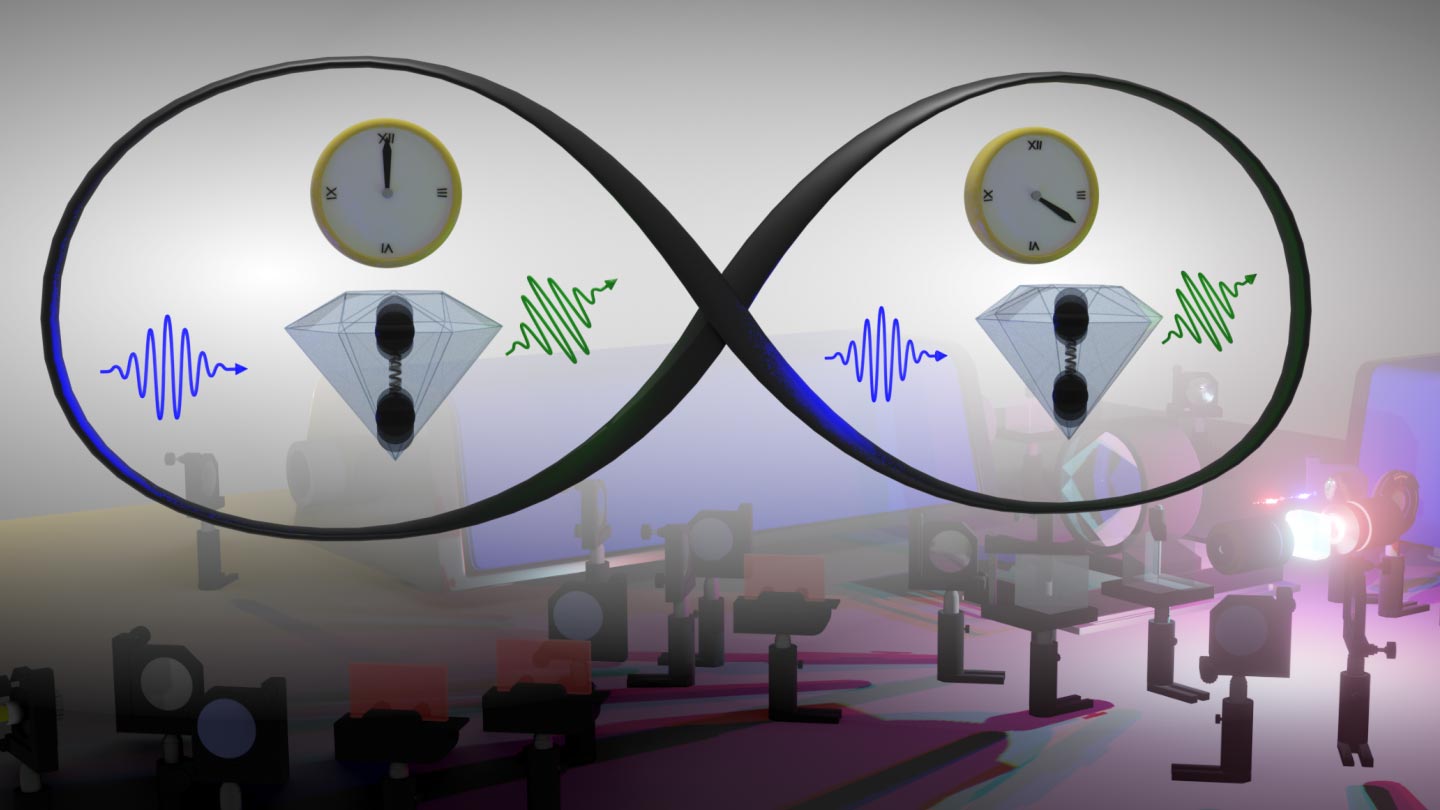
This classical picture, however, is inconsistent with the experiments. Instead, both light and vibration should be described as particles, or quanta: light energy is quantized into discrete photons while vibrational energy is quantized into discrete phonons (named after the ancient Greek “photo = light” and “phono = sound”).
The process described above should therefore be seen as the fission of an incoming photon from the laser into a pair of photon and phonon — akin to nuclear fission of an atom into two smaller pieces.
But it is not the only shortcoming of classical physics. In quantum mechanics, particles can exist in a superposition state, like the famous Schrödinger cat being alive and dead at the same time.
Even more counterintuitive: two particles can become entangled, losing their individuality. The only information that can be collected about them concerns their common correlations. Because both particles are described by a common state (the wavefunction), these correlations are stronger than what is possible in classical physics. It can be demonstrated by performing appropriate measurements on the two particles. If the results violate a classical limit, one can be sure they were entangled.
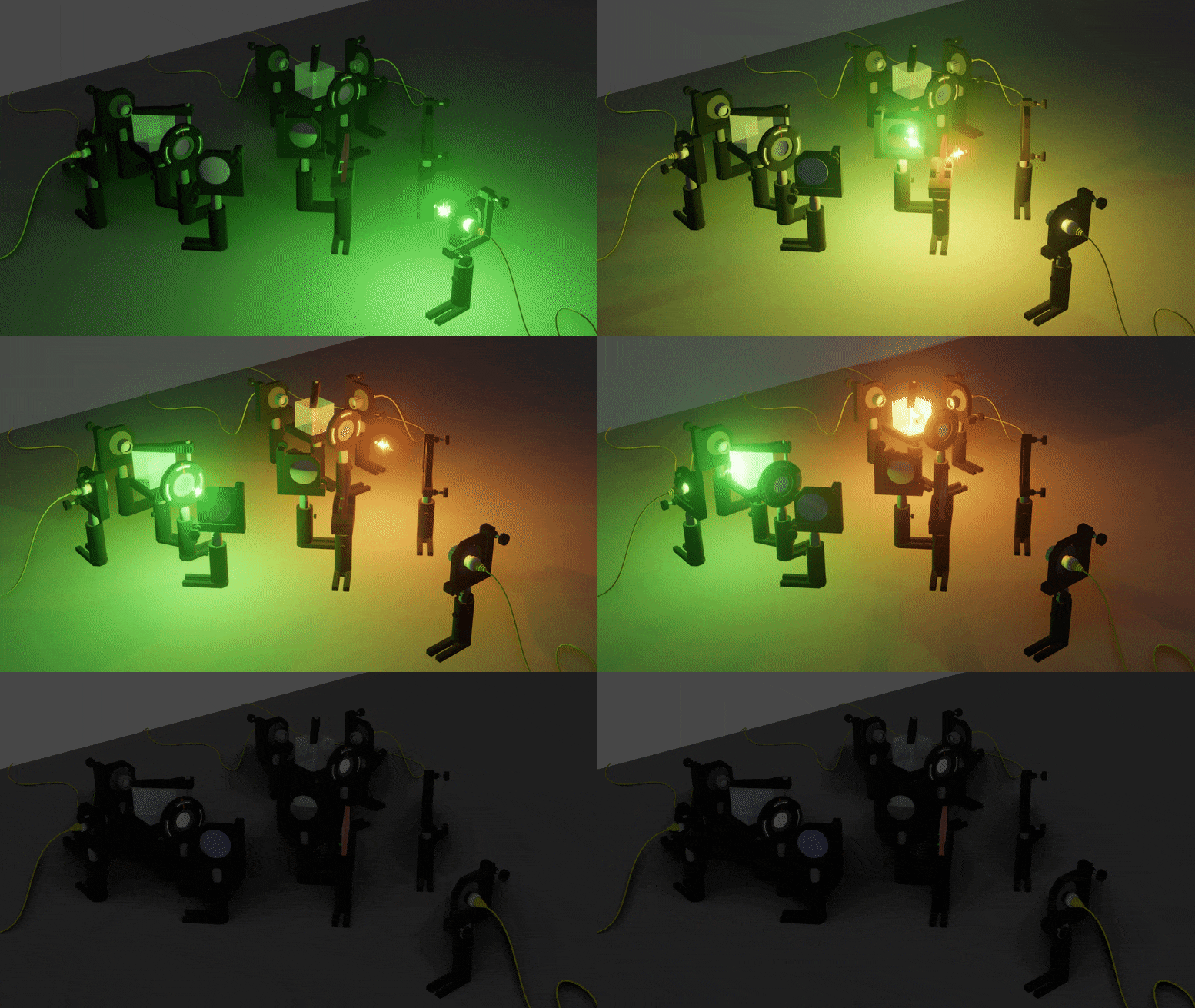
1. A laser generates a very short pulse of light 2. A fraction of this pulse is sent to a nonlinear device to change its color 3. The two laser pulses overlap on the same path again, creating a “write & read” pair of pulses. 4. Each pair is split into a short and a long path, 5. yielding an “early” and a “late” time slot, overlapping once again 6. Inside the diamond, during the “early” time slot, one photon from the “write” pulse may generate a vibration, while one photon from the “read” pulse converts the vibration back into light. 7. The same sequence may also happen during the “late” slot. But in this experiment, the scientists made sure that only one vibration is excited in total (in both early and late time slots). 8. By overlapping the photons in time again it becomes impossible to discriminate the early vs. late moment of the vibration. The vibration is now in a quantum superposition of early and late time. 9. In the detection apparatus, “write” and “read” photons are separated according to their different colors, and analyzed with single-photon counters to reveal their entanglement. Credit: Santiago Tarrago Velez (EPFL)
In the new study, EPFL researchers managed to entangle the photon and the phonon (i.e., light and vibration) produced in the fission of an incoming laser photon inside the crystal. To do so, the scientists designed an experiment in which the photon-phonon pair could be created at two different instants. Classically, it would result in a situation where the pair is created at time t1 with 50% probability, or at a later time t2 with 50% probability.
But here comes the “trick” played by the researchers to generate an entangled state. By a precise arrangement of the experiment, they ensured that not even the faintest trace of the light-vibration pair creation time (t1 vs. t2) was left in the universe. In other words, they erased information about t1 and t2. Quantum mechanics then predicts that the phonon-photon pair becomes entangled, and exists in a superposition of time t1 and t2. This prediction was beautifully confirmed by the measurements, which yielded results incompatible with the classical probabilistic theory.
By showing entanglement between light and vibration in a crystal that one could hold in their finger during the experiment, the new study creates a bridge between our daily experience and the fascinating realm of quantum mechanics.
“Quantum technologies are heralded as the next technological revolution in computing, communication, and sensing, says Christophe Galland, head of the Laboratory for Quantum and Nano-Optics at EPFL and one of the study’s main authors. “They are currently being developed by top universities and large companies worldwide, but the challenge is daunting. Such technologies rely on very fragile quantum effects surviving only at extremely cold temperatures or under high vacuum. Our study demonstrates that even a common material at ambient conditions can sustain the delicate quantum properties required for quantum technologies. There is a price to pay, though: the quantum correlations sustained by atomic vibrations in the crystal are lost after only 4 picoseconds — i.e., 0.000000000004 of a second! This short time scale is, however, also an opportunity for developing ultrafast quantum technologies. But much research lies ahead to transform our experiment into a useful device — a job for future quantum engineers.”
Reference: “Bell correlations between light and vibration at ambient conditions” by Santiago Tarrago Velez, Vivishek Sudhir, Nicolas Sangouard and Christophe Galland, 18 December 2020, Science Advances.
DOI: 10.1126/sciadv.abb0260
Never miss a breakthrough: Join the SciTechDaily newsletter.
Follow us on Google and Google News.
8 Comments
At what point can reality become as above so below?
? Whether an allusion to the recent movie [“As Above, So Below (film)” @ Wikipedia] or the ancient idiom [“As above, so below”] that references myth, and by way of “reality” philosophy – all of that is superstition, none of that is science.
Also, what would be the relevance in the context of the article?
Way above my comprehension.
I guess it epitomizes the relativity underlying quantum field theory, where time gets related to space by the Lorentz metric.
… “Counter-Intuitive”, well that is better, just because our perception of the world is wrong, it doesn’t mean that our world is not logical.
The humans have developed some wrong perceptions, that are just imperfections we have, we have some out of the mind examples, that will challenge the way one see the world around it self.
However, there is an education that can help with that issues, and provide some light that one needs in order to understand the nature we live in…
… a winning strategy in the maze of life…
… yeah, and what if something is traveling at the speed of light, or close to it… So, if we observe a light it self.
When time stops to tick, how would the light “know” what happened before, and what happened after, because there is not way to compare time lapses…
… Just a thought…
… causality…
… it is kind of hard to saw the sims, it is hard to weld the sheets of metal, but it is not impossible, all it takes is some Fuzzy logic to kick in… and … well, that is the secret to best of your friends…
… Sorry, just my ayes and mind only…