
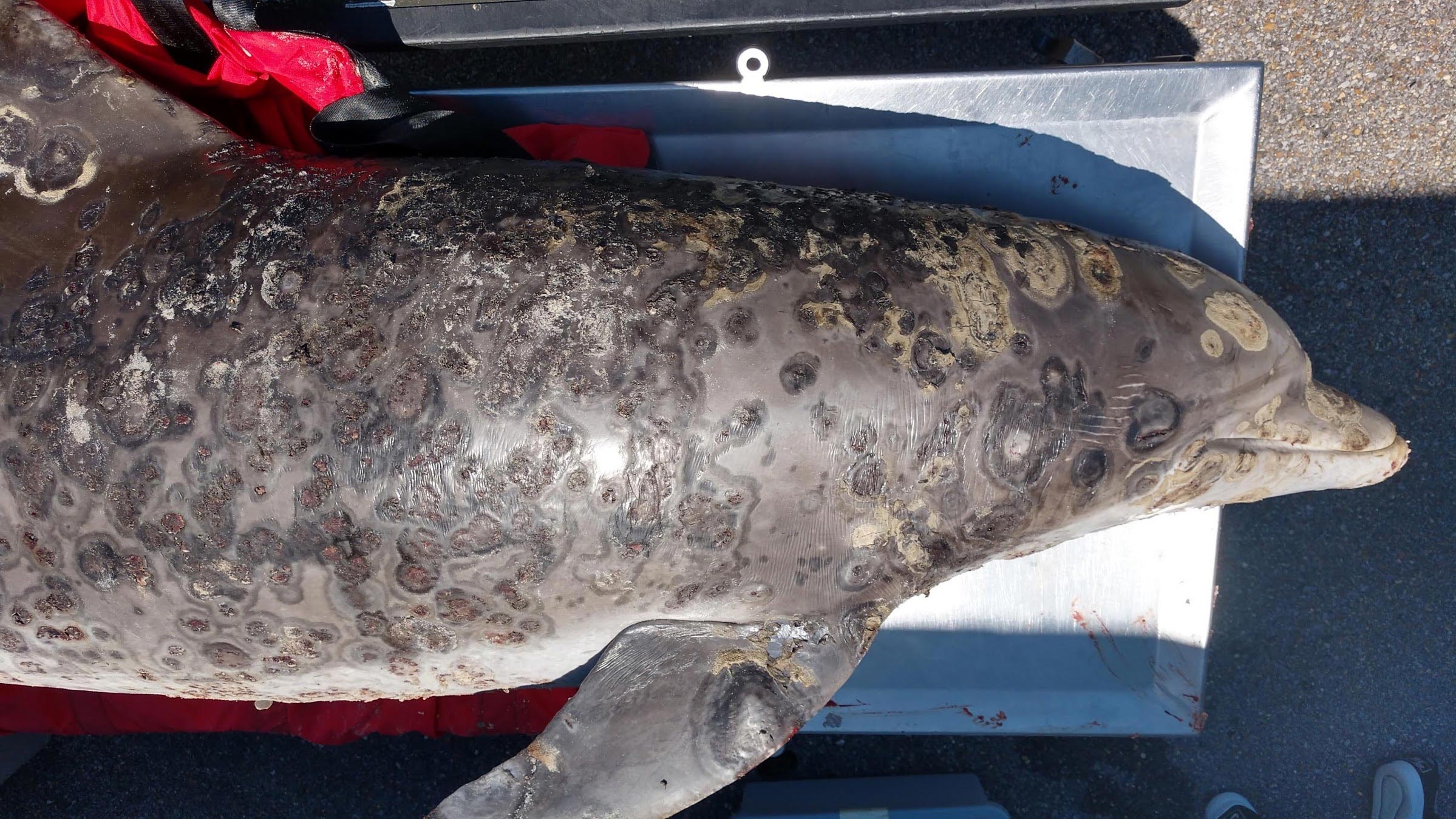
In collaboration with Australian researchers, The Marine Mammal Center has found that the increasing frequency and severity of storm systems drastically decrease the salinity of coastal waters, causing fatal skin disease in dolphins worldwide.
Scientists at The Marine Mammal Center in Sausalito, CA — the largest marine mammal hospital in the world — and international colleagues have identified a novel skin disease in dolphins that is linked to climate change. The study is a groundbreaking discovery, as it is the first time since the disease first appeared in 2005 that scientists have been able to link a cause to the condition that affects coastal dolphin communities worldwide. Due to the decreased water salinity brought upon by climate change, the dolphins develop patchy and raised skin lesions across their bodies — sometimes covering upwards of 70 percent of their skin.
The international study, which can be found here, was co-authored by three internationally respected scientists, from California and Australia:
- Dr. Pádraig Duignan, Chief Pathologist at The Marine Mammal Center
- Dr Nahiid Stephens, a veterinary pathologist at Murdoch University (Perth, Australia)
- Dr. Kate Robb, Founding Director, zoologist, and geneticist of the Marine Mammal Foundation (Victoria, Australia)
The study, published in Scientific Reports, a peer-reviewed natural sciences journal, provides the first-ever case definition for fresh-water skin disease in bottlenose dolphins.
This study comes on the heels of significant outbreaks in Louisiana, Mississippi, Alabama, Florida, Texas, and Australia in recent years. In all of these locations, a sudden and drastic decrease in salinity in the waters was the common factor. Coastal dolphins are accustomed to seasonal changes in salinity levels in their marine habitat, but they do not live in freshwater. The increasing severity and frequency of storm events like hurricanes and cyclones, particularly if they are preceded by drought conditions, are dumping unusual volumes of rain that turn coastal waters to freshwater. Freshwater conditions can persist for months, particularly after intense storms such as hurricanes Harvey and Katrina. With the increasing climate temperatures, climate scientists have predicted extreme storms like these will occur more frequently and, consequently, will result in more frequent and severe disease outbreaks in dolphins.
“This devastating skin disease has been killing dolphins since Hurricane Katrina, and we’re pleased to finally define the problem,” said Duignan. “With a record hurricane season in the Gulf of Mexico this year and more intense storm systems worldwide due to climate change, we can absolutely expect to see more of these devastating outbreaks killing dolphins.”
The study has major implications for the current outbreak in Australia, which is impacting the rare and threatened Burrunan dolphin in southeast Australia, and could provide professionals with the information needed to diagnose and treat affected animals. Currently, the long-term outlook for dolphins affected with the skin disease is poor. This is especially true for animals suffering from prolonged exposure to freshwater.
The deadly skin disease was first noted by researchers on approximately 40 bottlenose dolphins near New Orleans after Hurricane Katrina in 2005.
“As warming ocean temperatures impact marine mammals globally, the findings in this paper will allow better mitigation of the factors that lead disease outbreaks for coastal dolphin communities that are already under threat from habitat loss and degradation,” said Duignan. “This study helps shed light on an ever-growing concern, and we hope it is the first step in mitigating the deadly disease and marshaling the ocean community to further fight climate change.”
Reference: “Fresh water skin disease in dolphins: a case definition based on pathology and environmental factors in Australia” by Pádraig J. Duignan, Nahiid S. Stephens and Kate Robb, 15 December 2020, Scientific Reports.
DOI: 10.1038/s41598-020-78858-2
About The Marine Mammal Center
Headquartered on the site of a former Cold War missile base, The Marine Mammal Center is a global leader in marine mammal health, science and conservation, and is the largest marine mammal hospital in the world. The Center’s teaching hospital and training programs operate globally, with its headquarters in the Golden Gate National Recreation Area, part of the National Park Service. Expert teams from the Center travel around the world to work with emerging first responders and has itself rescued more than 24,000 marine mammals from 600 miles of its authorized rescue area of California coastline and the Big Island of Hawai’i. The Center’s mission is to advance global ocean conservation through marine mammal rescue and rehabilitation, scientific research, and education.
Never miss a breakthrough: Join the SciTechDaily newsletter.
Follow us on Google and Google News.
11 Comments
Looks like Mycosis Fungoides a form of very rare lymphoma that manifests on the skin and sometimes called a skin cancer but it’s a blood cancer.I’ve heard of it in humans,dogs and cats but not other animals.
Any testing for pesticides?
Less storms in Queensland, lowest in 20 years for storm activity.
Humans, that’s the problem. To make life good for us without hurting ourselves or other lifeforms.. That’s the right Way, but humans never have been right. That is what’s sad. No life on Earth is better than most life on Earth suffering because of 1 Specie’s, the Humans…
your a victim of left wing propaganda. Many ‘global’ warming signs are natural variation and normal occurrences, Not ‘manmade’. If you hate humanity that much you’re welcome to leave the planet.
Our human existence has for too long been analogous to a cafeteria lineup consisting of diversely societally represented people, all adamantly arguing over which identifiable traditionally marginalized person should be at the front and, conversely, at the back of the line.
Many of them further fight over to whom amongst them should go the last piece of quality pie and how much should they have to pay for it—all the while the interstellar spaceship on which they’re all permanently confined, owned and operated by (besides the most wealthy) the fossil fuel industry, is burning and seriously polluted at locations not normally investigated.
And the latter is allowed to occur, because blue-shirted liberals and red-hatted conservatives are preoccupied loudly blasting each other for their politics and beliefs thus distracting attention from big business’s moral and ethical corruption, where it should be focused.
Meanwhile, mindless arguments are made, like the stupid-sounding catchphrase, “It’s the economy, stupid!”
There’s discouragingly insufficient political gonad to sufficiently address the cause-and-effect of manmade global warming and climate change.
What is sufficiently universal, however, is that the laborers are simply too exhausted and preoccupied with just barely feeding and housing their families on a substandard, if not below the poverty line, income to criticize the former for the great damage it’s doing to our planet’s natural environment and therefore our health, particularly when that damage may not be immediately observable.
“Meanwhile, mindless arguments are made, like the stupid-sounding catchphrase, ‘It’s the economy, stupid!’”
It is unfortunate the reality sounds stupid to you. If one looks at what has happened to past societies when necessary resources were exhausted, or the economy collapsed — most recently during the Great Depression, which led to WWII — then it should be obvious to any thinking person that the economy is critical to not only the improvement of the standard of living, but even survival!
You come across as someone who thinks they have all the answers to the world’s problems. I suspect that you are someone suffering from the Dunning-Kruger syndrome.
Um, fyi. If you eggheads are right. Then humans are apart of nature. Get off your high horse and admit it. Your never going to stop humans from being human. Soooo, go help some humans. Maybe dig some wells or build a school. Your wasting time and money on things that are not going to change. Stop whining for grants and build something useful.
“With the increasing climate temperatures, climate scientists have predicted extreme storms like these will occur more frequently …”
Perhaps that should be “SOME climate scientists.” Not all climate scientists are in agreement in predicting more frequent or more severe storms. After all, weather is driven by temperature/pressure differences in the air masses, with the largest difference being between the poles and tropics. Because at least the Arctic is warming about twice as fast as the global average, the temperature difference is decreasing.
I love the way some people believe the hearsay and opinions of others who have no factual basis for their arguments. Kinda like the politics surrounding global warming. Yes, there are periods of warming and cooling of the Earth which are natural. I urge those who have any doubts about what is said by so called “experts” to do their own research, preferably, not exclusively, online research, but also check out libraries and museums. These are great places to obtain factual information on these topics.
I’m sure you can also email authors of these articles and find out their sources for information. This will save you a lot of trouble and humiliation. Also, if it sounds too good to be true, it most likely is.
Thanks and have a great day!
… a LOL moment, if true, …
If a scientist is going to blame something on ‘man-made climate change’ should they not have to prove that ‘man-made climate change’ is a real thing? I have not seen this definitive proof yet.
Waiting…