

Quantum Light Improves Sensitivity of Biological Measurements
In a new study, researchers showed that quantum light can be used to track enzyme reactions in real time. The work brings together quantum physics and biology in an important step toward the development of quantum sensors for biomedical applications.
The complex molecules known as enzymes are responsible for many processes inside our bodies. However, they can be difficult to study with optical approaches because too much light will reduce their activity or even stop it altogether.
In The Optical Society (OSA) journal Optics Express, a multidisciplinary group of researchers showed that light controlled at the single-photon, or quantum, level can allow accurate measurements without disrupting enzymatic activity.
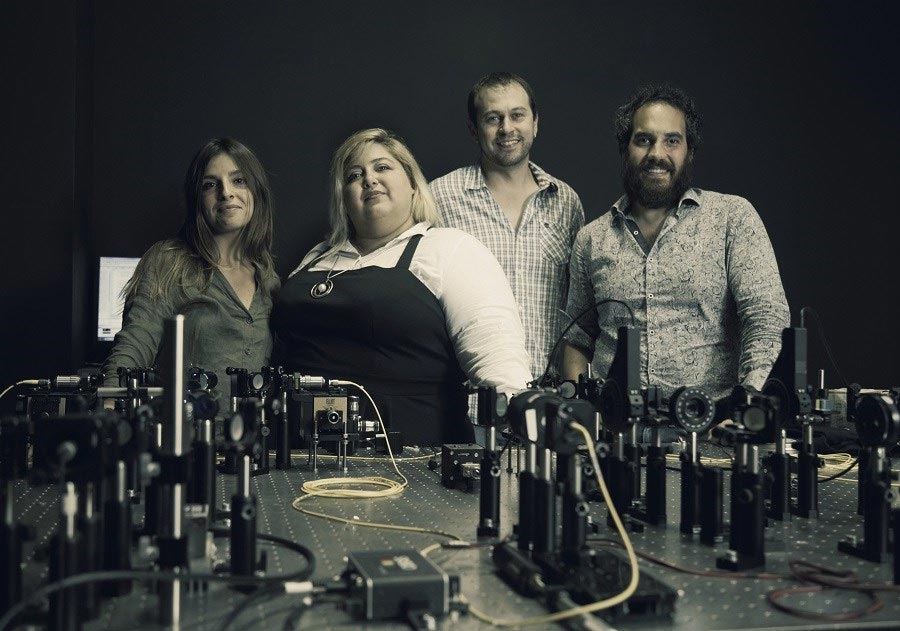
“Although it might be a few years before practical quantum sensors are achieved, this type of proof-of-principle experiment is important,” said research team leader Ilaria Gianani from Università degli Studi Roma Tre in Italy. “It helps pinpoint the areas where we can start building shared knowledge with other fields and reveals where technological advancement is needed to make progress.”
Single-photon control
When investigating biomolecules it is important to avoid using levels of light that might alter their properties or behavior. Achieving this can be challenging because low levels of light may not provide very much information and noise can easily overcome the faint signal. Today, enzymes are studied with measurements performed on assays collected from the main sample to avoid damaging the sample with light. This procedure not only takes time but also prevents direct observation of the enzymes in real time.
The researchers overcame this problem by developing a setup that allowed them to control the light extremely precisely — at the level of a single photon. This made it possible to use low illumination without disrupting the enzymes, with the potential to achieve a better sensitivity. The capability to address the sample directly also allowed dynamic tracking with higher resolution.
“Key to our success was a collaboration between quantum physicists, who know how to deal with photons, and biologists, who know how to deal with biological systems.” said Gianani. “Although it was difficult to exchange ideas at first, the team eventually grew together and developed a shared language that helped the work progress smoothly. This collaboration wouldn’t have been possible without the supervision of Prof. M. Barbieri, principal investigator of the Quantum Optics Group.”
Tracking enzyme activity
The researchers used their new technique to track changes in the chirality of a sucrose solution due to activity of an enzyme known as invertase. Tracking the chirality — the ability of a given molecule to rotate the polarization of light — provides information that can be used to determine how many molecules of sucrose have been processed by the enzymes. The experiments showed that quantum light can be used to probe enzyme activities in real time without perturbing the sample.
“This work is just one example of what quantum sensors could do,” said Gianani. “Quantum sensors could be used to optimally use light for countless applications, including biological imaging, magnetic field sensing and even detection of gravitational waves.”
The researchers say that there are some technological aspects to address before their approach could become a go-to method for tracking enzymatic reactions. For example, light losses are a strong limiting factor, but they hope their work will help spur technology development that could address this problem.
Reference: ” Adaptive tracking of enzymatic reactions with quantum light ” by Valeria Cimini, Marta Mellini, Giordano Rampioni, Marco Sbroscia, Livia Leoni, Marco Barbieri, and Ilaria Gianani, 18 November 2019, Optics Express.
DOI: 10.1364/OE.27.035245
Never miss a breakthrough: Join the SciTechDaily newsletter.
Follow us on Google and Google News.