

New research suggests some early Americans may have traveled on winter sea ice down the coast from Beringia as long as 24,000 years ago.
One of the hottest debates in archeology is how and when humans first arrived in North America. Archaeologists have traditionally argued that people walked through an ice-free corridor that briefly opened between ice sheets an estimated 13,000 years ago.
New Evidence Challenges Traditional Theories
But a growing number of archeological and genetic finds — including human footprints in New Mexico dated to around 23,000 years old — suggests that people made their way onto the continent much earlier. These early Americans likely traveled along the Pacific coastline from Beringia, the land bridge between Asia and North America that emerged during the last glacial maximum when ice sheets bound up large amounts of water, causing sea levels to fall.
Now, in research that was presented Friday, December 15, at the American Geophysical Union Annual Meeting (AGU23) in San Franciso, paleoclimate reconstructions of the Pacific Northwest hint that sea ice may have been one way for people to move farther south.
Coastal Migration Theories
The idea that early Americans may have traveled along the Pacific Coast isn’t new. People were likely south of the massive ice sheets that once covered much of the continent by at least 16,000 years ago. Given that the ice-free corridor wouldn’t be open for thousands of years before these early arrivals, scientists instead proposed that people may have moved along a “kelp highway,” where early Americans slowly traveled down into North America in boats, following the bountiful goods found in coastal waters.
Archeologists have found evidence of coastal settlements in western Canada dating from as early as 14,000 years ago. But in 2020, researchers noted that freshwater from melting glaciers at the time may have created a strong current that would make it difficult for people to travel along the coast.
Ice Highway Over Dangerous Waters
To get a fuller picture of ocean conditions during these crucial windows of human migration, Summer Praetorius of the US Geological Survey and her colleagues looked at climate proxies in ocean sediment along the coast. Most of the data came from tiny, fossilized plankton. Their abundance and chemistry help scientists reconstruct ocean temperatures, salinity and sea ice cover.
Praetorious’ presentation is part of a session on the climate history and geology of Beringia and the North Pacific during the Pleistocene at AGU23. The week-long conference has brought 24,000 experts from across the spectrum of the Earth and space sciences to San Francisco this year and connected 3,000 online attendees.
Praetorious’ team used climate models and found that ocean currents were more than twice the strength they are today during the height of the last glacial maximum around 20,000 years ago due to glacial winds and lower sea levels. While not impossible to paddle against, these conditions would have made traveling by boat very difficult, Praetorius said.
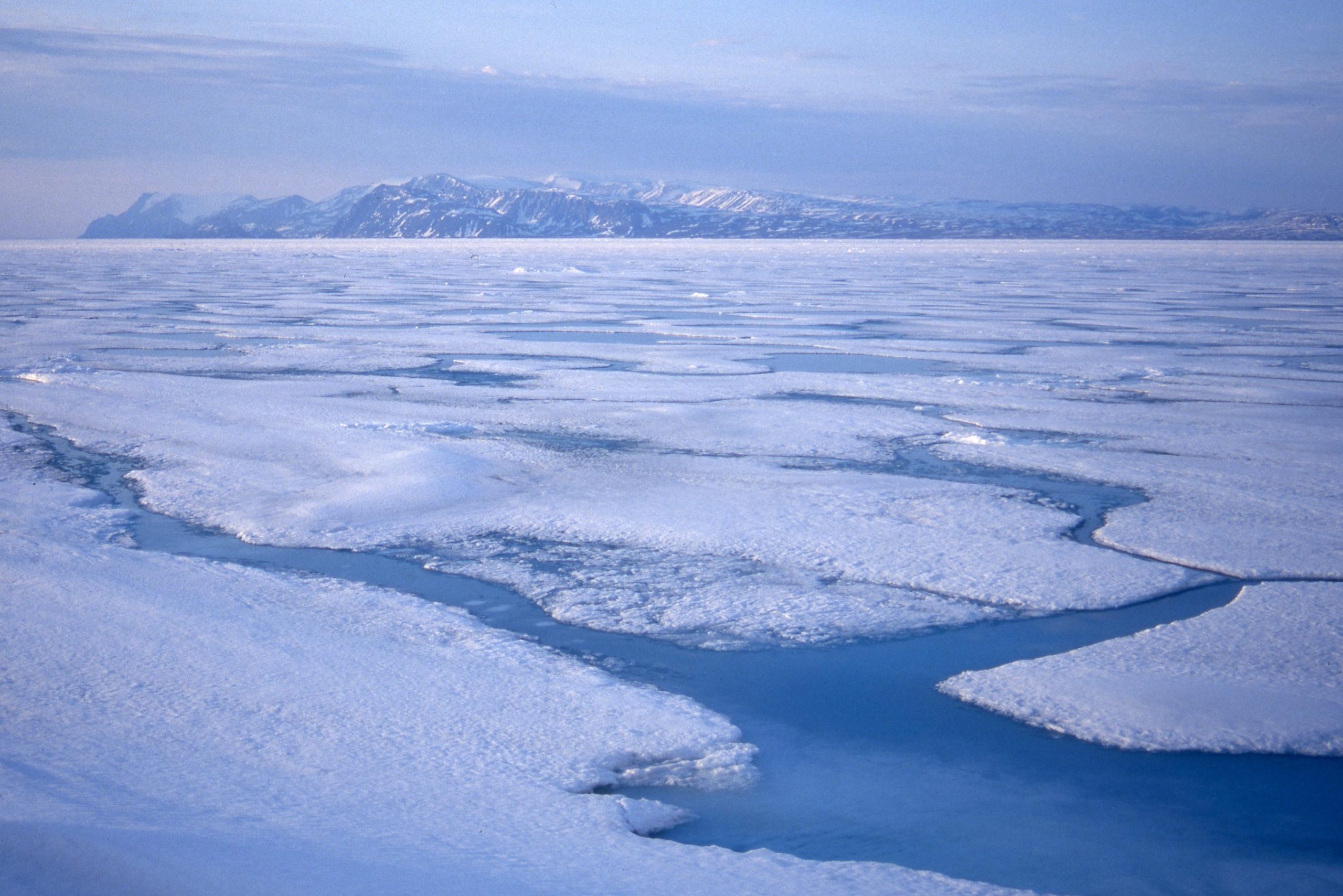
However, the records also showed that much of the area was home to winter sea ice until around 15,000 years ago. As a cold-adapted people, “rather than having to paddle against this horrible glacial current, maybe they were using the sea ice as a platform,” Praetorius said.
Sea Ice as a Migration Path
Arctic people today travel along sea ice on dog sleds and snowmobiles. Early Americans may also have used the ‘sea ice highway’ to get around and hunt marine mammals, slowly making their way into North America in the process, Praetorius said. The climate data suggest conditions along the coastal route may have been conducive to migration between 24,500-22,000 years ago and 16,400-14,800 years ago, possibly aided by the presence of winter sea ice.
Integrating New and Old Theories
While proving that people were using sea ice to travel will be tricky given most of the archeological sites are underwater, the idea provides a new framework for understanding how humans may have arrived in North America without a land bridge or easy ocean travel.
And the sea ice highway isn’t mutually exclusive with other human migrations further down the line, Praetorius said. The team’s models show the Alaskan current had calmed down by 14,000 years ago, making it easier for people to travel by boat along the coast.
“Nothing is off the table,” she said. “We will always be surprised by ancient human ingenuity.”
Never miss a breakthrough: Join the SciTechDaily newsletter.
Follow us on Google and Google News.
1 Comment
Why would they take the Atlantic route? The western coast of Europe and Africa had 70% more population going back millions of years. Crossing the Atlantic was just easier especially at the top of the world. The oldest archeological sites are located mainly on the Atlantic coast. So why does everyone think the Pacific route still makes any since is beyond me. If you’re argument is genetics we just realized we were wrong about Attila the huns lineage thought to be Turkish we will continue to find old findings to be false.