
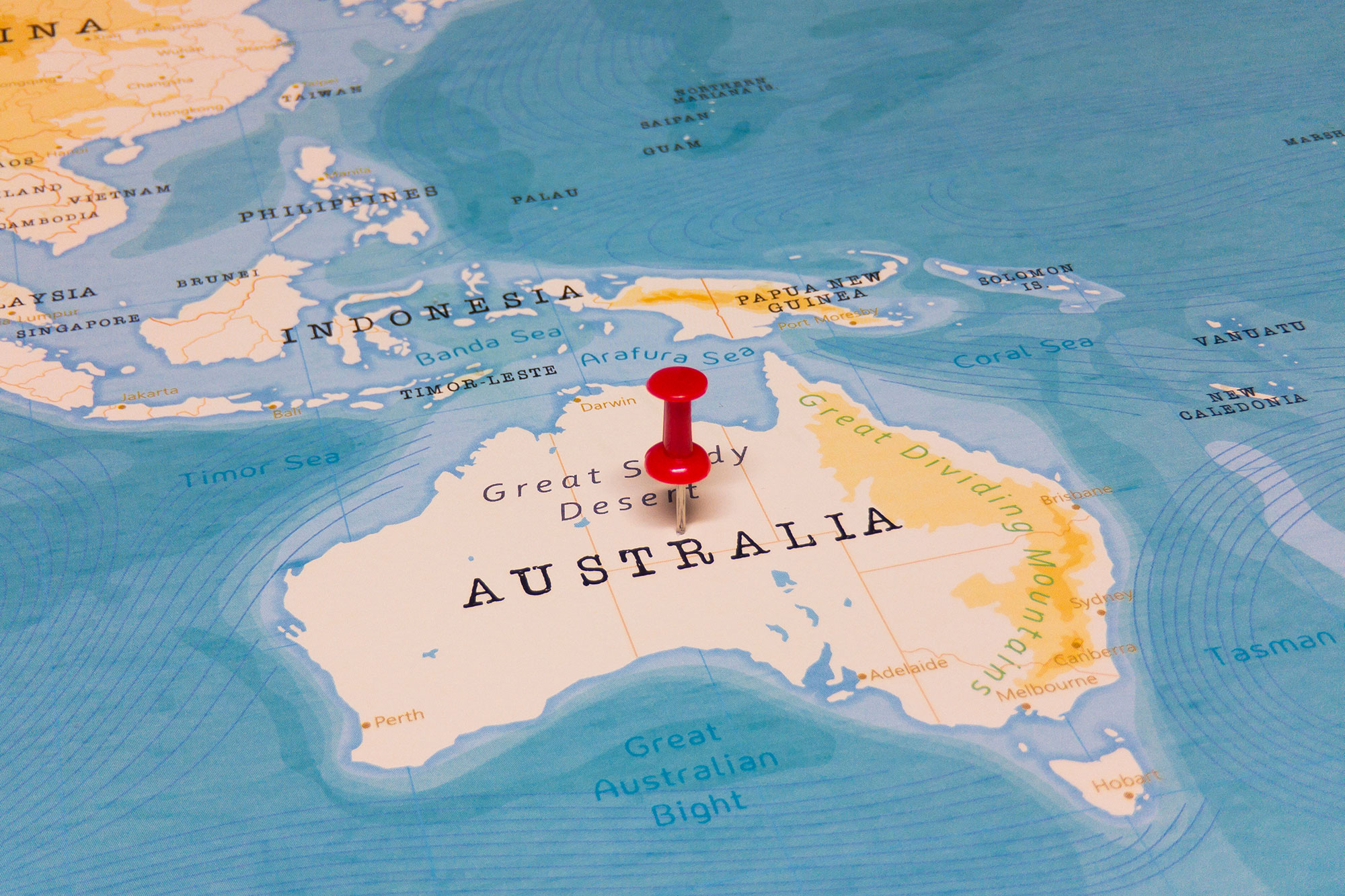
A new study by a Utah anthropologist, based on genetic evidence, concludes that the colonizers of Sahul arrived later than the commonly held estimate of 65,000 years ago.
Aboriginal Australian culture is recognized as the world’s longest continuous living tradition. Earlier studies estimated that the ancestors of today’s Indigenous Australians, known as the Sahul peoples, first reached the continent about 65,000 years ago. Yet new genetic research from the University of Utah, which examines traces of Neanderthal DNA in Homo sapiens, suggests their arrival occurred more recently—no earlier than 50,000 years ago.
Working with a colleague from Australia’s La Trobe University, James O’Connell, Distinguished Professor Emeritus in the Department of Anthropology at the University of Utah, shared these updated findings in the journal Archaeology in Oceania.
The research builds on prior evidence indicating that Homo sapiens and Neanderthals interbred only once over several thousand years (between 43,500 and 51,500 before present, or BP). Because all modern humans, including Indigenous Australians, carry 1–4% Neanderthal DNA, O’Connell’s team concludes that Aboriginal ancestors could not have arrived before this period.
Additionally, most archaeological sites found across Australia date to between 43,000 and 54,000 years ago, further supporting a later timeline for the first human settlement of the continent.
“The colonization date falls within that interval,” O’Connell said. “That puts it in the same time range as the beginning of the displacement of Neanderthal populations in western Eurasia by anatomically modern humans.”
Other hominids, such as Homo erectus, had lived in Southeast Asia for more than a million years, but had not crossed overseas in large enough numbers to create a stable population in Australia. That is an important measure of the significance of Homo sapiens’ arrival.
Dating archaeological sites using OSL
One important Australian outlier among archaeological sites, O’Connell notes, is Madjedbebe, a site dated within a range of 59,000 to 70,000 years ago. The dating technique used in a 2017 study of Madjedbebe published in Nature was optically stimulated luminescence, or OSL. The technique reads minerals, typically quartz or feldspar, recovered at the site like a “clock” by measuring the energy they store. Radiation accumulates when these minerals are buried, then released when they are exposed to light. Measurements of the amount released determine when the minerals were last exposed to light.
The site has been subject to sand deposition, which may explain the estimated age of the artifacts. “The question for us has not been about the validity of the date. It’s about the relationship between the date and material evidence of human presence—that is, artifacts. In that part of Australia, many older archaeological sites are in situations where the depositional environment is a sand sheet. Material can move down through those deposits over time.”
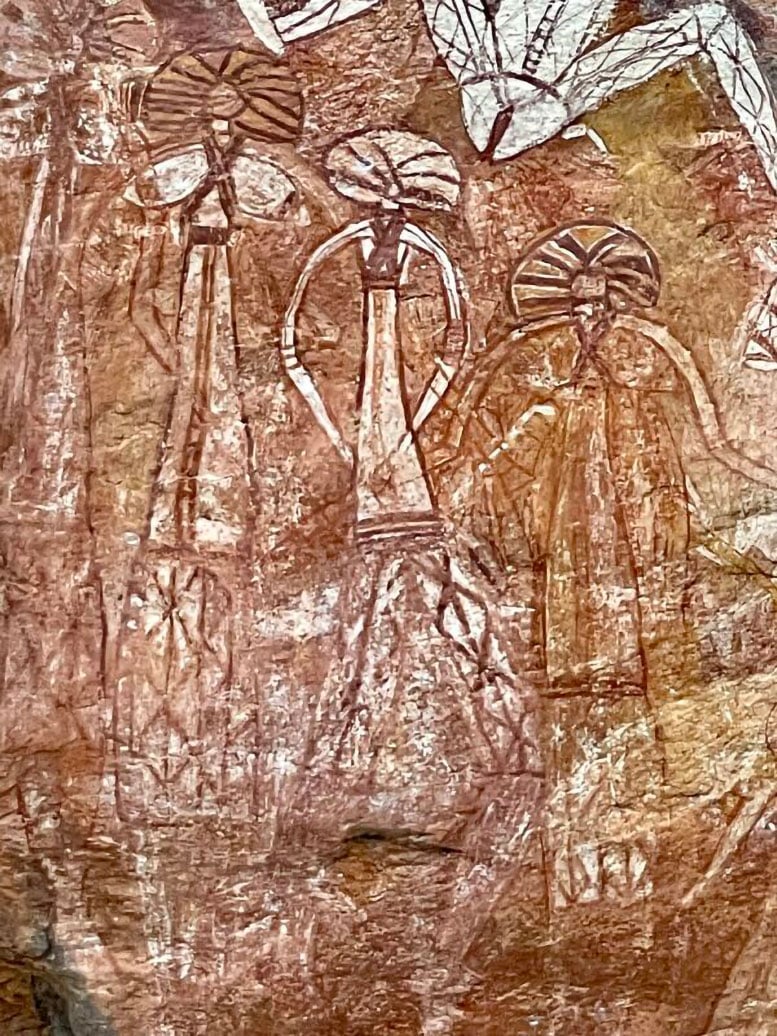
Artifacts that are heavier than sand could settle through the sand deposit over time, and as a result, the dating process may have accurately analyzed the age of the sand deposits but not the artifacts they come to contain.
O’Connell also reviewed the hurdles the first Sahul peoples to arrive in Australia would have faced. The Sahul likely relied on rafts or canoes for exploration from Southeast Asia and colonization of Australia. But several challenges existed: first, they would need to engineer marine-capable watercraft that could pass through a “formidable ecological barrier,” the Wallacean archipelago, spanning 1,500 kilometers. Island-hopping through the archipelago, now comprising the nation of Indonesia, to Australia would involve at least eight separate crossings, the longest being 90 kilometers.
Early colonizers arrived in at least four groups
Moreover, these journeys would need to support a sizable population. Citing mitochondrial data, O’Connell noted: “Genomic analysis shows that early human colonizing populations included at least four separate mitochondrial lineages. Simple modeling exercises show that establishing each lineage on Sahul required the presence of at least five–10 women of reproductive age, which implies census populations of at least 25–50 individuals per lineage among the founders.”
The analysis indicates that these founding populations arrived within a short timeframe, lasting just a few centuries.
“This strongly suggests that colonizing passage was deliberate, not accidental,” O’Connell said,” and that it required sturdy rafts or canoes capable of holding, say, 10 or more people each plus the food and water needed to sustain those folks on open ocean voyages of up to several days, and of making headway against occasionally contrary ocean currents.”
Altogether, this technological progression adds more weight to a post-50,000-year arrival date, with other innovations and behavioral shifts—including cave art, tools, and ornaments—emerging in that timeframe.
The 50,000-year hypothesis has been a focus of the Australian anthropological debate since 2018. Four separate genetics studies have outlined the DNA ancestries of modern Indigenous New Guineans and Australians, concluding they could not have arrived earlier than 55,000 years ago. The other side of the debate continues to favor a 65,000-year date, which O’Connell disputes.
“I would expect in the next five years or so, the pendulum is going to swing back to general agreement for an under 50,000-year date for Australian colonization. It links up with the broader Eurasian record of an out-of-Africa population wave that spreads across Eurasia—a process that occurs over several thousand years. That raises all kinds of questions about why it happens, what it involves, what prompts it, and what changes in behavior are indicated in greater detail than they are now.”
Reference: “Recent DNA Studies Question a 65 kya Arrival of Humans in Sahul” by Jim Allen and James F. O’Connell, 29 June 2025, Archaeology in Oceania.
DOI: 10.1002/arco.70002
Never miss a breakthrough: Join the SciTechDaily newsletter.
Follow us on Google and Google News.
22 Comments
Not so sure that Australian Aboriginals migrated via Europe. Neanderthals present in the Levant and Yunnan province of China 120K ago. Could have been multiple hybrid events.
The article is not suggesting from Europe. It’s suggesting that the arrival of humans in Australia coincides with the arrival of humans in Europe boh from the same Dna lineage .
This is interesting. The Sahul/ Aboriginal peoples of Australia were the oldest continuous indigenous people anywhere on earth.
Pretty awful, shameful how we’ve treated them since “discovering” their home and declaring it uninhabited, in the name of colonisation.
Could we not start to treat them with more respect, and dignity, instead of emphasizing how they fail to fit into the role we choose for them?
Agree absolutely!
If sahul humans arrived in Austrasia mode than 50k years ago then when humans arrived in Bangladesh Myanmar or Malaysia? In that scenario When humans first arrived in levant out of africa 120k years probably need to increase.
Of course it was much easier for humans to get from the Levant to Bangladesh, Myanmar and Malaya, than to Sahul, long time ago, because for that they did not have to cross any sea. As far as the rest of Malaysia, namely Sabah and Sarawak, there could have been a land bridge connecting Borneo to mainland Asia some thousands of years ago, when sea levels were lower. Sahul was a big continent until about 10,000 years ago, when sea levels were rising, separating Australia from New Guinea and from Tasmania. So when people crossing seas got to Sahul, maybe some 50,000 years ago, they could get to all parts of Sahul easily, namely New Guinea, Australia, and Tasmania, since they not need to cross any sea to get to Australia and Tasmania from New Guinea, due to lower sea levels.
Shakespeare:: what’s done tis done and cannot be undone
As far as Sahul, that was a rather large continent, including New Guinea, Australia and Tasmania, connected by dry land, due to lower sea levels. But as far as British colonizers who got there about 200 years ago, they found the weather to be too hot for what they were used to on New Guinea, so not many settled there. So the most recent large migration to New Guinea occurred some 2,000 or 3,000 years ago, when people speaking Austronesian languages got there. People speaking various Austronesian languages on New Guinea are found mostly in the coastal regions of New Guinea. Mainly in the northern and eastern coastal regions. But most of the languages spoken on New Guinea are not Austronesian. There is a huge variety of languages spoken on New Guinea, belonging to various language families.
I suppose your house is sitting on Aboriginal land that was taken. Are you going to give that back
Neanderthals are living with us (homosapiens) for at least 300000 years. It doesn’t matter if there was sexual intercourse or not most likely there was. Neanderthal is a small town near Dusseldorf Germany where this humanoids were first found and in Spain, Morocco, Israel and other places.
Please contact the Max Planck working group on Neanderthal Genomes, and check with them as to whether there was only one significant interbreeding event between H.sapiens and H.neanderthalis.
There are several, including a H.sapiens YDNA replacement of all subsequently found H.neanderthalensis between 130k BP to 100k BP. While much H.neanerthalensis DNA is understood to be in H.sapiens from the most recent hybridisation as assumed by the authors, it is far from the whole story. To research whether aboriginals descended from just the last phase of recent interaction would require iscovery of specific genetic clusters that could be tracked back to that event exclusive of all others.
That means we’re all connected and part aboriginal we all have neandertahl dna
Umm NOOO!!….. AND the reasoning for indigenous peoples have Neanderthal DNA 🧬 is because of all the trying to breed out the “black” from Aboriginal DNA 🧬. 20 generations later random “DARK Complexion” babies are being born
I thought Africans do not have neanderthal dna.
That is correct . Modern Africans do not have Neanderthal dna . I thought I read somewhere that Aboriginals and Png have a higher Denisovan percentage than else where .
It depends on what part of Africa. People of northern and northeastern Africa do have a bit of Neanderthal DNA. People in other parts of Africa have hardly any Neanderthal DNA, except for immigrants from elsewhere, like from Europe and Asia, and descendants of the immigrants.
How odd that H erectus was in Indonesia 100 000 years ago and therefore this dumb cousin of ours must have been capable of building sea-going craft; perhaps stable catamarans from two hollow-log canoes? And tradewind sailing, downwind, is not that difficult.
I wonder what history is hidden under the sea as the oceans were much lower then, because of the ice age. Also there wouldn’t be as much water to cross as the islands of Indonesia would’ve been much larger.
Why is it that no one acknowledges that Australia was a hot searing Volanic landscape? The last ACTIVE VOLCANO was only 5000 yrs ago? Before that,10,000 yrs ago? Before 10,000 yrs ago the whole of Australia had ACTIVE VOLANOES and has the longest Volcano LAVA TUBES in the WORLD. Hardly a place for any human to migrate to 65,000 yrs ago!
After 50,000 years why didn’t the aboriginal evolve, like for this time remained exactly the same,doing exactly the same.
There are at least two different papers that I know of which show that around 4000-5000 years ago, some South Asian (i.e. Indian) DNA entered the Australian gene pool (about the same time as dingoes arrived in Australia and changes in tool technology). Could any Neanderthal DNA in modern Australian Aboriginal populations be an artifact of this later contact?
Utah, Mormons. LoL. I only believed real scientists, not some fake Christians and theirs fake books. I may not saying they fake but it’s just look like they took pages, out of the King James Bible and twisted it. And no l did not read it all just few pages,