
Close Menu
    Facebook X (Twitter) Instagram
    SciTechDaily
    • Biology
    • Chemistry
    • Earth
    • Health
    • Physics
    • Science
    • Space
    • Technology
    Facebook X (Twitter) Pinterest YouTube RSS
    SciTechDaily
    Home»Space»NASA’s Dawn Spacecraft Gets a Closer View of Ceres
    Space

    NASA’s Dawn Spacecraft Gets a Closer View of Ceres

    By Elizabeth Landau, NASA's Jet Propulsion LaboratoryFebruary 5, 20152 Comments2 Mins Read
    Facebook Twitter Pinterest Telegram LinkedIn WhatsApp Email Reddit
    Share
    Facebook Twitter LinkedIn Pinterest Telegram Email Reddit
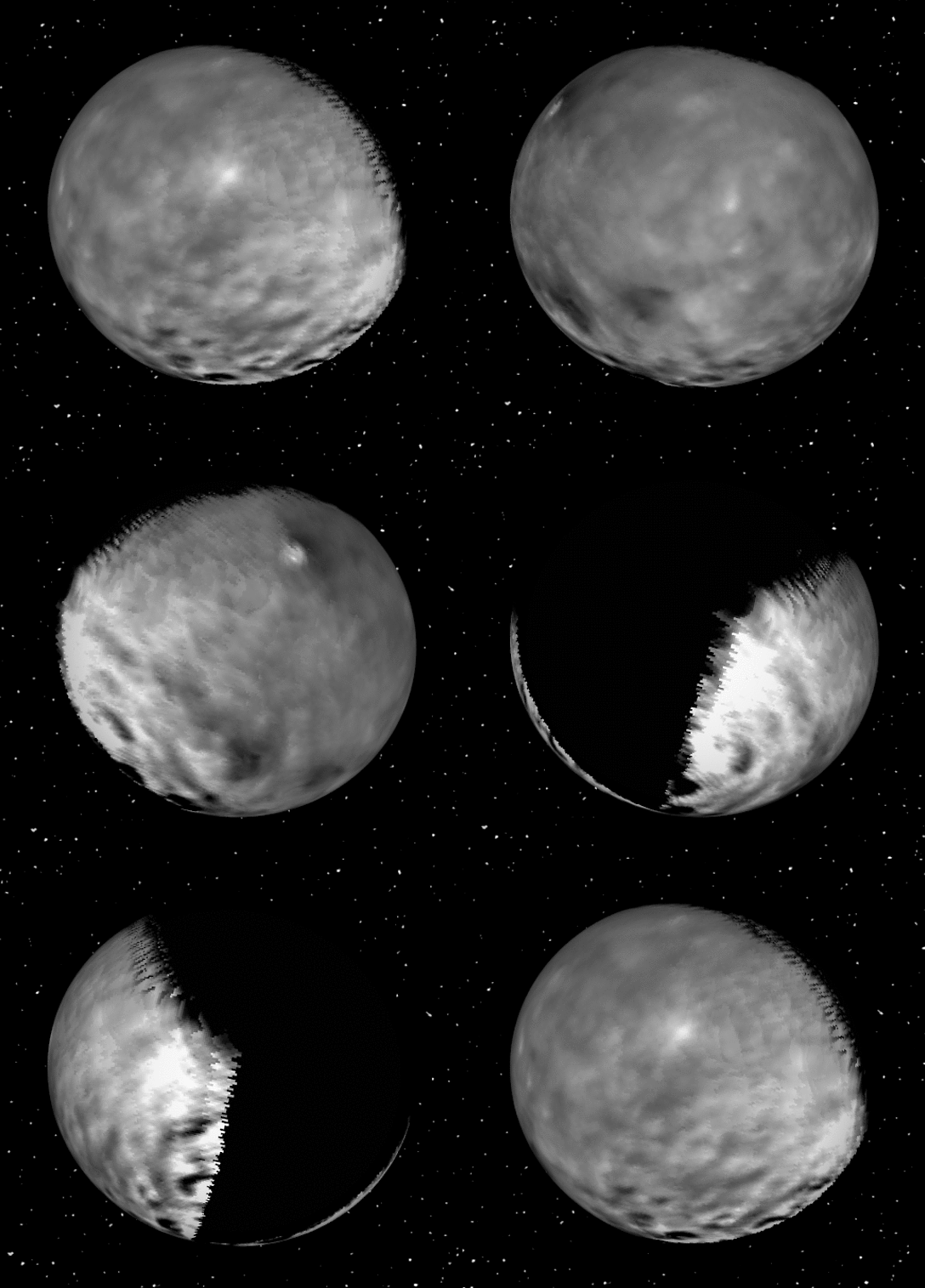
     Dawn Gets Closer Views of Ceres
    This animation showcases a series of images NASA’s Dawn spacecraft took on approach to Ceres on February 4, 2015 at a distance of about 90,000 miles (145,000 kilometers) from the dwarf planet. Credit: NASA/JPL-Caltech/UCLA/MPS/DLR/IDA

    NASA’s Dawn spacecraft has acquired its latest and closest-yet snapshot of Ceres.

    At a resolution of 8.5 miles (14 kilometers) per pixel, the pictures represent the sharpest images to date of Ceres.

    After the spacecraft arrives and enters into orbit around the dwarf planet, it will study the intriguing world in great detail. Ceres, with a diameter of 590 miles (950 kilometers), is the largest object in the main asteroid belt, located between Mars and Jupiter.

    Dawn’s mission to Vesta and Ceres is managed by the Jet Propulsion Laboratory for NASA’s Science Mission Directorate in Washington. Dawn is a project of the directorate’s Discovery Program, managed by NASA’s Marshall Space Flight Center in Huntsville, Alabama. UCLA is responsible for overall Dawn mission science. Orbital Sciences Corp. of Dulles, Virginia, designed and built the spacecraft. JPL is managed for NASA by the California Institute of Technology in Pasadena. The framing cameras were provided by the Max Planck Institute for Solar System Research, Gottingen, Germany, with significant contributions by the German Aerospace Center (DLR) Institute of Planetary Research, Berlin, and in coordination with the Institute of Computer and Communication Network Engineering, Braunschweig. The visible and infrared mapping spectrometer was provided by the Italian Space Agency and the Italian National Institute for Astrophysics, built by Selex ES, and is managed and operated by the Italian Institute for Space Astrophysics and Planetology, Rome. The gamma ray and neutron detector was built by Los Alamos National Laboratory, New Mexico, and is operated by the Planetary Science Institute, Tucson, Arizona.

    Never miss a breakthrough: Join the SciTechDaily newsletter.
    Follow us on Google and Google News.

    Astronomy Dawn Spacecraft Planetary Science Planetology
    Share. Facebook Twitter Pinterest LinkedIn Email Reddit

    Related Articles

    New Color Map of Ceres Reveals Surface Diversity

    NASA’s Dawn Spacecraft Achieves Orbit Around Ceres

    Dawn Spacecraft Shows Crater Shapes on Ceres’ Surface

    NASA’s Dawn Captures Sharper Images of Ceres

    Dawn Spacecraft Captures Best-Ever View of Ceres

    NASA’s Dawn Spacecraft Closes in on Ceres, Delivers New Images

    NASA’s Dawn Spacecraft Begins Approach to Ceres

    Dawn Spacecraft Finds Traces of Water on Giant Asteroid Vesta

    NASA’s Dawn Mission Reveals Hydrated Minerals on Vesta

    2 Comments

    1. Tim Staffell on February 6, 2015 6:57 am

      Why are the images such poor quality, when the craft is well within our own lunar orbital distance, and even from earth the cheapest binoculars show lunar detail better than this, presumably top quality lensing device. Admittedly Ceres is only 1/4 the diameter of the moon, but even so, they should be better than this, shouldn’t they?

      Reply
      • Bill Ottinger on May 28, 2015 11:28 am

        Yeah, the image should be alot clearer I should think. You would think that with the equipment that NASA has it would be alot clearer. I think they don’t want us to see something, especially the bright spots!

        Reply
    Leave A Reply Cancel Reply

    • Facebook
    • Twitter
    • Pinterest
    • YouTube

    Don't Miss a Discovery

    Subscribe for the Latest in Science & Tech!

    Trending News

    The Strange “Spacetime Crystal” That Can Suddenly Turn Into a Black Hole

    The Surprising Way Asteroids May Have Helped Life Begin on Earth

    Vast Hidden Structure Discovered Under Miles of Ice in East Antarctica

    A Surprising Discovery Suggests Autism Is Not One Condition

    New Alzheimer’s Discovery Could Change How Scientists Fight the Disease

    Yale Discovery Overturns Long-Held “Evolutionary Dead End” Theory

    UCLA Scientists Uncover a “Hidden Weakness” in Some of the World’s Deadliest Cancers

    Humpback Whale Stuns Scientists With 15,000 Kilometer Journey Across Oceans

    Follow SciTechDaily
    • Facebook
    • Twitter
    • YouTube
    • Pinterest
    • Newsletter
    • RSS
    SciTech News
    • Biology News
    • Chemistry News
    • Earth News
    • Health News
    • Physics News
    • Science News
    • Space News
    • Technology News
    Recent Posts
    • Meet the Artemis III Astronauts Preparing for NASA’s Boldest Moon Mission Yet
    • Scientists Develop a New Way To Measure Gravitational Waves in the Expanding Universe
    • MIT’s New Dual-Mode Rocket System Could Send Tiny Satellites to Mars
    • Scientists Discover a Biological Clock Unlike Anything Seen Before
    • This “Zombie” Sea Creature Keeps Growing After Being Cut Apart
    Copyright © 1998 - 2026 SciTechDaily. All Rights Reserved.
    • Science News
    • About
    • Contact
    • Editorial Board
    • Privacy Policy
    • Terms of Use

    Type above and press Enter to search. Press Esc to cancel.