
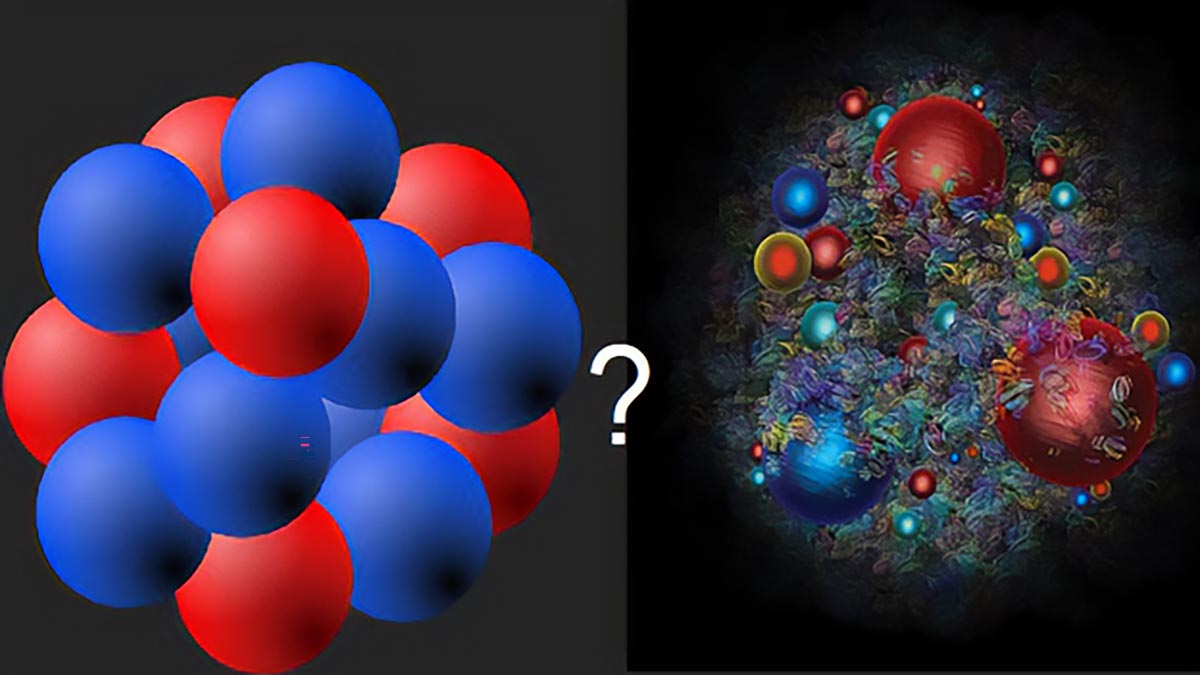
What happens when matter is crushed so densely that it breaks apart into its most fundamental ingredients?
Scientists theorize that at ultra-high densities, nucleons melt into a sea of quarks, forming an exotic liquid unlike anything in ordinary nuclear matter. This quark liquid behaves differently—spinning it creates vortices that carry unique color-magnetic fields, a feature entirely missing in nucleon liquids.
The Science of Neutron Star Matter
Deep inside every atom lies a hidden world—protons and neutrons (known as nucleons), which themselves are made of even tinier particles called quarks. But what happens when matter is pushed to its absolute limits?
At incredibly high densities, like those found in neutron stars or created in powerful particle collisions, nuclei break apart into a swirling liquid of nucleons. Squeeze it even more, and those nucleons dissolve into something even stranger: a quark liquid.
Now, scientists have asked a fascinating question: are these two ultra-dense liquids—the nucleon one and the quark one—actually different at a fundamental level? According to new theoretical research, the answer is a resounding yes.
Both types of liquids spin and form vortices, much like whirlpools. But here’s the twist: in quark liquids, those vortices carry a mysterious “color-magnetic field,” something like a magnetic field, but unique to the world of quarks. This special feature doesn’t appear in nucleon liquids, revealing a striking difference between the two.
The Impact of Quark and Nucleon Liquids
Quarks and nucleons inside nuclei interact with each other via the strong nuclear force. This force has an intriguing property known as confinement. This means scientists can only observe groups of quarks bound together, but never an individual quark by itself. In other words, quarks are said to be “confined.” It is also difficult to describe confinement or even define it precisely using theoretical tools.
This work, using vortex properties to distinguish quark liquids from nucleon liquids, addresses this longstanding problem. It suggests that there is a precise sense in which dense quark liquids are not confining while nuclear liquids are confining.
Challenging Traditional Theories
Whether nuclear matter is distinct from quark matter, in other words, separated by a phase transition, is an old question in the study of strong interactions, specifically the theory of quantum chromodynamics (QCD). Similarly, scientists have asked whether or not it is possible to provide a sharp definition of confinement. Both of these questions have been explored in the past from a relatively old perspective, known as the Landau paradigm for phase transitions. Landau paradigm considerations suggest that nuclear and quark matter are not distinct. It also implies that confinement cannot be sharply defined in QCD.
This work challenges these conclusions by adopting a new set of tools discovered by physicists over the last 40 years. These tools detect topological transitions in materials that don’t fit within the former paradigm. When applied to the study of QCD, they reveal that quark matter and nuclear matter are distinct. To differentiate quark matter from nuclear matter, scientists must compare vortex properties in the two cases. A simple calculation reveals that the vortex in quark matter traps a color-magnetic field, which is absent in nuclear matter. This result also suggests that confinement can be rigorously defined in dense QCD.
References:
“Higgs-confinement phase transitions with fundamental representation matter” by Aleksey Cherman, Theodore Jacobson, Srimoyee Sen and Laurence G. Yaffe, 24 November 2020, Physical Review D.
DOI: 10.1103/PhysRevD.102.105021
“Vortices in spin-0 superfluids carry magnetic flux” by Aleksey Cherman, Theodore Jacobson, Srimoyee Sen and Laurence G. Yaffe, 5 January 2023, Physical Review B.
DOI: 10.1103/PhysRevB.107.024502
This research was supported by the Department of Energy Office of Science, Office of Nuclear Physics and its Quantum Horizons program.
Never miss a breakthrough: Join the SciTechDaily newsletter.
Follow us on Google and Google News.
2 Comments
From accretion disks to quantum spins (or vortex), vortices are everywhere. Physics must accept the fact that physical experiments are limited by nature. Mathematics is the language of science. Can physics use mathematics to explore the causes and essence of vortex gravitational fields? Scientific research is guided by correct theories can make physical experiments more scientific, concise, and efficient.
Do you firmly believe that two objects (such as two sets of cobalt-60) rotating in opposite directions can form a mirror image of each other? This is the pseudoscientific theory that has been widely spread by the Physical Review Letters (PRL).
Low dimensional spacetime matter is the understructure of high-dimensional spacetime matter. No observable particle can be two-dimensional. Physics should not detach itself from mathematics to speculate the world that before the topological vortex synchronization effect occurs.