
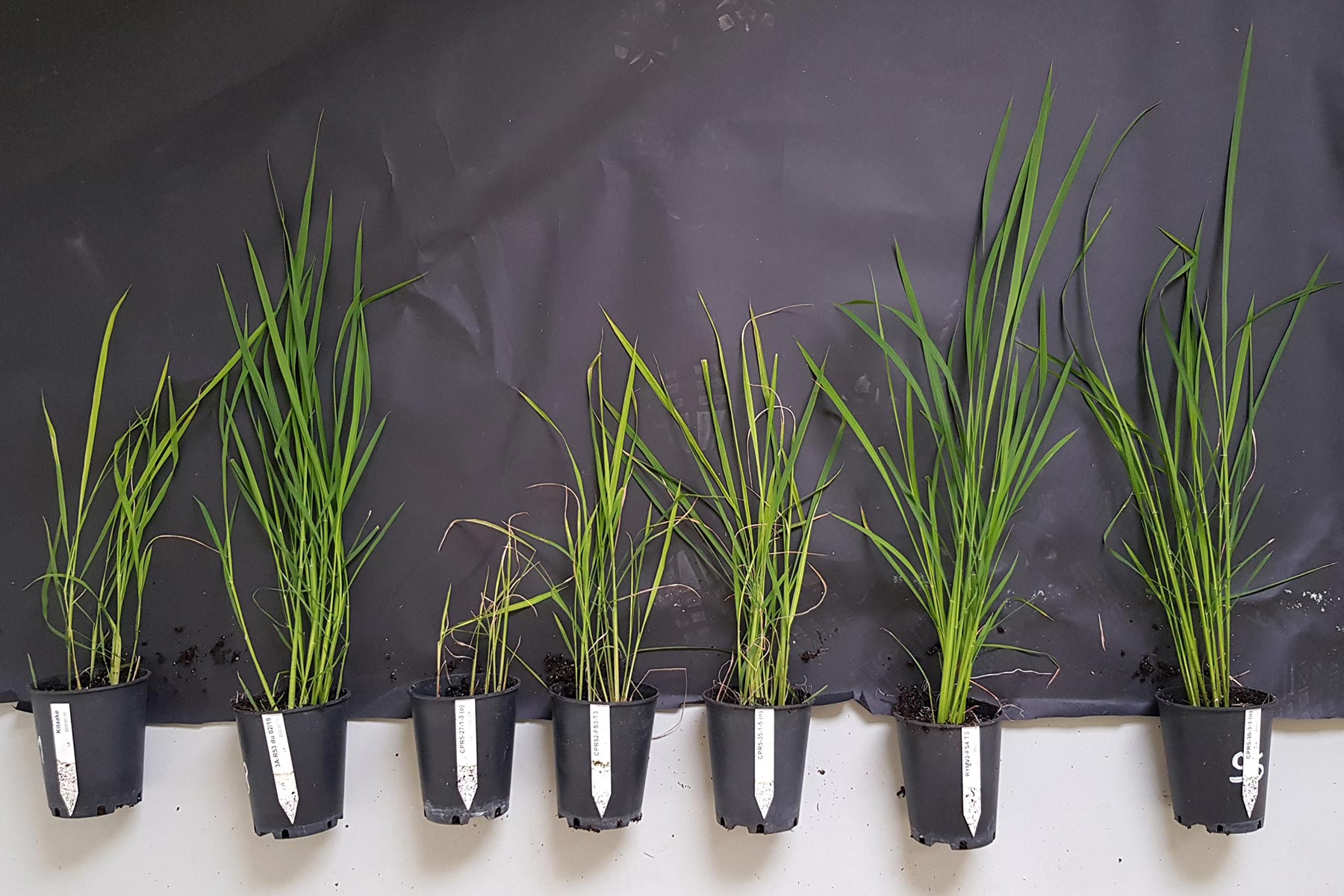
The so-called Rice Yellow Mottle Virus (for short: RYMV) is responsible for high crop losses in Africa, particularly among small-scale farmers. A research team from Heinrich Heine University Düsseldorf (HHU) and the French National Research Institute for Sustainable Development (IRD) has now produced rice lines that are resistant to the disease by means of genome editing. The rice varieties, the development of which the team describes in Plant Biotechnology Journal, are a preliminary step toward being able to generate resistant locally adapted elite varieties for small-scale food producers in Africa.
RYMV is an RNA virus spread by beetles and direct leaf-to-leaf contact. In Africa, where the majority of producers farm plots of land barely one hectare in size, between ten and one hundred percent of the rice harvests are regularly lost to this virus. This makes it a life-threatening problem for the poorest farmers.
Developing Resistant Rice Varieties
There is no effective protection against the virus. “The only real protection is to develop rice varieties that possess a resistance gene against RYMV, which would make the plant invulnerable,” says Dr. Yugander Arra, lead author of the study now published in Plant Biotechnology Journal.
A research team from the Institute for Molecular Physiology at HHU (headed by Professor Dr. Wolf B. Frommer) and the Institut de recherche pour le développement (IRD) in Montpellier, France, has developed such resistant rice lines.
Three resistance genes are currently known; mutations in just one of the genes, called RYMV1, 2, and 3, are sufficient to achieve resistance. The resistant form rymv2 occurs in poor-yielding African rice (Oryza glaberrima) varieties. RYMV2, also known as CPR5.1, encodes an important protein from the pores of the cell nucleus. In the model plant Arabidopsis thaliana, the loss of the only gene copy of CPR5 results in a broad spectrum of resistance not only to viruses, but also to bacteria and fungi. However, growth is severely restricted, the plants exhibit spontaneous lesions and produce low yields. So it was important to test whether rymv2 resistance could be transferred to other rice varieties without negative consequences.
Challenges and Solutions in Rice Breeding
In Africa, other high-yield rice varieties based on the Asian species Oryza indica are mainly used and these do not have the resistance gene. Inserting the relevant gene is however not a particularly promising approach as the descendants of such “inter-species” hybrids are highly sterile and therefore cannot reproduce and pass on the resistance easily.
Using the CRISPR/Cas genome editing method, the research group has now shown that mutations of the RYMV2 gene can be produced in an Asian rice variety that make it resistant to the virus in a similar way to the African form. In the next step, the aim is to edit relevant African elite varieties in the same way in order to then make them available to African small-scale producers. Helping these farmers is the goal of the international research consortium “Healthy Crops,” which is headed by HHU.
Genetic Insights for Crop Improvement
Plants have hereditary mechanisms that were useful for survival in the early days of evolution, but which are now more likely to be harmful. Maize is a good example of this: A gene causes the kernels to be aborted when drought conditions prevail at the time of fertilization. This trait caused by the gene was good for the wild perennial forebears of today’s maize plants, but has a detrimental effect on the yield of the annual plants now used in agriculture.
The situation is similar with the rice examined here. Professor Frommer: “This resistance trait is attributable to the loss of a gene function that is not essential. If we switch the gene off completely, the plants behave normally. However, as a result of the loss of the gene function, they are resistant to the virus.”
Dr. Eliza Loo, Healthy Crops Group Leader, adds: “It is so to speak an archetype, which was useful for its forebears, but which now leads to devastating crop losses in periods of drought. It would appear expedient to switch this gene off and it has no obvious side effects.”
Promising Results and Future Directions
Surprisingly, neither switching off the closely related CPR5.2 gene nor the two genes RYMV2 and CPR5.2 – at least under greenhouse conditions – leads to impairments. It is also noteworthy that the loss of CPR5.2 does not lead to RYMV resistance. Everything indicates that editing the RYMV2 gene is a promising approach to combating the rice disease in Africa.
Reference: “Rice Yellow Mottle Virus resistance by genome editing of the Oryza sativa L. ssp. japonica nucleoporin gene OsCPR5.1 but not OsCPR5.2” by Yugander Arra, Florence Auguy, Melissa Stiebner, Sophie Chéron, Michael M. Wudick, Manuel Miras, Van Schepler-Luu, Steffen Köhler, Sébastien Cunnac, Wolf B. Frommer and Laurence Albar, 20 December 2023, Plant Biotechnology Journal.
DOI: 10.1111/pbi.14266
The research took place within the framework of the Cluster of Excellence for Plant Research CEPLAS and was funded as part of Prof Frommer’s Alexander von Humboldt Professorship.
Never miss a breakthrough: Join the SciTechDaily newsletter.
Follow us on Google and Google News.