

Close Menu
    Facebook X (Twitter) Instagram
    SciTechDaily
    • Biology
    • Chemistry
    • Earth
    • Health
    • Physics
    • Science
    • Space
    • Technology
    Facebook X (Twitter) Pinterest YouTube RSS
    SciTechDaily
    Home»Space»Cosmic Building Blocks of Life Discovered – Scientists Perform First Chemical-Free Analysis of Extraterrestrial Amino Acids in Winchcombe Meteorite
    Space

    Cosmic Building Blocks of Life Discovered – Scientists Perform First Chemical-Free Analysis of Extraterrestrial Amino Acids in Winchcombe Meteorite

    By University of MünsterFebruary 10, 2024No Comments4 Mins Read
    Facebook Twitter Pinterest Telegram LinkedIn WhatsApp Email Reddit
    Share
    Facebook Twitter LinkedIn Pinterest Telegram Email Reddit
    Meteor Earth Storm
    Meteorites, remnants of asteroids, are crucial for understanding our solar system’s history, acting as time capsules that preserve primordial material. Researchers have made a groundbreaking discovery in the Winchcombe meteorite, identifying key nitrogen compounds, including amino acids and hydrocarbons, without chemical treatments, using a novel detector design. This finding, significant for research into life’s origins on Earth, was facilitated by a high-resolution electron microscope at the SuperSTEM laboratory. This technique not only enhances our understanding of meteorites but also holds potential for analyzing extraterrestrial specimens from space missions.

    A research team has analyzed extraterrestrial amino acids and other organic compounds in an English meteorite fall for the first time without using any chemical treatments.

    Meteorites are fragments of asteroids which find their way to Earth as shooting stars. These cosmic sediments have frozen the primordial soup from which our solar system emerged – preserving it just like a time capsule. These rocks help researchers to get to the bottom of the origins of matter and of life on Earth. Working together with British colleagues, Dr. Christian Vollmer from the Institute of Mineralogy at Münster University has examined one of these time capsules, and a very special one – the Winchcombe meteorite.

    The team of researchers are now the first to demonstrate, to a high degree of precision, the existence of some important nitrogen compounds in this meteorite with amino acids and heterocyclic hydrocarbons – without applying any chemical treatment, and by using a new type of detector design. The results have been published in the journal Nature Communications.

    The Winchcombe Meteorite

    The Winchcombe meteorite was observed by a camera network in England in February 2021, and it was collected within just a few days. “Normally, meteorites are tracked down in the cold and hot deserts on Earth, where the dry climate means that they don’t weather very fast, but they do change as a result of humidity,” says Christian Vollmer. “If a meteorite fall is observed soon after the event and the meteorite is quickly collected, as was the case in Winchcombe, they are important ‘witnesses’ for us regarding the birth of our solar system – which makes them especially interesting for research purposes.”
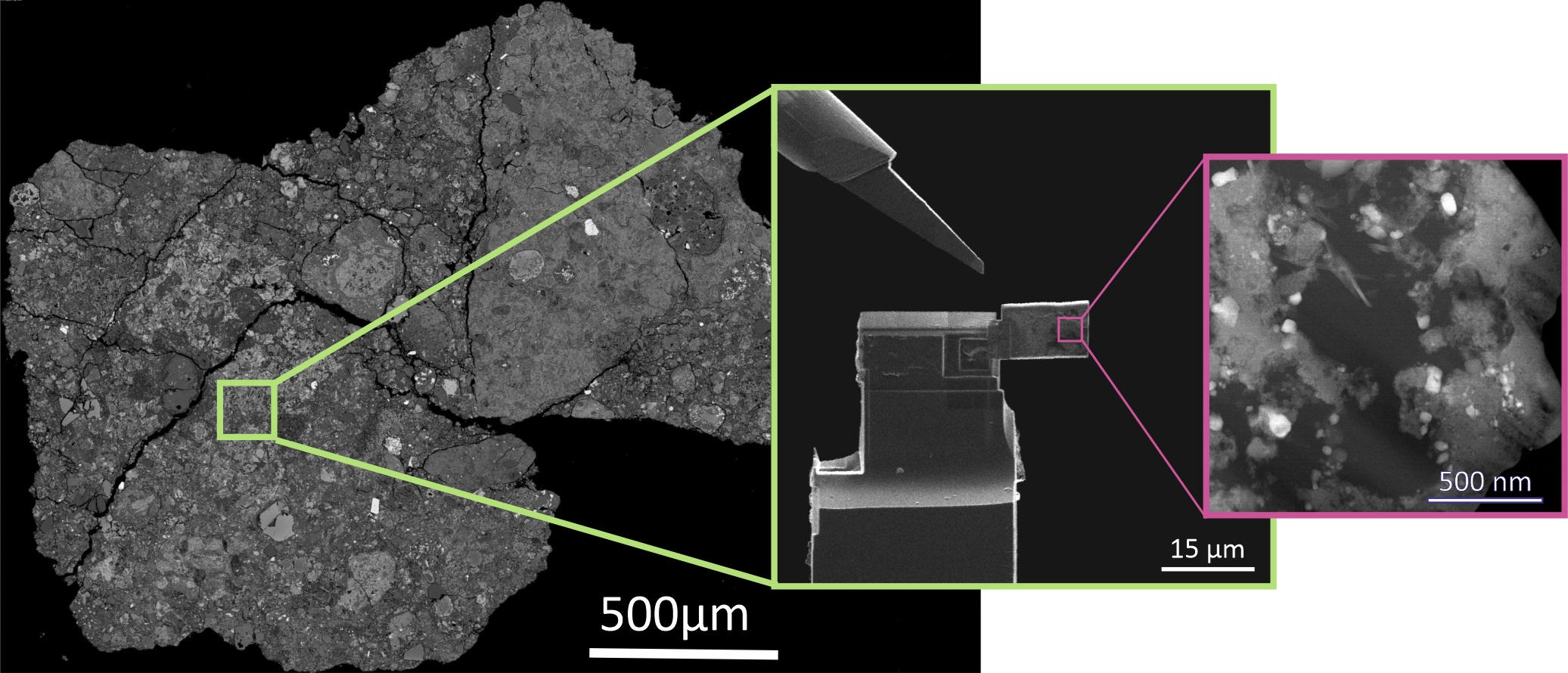
    Nanomanipulator and an Ultra Fine Ion Beam
    Using a nanomanipulator and an ultra-fine ion beam, a tiny lamella, about five by ten micrometres in size and only one hundred nanometres thin, is cut out of the meteorite and attached to a sample bar. The scientists can then analyze the organic particles in this lamella under an electron microscope (right). Credit: SuperSTEM Laboratory, Daresbury, UK

    Origins of Life and Advanced Research Techniques

    The origins of life on our planet are still shrouded in mystery, and some researchers assume that the first biologically relevant matter was transported to Earth in meteorites over four billion years ago. This matter includes for example complex organic compounds such as amino acids or hydrocarbons. However, these molecules have only very low concentrations, and the experts generally have to separate them out from the meteorite by using solvents or acids and then enrich them for analytical purposes.

    Christian Vollmer’s team was now the first to be able to demonstrate the existence of these biologically relevant nitrogen compounds in the Winchcombe meteorite without first treating them chemically – although here too the concentrations of these substances are very low.

    In their work, the researchers used a modern, high-resolution electron microscope such as is found at only a few locations worldwide. This “super-microscope” at the SuperSTEM laboratory in Daresbury in England not only depicts high-carbon compounds at atomic resolution – it can also analyze the samples chemically by means of a new type of detector.

    “Demonstrating the existence of these biologically relevant organic compounds in an untreated meteorite is a significant achievement for research,” says Vollmer. “It shows that these building blocks of life can be characterized in these cosmic sediments even without chemical extraction.” The development is also of great importance because chemical treatment includes the risk of these fragile substances being changed.

    This is why the analytical methods applied here to solid matter are potentially also valuable for research on small, extraterrestrial specimens brought back to Earth from space missions – such as the dust particles from asteroids recently brought back by the Japanese Space Agency (Hayabusa2) and NASA (OSIRIS-REx).

    Reference: “High-spatial resolution functional chemistry of nitrogen compounds in the observed UK meteorite fall Winchcombe” by Christian Vollmer, Demie Kepaptsoglou, Jan Leitner, Aleksander B. Mosberg, Khalil El Hajraoui, Ashley J. King, Charlotte L. Bays, Paul F. Schofield, Tohru Araki and Quentin M. Ramasse, 26 January 2024, Nature Communications.
    DOI: 10.1038/s41467-024-45064-x

    Never miss a breakthrough: Join the SciTechDaily newsletter.
    Follow us on Google and Google News.

    Meteorites Solar System Spectroscopy University of Münster
    Share. Facebook Twitter Pinterest LinkedIn Email Reddit

    Related Articles

    How Ancient Collisions Explain Current Planetary Orbits

    Dartboard or Doughnut? Iron Meteorites Reveal Shape of Our Infant Solar System

    When Giants Moved: Tracing Planetary Shifts That Formed the Moon

    The Far-Flung Origin of Life’s Building Blocks: Researchers Uncover “Completely Unexpected” Findings

    Complete Chaos: Scientists Unravel the Early History of the Solar System

    Earth and Mars Were Formed From Collisions of Large Bodies Made of Inner Solar System Material

    Analyzing Meteorites To Track Down the Forces That Shaped Our Solar System’s Evolution

    Sculpted by Starlight: An Unusual Meteorite Witness to the Solar System’s Birth

    Meteorites Show That Our Solar System Formed in Less Than 200,000 Years

    Leave A Reply Cancel Reply

    • Facebook
    • Twitter
    • Pinterest
    • YouTube

    Don't Miss a Discovery

    Subscribe for the Latest in Science & Tech!

    Trending News

    Mezcal “Worm” in a Bottle Mystery: DNA Testing Reveals a Surprise

    New Research Reveals That Your Morning Coffee Activates an Ancient Longevity Switch

    This Is What Makes You Irresistible to Mosquitoes

    Shockingly Powerful Giant Octopuses Ruled the Seas 100 Million Years Ago

    Scientists Stunned by New Organic Molecules Found on Mars

    Rewriting Dinosaur Evolution: Scientists Unearth Remarkable 150-Million-Year-Old Stegosaur Skull

    Omega-3 Supplements Linked to Cognitive Decline in Surprising New Study

    First-of-Its-Kind Discovery: Homer’s Iliad Found Embedded in a 1,600-Year-Old Egyptian Mummy

    Follow SciTechDaily
    • Facebook
    • Twitter
    • YouTube
    • Pinterest
    • Newsletter
    • RSS
    SciTech News
    • Biology News
    • Chemistry News
    • Earth News
    • Health News
    • Physics News
    • Science News
    • Space News
    • Technology News
    Recent Posts
    • Male Birth Control Breakthrough: Scientists Find Way To Turn Sperm Production Off and Back On
    • A Common Vitamin Could Hold the Key to Treating Fatty Liver Disease
    • New Research Shows Vitamin B12 May Hold the Key to Healthy Aging
    • Scientists Map Thousands of Brain Connections With RNA Barcodes
    • This Gene Tweak Turns Strawberries Into Healthier, Tastier Superfruit
    Copyright © 1998 - 2026 SciTechDaily. All Rights Reserved.
    • Science News
    • About
    • Contact
    • Editorial Board
    • Privacy Policy
    • Terms of Use

    Type above and press Enter to search. Press Esc to cancel.