
Close Menu
    Facebook X (Twitter) Instagram
    SciTechDaily
    • Biology
    • Chemistry
    • Earth
    • Health
    • Physics
    • Science
    • Space
    • Technology
    Facebook X (Twitter) Pinterest YouTube RSS
    SciTechDaily
    Home»Space»Dawn Captures New Images of Ceres Bright Spots
    Space

    Dawn Captures New Images of Ceres Bright Spots

    By Elizabeth Landau, Jet Propulsion LaboratoryMay 21, 2015No Comments2 Mins Read
    Facebook Twitter Pinterest Telegram LinkedIn WhatsApp Email Reddit
    Share
    Facebook Twitter LinkedIn Pinterest Telegram Email Reddit
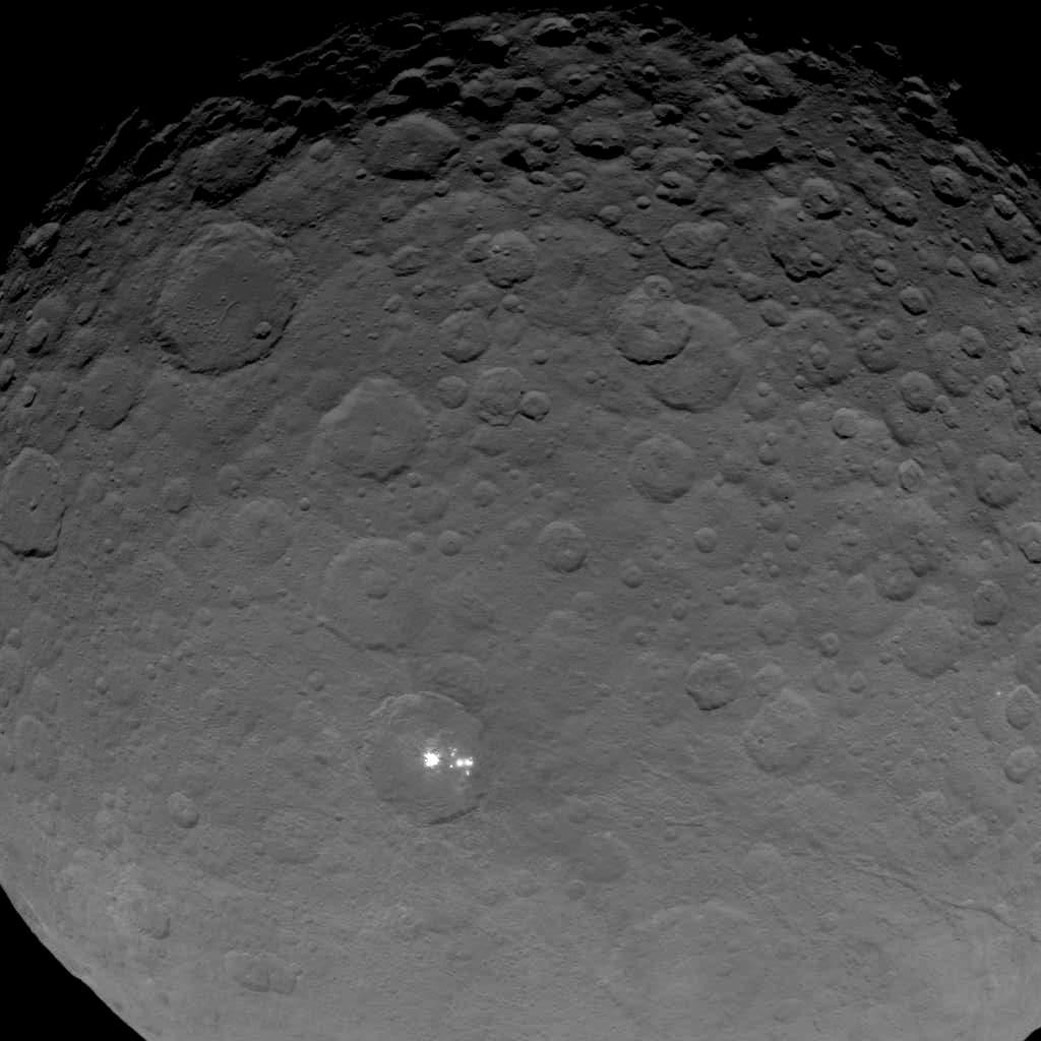
    A Closer Look at Ceres Bright Spots
    This image of Ceres is part of a sequence taken by NASA’s Dawn spacecraft on May 16, 2015, from a distance of 4,500 miles (7,200 kilometers). Credit: NASA/JPL-Caltech/UCLA/MPS/DLR/IDA

    New images from NASA’s Dawn spacecraft show the closest view to date of the mysterious bright spots on Ceres.

    NASA’s Dawn mission captured a sequence of images, taken for navigation purposes, of the dwarf planet Ceres on May 16, 2015. The image showcases the group of the brightest spots on Ceres, which continue to mystify scientists. It was taken from a distance of 4,500 miles (7,200 kilometers) and has a resolution of 2,250 feet (700 meters) per pixel.

    “Dawn scientists can now conclude that the intense brightness of these spots is due to the reflection of sunlight by highly reflective material on the surface, possibly ice,” Christopher Russell, principal investigator for the Dawn mission from the University of California, Los Angeles, said recently.

    Dawn arrived at Ceres on March 6, marking the first time a spacecraft has orbited a dwarf planet. Previously, the spacecraft explored the giant asteroid Vesta for 14 months from 2011 to 2012. Dawn has the distinction of being the only spacecraft to orbit two extraterrestrial targets.

    The spacecraft has been using its ion propulsion system to maneuver to its second mapping orbit at Ceres, which it will reach on June 6. The spacecraft will remain at a distance of 2,700 miles (4,400 kilometers) from the dwarf planet until June 30. Afterward, it will make its way to lower orbits.

    Dawn’s mission is managed by NASA’s Jet Propulsion Laboratory, Pasadena, California, for NASA’s Science Mission Directorate in Washington. Dawn is a project of the directorate’s Discovery Program, managed by NASA’s Marshall Space Flight Center in Huntsville, Alabama. UCLA is responsible for overall Dawn mission science. Orbital ATK, Inc., in Dulles, Virginia, designed and built the spacecraft. The German Aerospace Center, the Max Planck Institute for Solar System Research, the Italian Space Agency and the Italian National Astrophysical Institute are international partners on the mission team.

    Never miss a breakthrough: Join the SciTechDaily newsletter.
    Follow us on Google and Google News.

    Astronomy Ceres Dawn Spacecraft Planetary Science
    Share. Facebook Twitter Pinterest LinkedIn Email Reddit

    Related Articles

    New Fly Over Video Shows a Unique Perspective of Ceres

    A New View of Ceres, Dawn Shows Finer Detail

    New Images by NASA’s Dawn Spacecraft Show Mysterious Bright Spots on Ceres

    New Color Map of Ceres Reveals Surface Diversity

    NASA’s Dawn Spacecraft Achieves Orbit Around Ceres

    Dawn Spacecraft Shows Crater Shapes on Ceres’ Surface

    NASA’s Dawn Captures Sharper Images of Ceres

    Dawn Spacecraft Captures Best-Ever View of Ceres

    NASA’s Dawn Spacecraft Closes in on Ceres, Delivers New Images

    Leave A Reply Cancel Reply

    • Facebook
    • Twitter
    • Pinterest
    • YouTube

    Don't Miss a Discovery

    Subscribe for the Latest in Science & Tech!

    Trending News

    These Toads Are Surviving a Deadly Fungus – Scientists May Finally Know Why

    These Brain Cells May Explain Why We Eventually Have To Sleep

    Tomatoes Contain an Invisible Ingredient With Surprising Effects on Liver Health

    World’s First Heat-Powered Cooling System Turns Waste Heat Into Cold

    Antarctica Gained a Record 695 Billion Tons of Ice in Just Two Years

    Don’t Miss: A Brilliant Venus and Glowing Harvest Moon Light Up the Sky

    New Twist on the Einstein Problem Reveals Unexpected Physics

    JWST Captures Stunning Evidence of How Supermassive Black Holes Feed

    Follow SciTechDaily
    • Facebook
    • Twitter
    • YouTube
    • Pinterest
    • Newsletter
    • RSS
    SciTech News
    • Biology News
    • Chemistry News
    • Earth News
    • Health News
    • Physics News
    • Science News
    • Space News
    • Technology News
    Recent Posts
    • Scientists Discover the 7 Stages a Meteoroid Goes Through Before Hitting Earth
    • Scientists Bring a Galápagos Plant Back From the Brink of Extinction
    • Scientists Discover a Bacterial Molecule That “Disarms” a Dangerous Fungus
    • Bats May Hold the Secret to Fighting Aging, Cancer, and Infection
    • Scientists Discover a Hidden Defect That Could Explain Why IBD Keeps Coming Back
    Copyright © 1998 - 2026 SciTechDaily. All Rights Reserved.
    • Science News
    • About
    • Contact
    • Editorial Board
    • Privacy Policy
    • Terms of Use

    Type above and press Enter to search. Press Esc to cancel.