
Close Menu
    Facebook X (Twitter) Instagram
    SciTechDaily
    • Biology
    • Chemistry
    • Earth
    • Health
    • Physics
    • Science
    • Space
    • Technology
    Facebook X (Twitter) Pinterest YouTube RSS
    SciTechDaily
    Home»Space»Advanced Radar Captures ERS-2 Satellite Buckling and Bending During Re-Entry
    Space

    Advanced Radar Captures ERS-2 Satellite Buckling and Bending During Re-Entry

    By European Space Agency (ESA)March 3, 2024No Comments2 Mins Read
    Facebook Twitter Pinterest Telegram LinkedIn WhatsApp Email Reddit
    Share
    Facebook Twitter LinkedIn Pinterest Telegram Email Reddit
    ERS-2 Buckles and Bends During Final Farewell
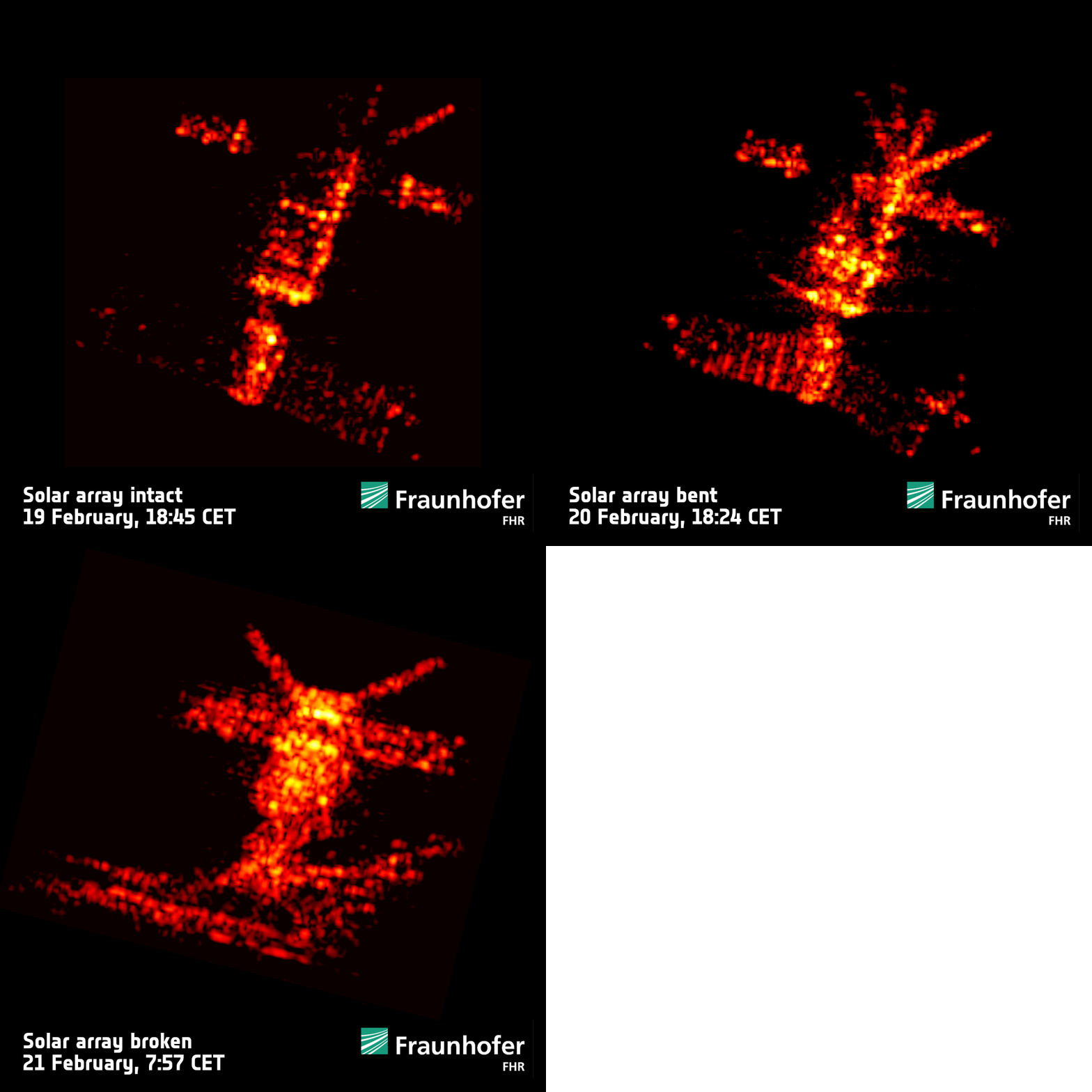
    Fraunhofer FHR’s radar tracking of ESA’s ERS-2 satellite revealed crucial structural changes before re-entry, enhancing understanding of satellite disintegration and aiding in more accurate future predictions. Credit: Fraunhofer FHR

    ESA’s ERS-2 satellite successfully reentered Earth’s atmosphere after nearly 30 years in orbit, with its final moments tracked by Germany’s Fraunhofer Institute. The unexpected detachment of its solar array provided crucial data for improving satellite reentry predictions.

    Following a hugely successful mission and almost 30 years in orbit, ESA’s ERS-2 reentered Earth’s atmosphere at approximately 18:17 CET (17:17 UTC) on February 21, 2024.

    Predicting the exact time and location of ERS-2’s natural reentry was made more difficult by the lack of new observations of the satellite during its final revolutions around Earth.

    Tracking ERS-2’s Final Moments

    This GIF combines some of the final images of ERS-2 tumbling through the sky. They were captured by the Tracking and Imaging Radar (TIRA) at the Fraunhofer Institute for High Frequency Physics and Radar Techniques FHR in Germany.

    TIRA’s 34-m antenna tracked the satellite as it passed overhead for a few minutes on each of February 19, 20, and 21. The final session took place around 8:00 CET on February 21, still roughly 10 orbits before reentry.
    ERS-2 Reentry
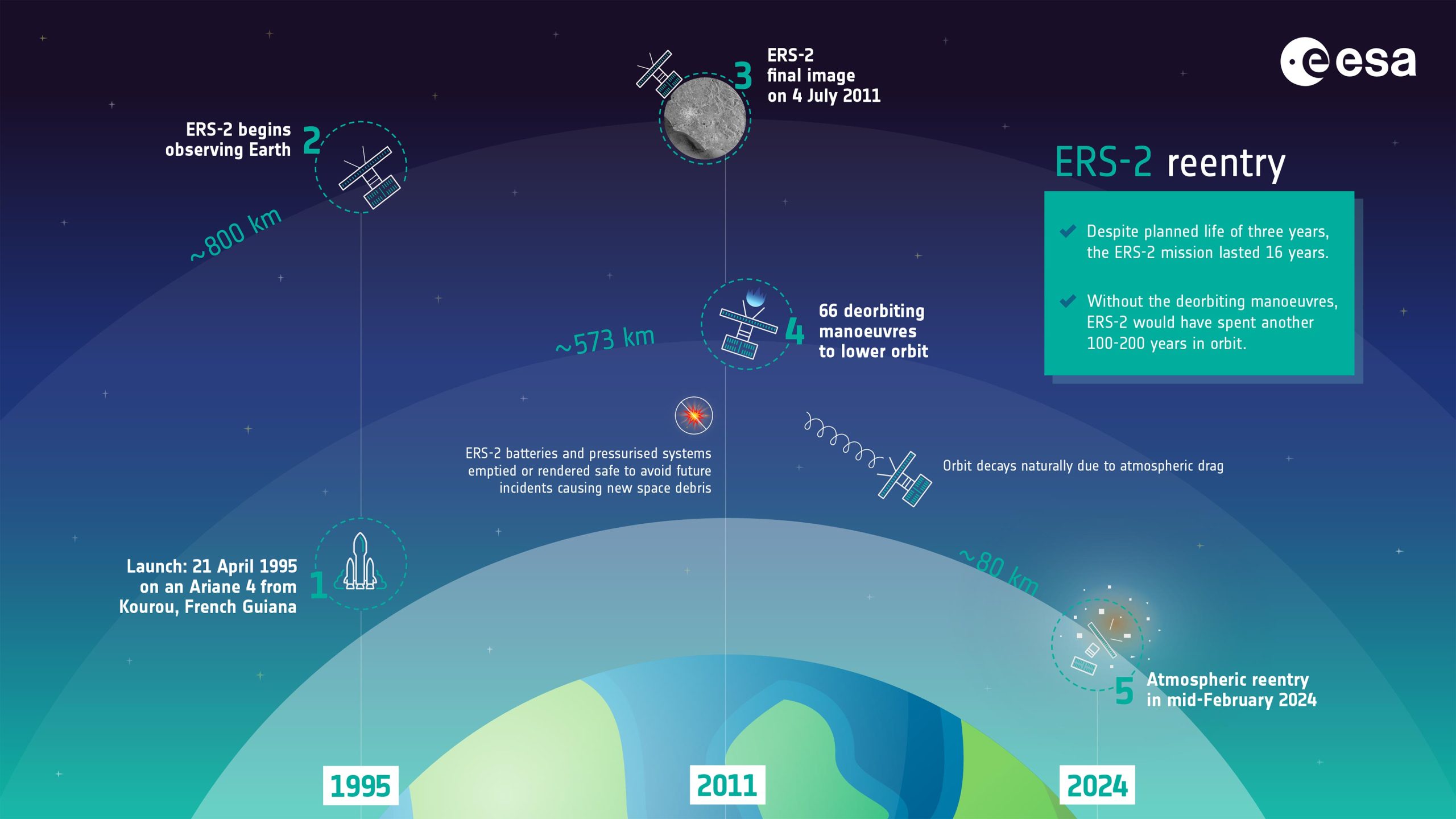
    ERS-2 reentry – how and why is it happening? Credit: ESA

    Analyzing ERS-2’s Solar Array Detachment

    By comparing the images from the three TIRA tracking sessions, we can see that ERS-2’s solar array was already coming loose and no longer firmly attached to the rest of the satellite the day before re-entry.

    When predicting a satellite’s reentry trajectory, experts treat it as one rigid object until almost the very end. If ERS-2’s solar array was loose and moving independently a day early, it may have caused the satellite to interact with the atmosphere in ways we did not expect.

    Experts are now analyzing the data. If the buckling of the solar array is related to the fact that ERS-2’s reentry took place slightly later than predicted, this research could help improve our forecasts of future natural reentries.

    ESA thanks Fraunhofer Institute for High Frequency Physics and Radar Techniques FHR for providing measurements of their space observation radar TIRA, in close collaboration with the German Space Situational Awareness Center, GSSAC.

    The color in these images represents radar echo intensity and not temperature.

    Never miss a breakthrough: Join the SciTechDaily newsletter.
    Follow us on Google and Google News.

    European Space Agency Space Debris
    Share. Facebook Twitter Pinterest LinkedIn Email Reddit

    Related Articles

    Aeolus’ Fiery Demise: The Blaze of Glory That Lights the Path to Space Safety

    Swarm Spacecraft Dodges Collision With Space Junk During Climb To Escape Sun’s Wrath

    Protecting Modern Life: New Laser Station Lights the Way To Space Debris Reduction

    ESA’s Solar Orbiter Spacecraft Is Skimming Earth for a Gravity Assist – And It’s One of the Riskiest Planetary Flybys Ever

    Drive to Destruction: Simulating Burn-Up During Atmospheric Reentry

    Space Debris: It’s Time to Act

    Dodging Debris to Keep Satellites Safe

    Space Debris Danger to Satellites: Over 129 Million Objects in Orbit Around the Earth [Video]

    Space Debris Threatens Our Continued Use of Near-Earth Space for the Benefit of Humankind

    Leave A Reply Cancel Reply

    • Facebook
    • Twitter
    • Pinterest
    • YouTube

    Don't Miss a Discovery

    Subscribe for the Latest in Science & Tech!

    Trending News

    Scientists May Have Discovered How To Heal Damaged Kidneys

    Interstellar Visitor 3I/ATLAS Is Bursting With an Unexpected Chemical

    Scientists Just Found All 5 Genetic “Letters” of DNA and RNA on an Asteroid

    The 4,000-Year-Old City That Defied History’s Rules on Wealth and Power

    The World’s Biggest Population Fear Has Flipped – and It Could Change Everything

    This “Fake” Pill Improved Memory and Physical Performance in Just 3 Weeks

    Scientists Say Frequent Ejaculation May Improve Sperm Quality and Fertility

    Scientists Have Found “The Heaven Sword” After Years of Looking

    Follow SciTechDaily
    • Facebook
    • Twitter
    • YouTube
    • Pinterest
    • Newsletter
    • RSS
    SciTech News
    • Biology News
    • Chemistry News
    • Earth News
    • Health News
    • Physics News
    • Science News
    • Space News
    • Technology News
    Recent Posts
    • A Giant Scorpion the Size of a Coffee Table Is Forcing Scientists To Rethink Evolution
    • Science Debunks a Common Belief About Pets and Stress
    • The Surprising Reason Sugary Gum Helped Lower Blood Pressure
    • Hidden Virus May Have Infected 9.4 Million People – Scientists Say We’ve Missed Most Cases
    • NASA’s Lucy Uncovers Ancient Water Clues on a Weirdly Wobbling Asteroid
    Copyright © 1998 - 2026 SciTechDaily. All Rights Reserved.
    • Science News
    • About
    • Contact
    • Editorial Board
    • Privacy Policy
    • Terms of Use

    Type above and press Enter to search. Press Esc to cancel.