
Close Menu
    Facebook X (Twitter) Instagram
    SciTechDaily
    • Biology
    • Chemistry
    • Earth
    • Health
    • Physics
    • Science
    • Space
    • Technology
    Facebook X (Twitter) Pinterest YouTube RSS
    SciTechDaily
    Home»Earth»Exploring the Geothermal Mysteries Under Nemrut’s Snow-Capped Surface
    Earth

    Exploring the Geothermal Mysteries Under Nemrut’s Snow-Capped Surface

    By NASA Earth ObservatoryMarch 1, 2024No Comments2 Mins Read
    Facebook Twitter Pinterest Telegram LinkedIn WhatsApp Email Reddit
    Share
    Facebook Twitter LinkedIn Pinterest Telegram Email Reddit
    Nemrut Volcano From Space Annotated
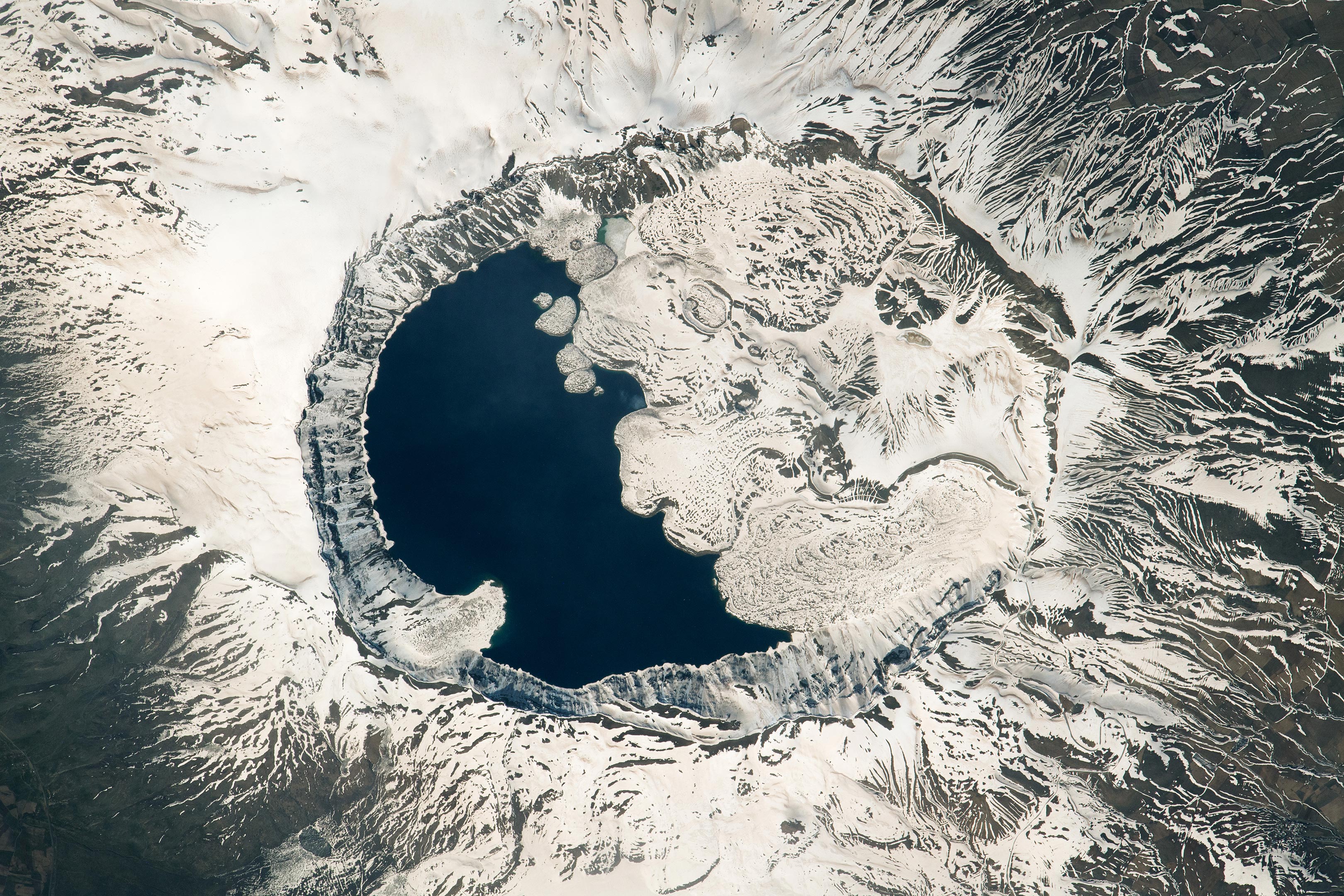
    Astronaut photo of the snow-covered caldera of the Nemrut volcano in eastern Türkiye captured on April 17, 2022, by an astronaut aboard the International Space Station.

    Lakes and lava flows fill the depression atop this geologically young stratovolcano in eastern Türkiye.

    An astronaut aboard the International Space Station captured this photo of the snow-covered caldera of the Nemrut volcano in eastern Türkiye, along the western shore of Lake Van. Mount Nemrut (Nemrut Daği) is a geologically young stratovolcano and last erupted in 1650 C.E.

    The eastern half of the caldera is partially filled by solidified lava flows from past eruptions. Snow cover present at the time of this photo accentuates pressure ridges that formed as the lava was flowing and cooling. These pressure ridges vary in size, thickness, and orientation due to the varying viscosity and flow direction of the lavas during eruptions.

    Lake Nemrut (Nemrut Gölü) occupies the western half of the caldera, creating a rough crescent shape that partially submerges the old lava flows. This freshwater lake, reaching up to 176 meters deep, is accompanied by a smaller lake at the upper center of the caldera. This lake is fed by hot springs, which indicates ongoing geothermal activity beneath the caldera.

    Astronaut photograph ISS069-E-16350 was acquired on April 17, 2022, with a Nikon D5 digital camera using a focal length of 1150 millimeters. The image was provided by the ISS Crew Earth Observations Facility and the Earth Science and Remote Sensing Unit at Johnson Space Center. The image was taken by a member of the Expedition 67 crew. It has been cropped and enhanced to improve contrast, and lens artifacts have been removed. The International Space Station Program supports the laboratory as part of the ISS National Lab to help astronauts take pictures of Earth that will be of the greatest value to scientists and the public and to make those images freely available on the Internet. Additional images taken by astronauts and cosmonauts can be viewed at the NASA/JSC Gateway to Astronaut Photography of Earth. Caption by Amber Turner/Jacobs-JETS II Contract at NASA-JSC.

    Never miss a breakthrough: Join the SciTechDaily newsletter.
    Follow us on Google and Google News.

    Geography NASA NASA Earth Observatory Volcano
    Share. Facebook Twitter Pinterest LinkedIn Email Reddit

    Related Articles

    Island Obliterated: Dramatic Changes at Hunga Tonga-Hunga Ha’apai

    Hunga Tonga Island Obliterated – NASA Satellites Capture Massive Blast

    A Wolf Awakens in the Galápagos Islands at Night

    A Deadly Day on Mount Semeru: Destructive Rivers of Debris on Indonesian Volcano

    Wall of Lava Burns a Path Through La Palma

    Cumbre Vieja Lights Up the Night – Astronaut Photo Captures Volcanic Eruption From Space

    Socked in Stratovolcano: Astronaut on ISS Captures Incredible View of Uninhabited Atlasov Island

    Kilauea’s Lava Lake Returns – Hawaii’s Most Active Volcano Is Erupting Again

    Newberry Volcano Photographed by Astronaut Onboard the International Space Station

    Leave A Reply Cancel Reply

    • Facebook
    • Twitter
    • Pinterest
    • YouTube

    Don't Miss a Discovery

    Subscribe for the Latest in Science & Tech!

    Trending News

    Study Finds Natural Dairy Trans Fats Behave Very Differently From Industrial Fats

    Your Voice May Reveal How Fast Your Brain Is Aging

    These Fingernail-Sized Animals Are Moving Astonishing Amounts of California Beach Sand

    NASA’s Perseverance Rover Finds Mars Had a Far More Complicated Water History Than Expected

    Why Do Muscles Weaken With Age? Scientists May Have Found an Important Missing Piece

    Cancer’s “Obesity Paradox” May Have a Surprising Explanation

    Engineers Have Created the World’s First Floating Titanium

    More Than 1 in 3 Adults Had High Blood Pressure – Most Didn’t Know It

    Follow SciTechDaily
    • Facebook
    • Twitter
    • YouTube
    • Pinterest
    • Newsletter
    • RSS
    SciTech News
    • Biology News
    • Chemistry News
    • Earth News
    • Health News
    • Physics News
    • Science News
    • Space News
    • Technology News
    Recent Posts
    • A Strange New Material Breaks the Usual Rules of Heat and Stiffness
    • Scientists Detect a Major Shift Beneath the Sun’s Surface
    • James Webb Telescope Detects the Fingerprints of Catastrophic Planetary Collisions
    • Aging Cells May Be Hiding From the Immune System – Scientists Think They Know How
    • Night Owls Were 70% More Likely To Leave Work on Disability, 12-Year Study Finds
    Copyright © 1998 - 2026 SciTechDaily. All Rights Reserved.
    • Science News
    • About
    • Contact
    • Editorial Board
    • Privacy Policy
    • Terms of Use

    Type above and press Enter to search. Press Esc to cancel.