
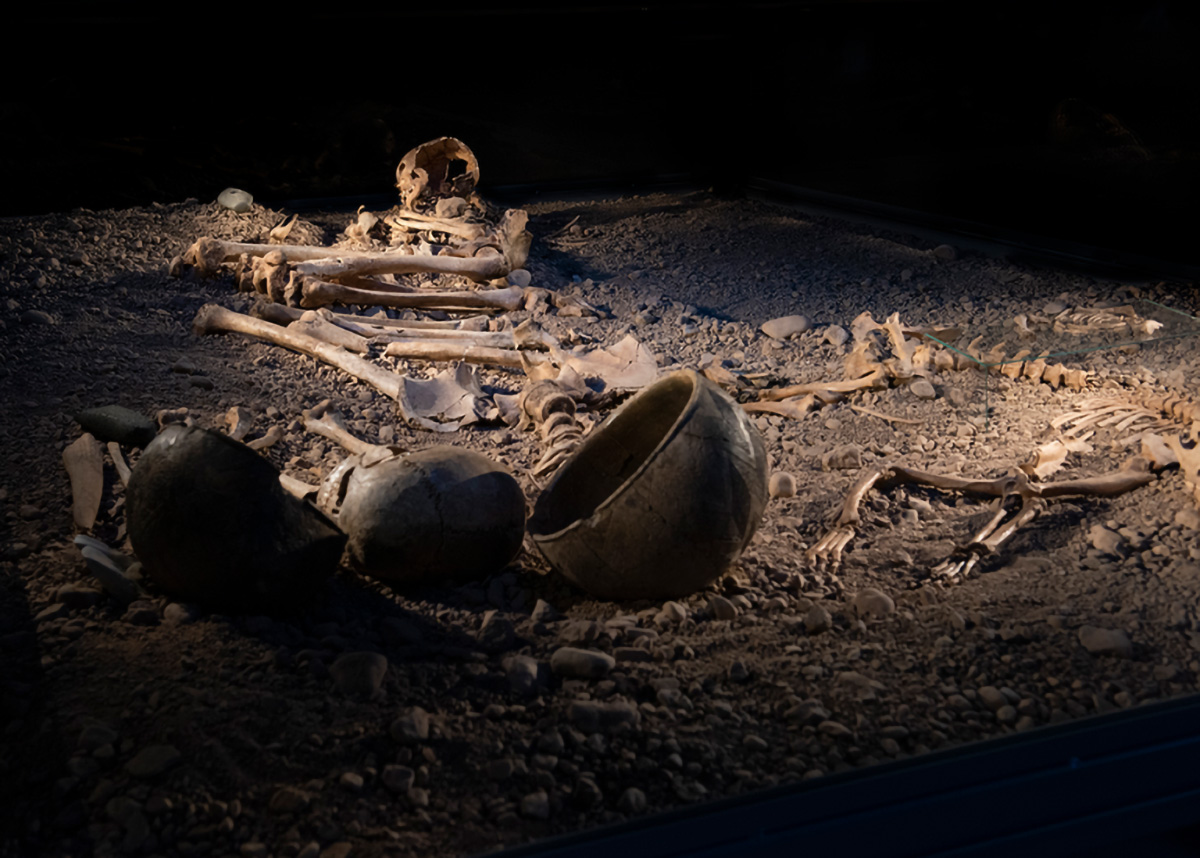
Bacterial poisoning via food and water – but also via contact such as kisses – caused a lot of suffering during the Stone Age. A recent study indicates that diseases that today can be treated with antibiotics were then fatal.
People living close together and not having access to antibiotics sound like a nightmare. Yet, this is how we spent much of our history and prehistory. A new international study coordinated from the Centre for Palaeogenetics in Stockholm explores microbes during the Stone Age in Scandinavia.
Different types of microbes are described, both the kind of microbes which are expected in a healthy person, but also several that must have caused pain and problems: Neisseria meningitidis that spreads through close contact between humans – for example when kissing, Yersinia entrecolitica that is often picked up from contaminated food and water, and Salmonella enterica that is a common cause of today’s food poisonings.
“Especially the case of Salmonella enterica shows us how difficult it could be. In a Battle Axe culture burial, Bergsgraven in Linköping, we find two infected individuals, and it is actually possible that we are witnessing their cause of death,” says Nora Bergfeldt at the Department of Zoology, Stockholm University who is conducting her research on bacterial diseases in prehistoric societies.
“This, and other bacterial diseases we have found among the individuals, are easily treated with antibiotics today, but back then they could be lethal.”
38 individuals screened for microbes
In the study, 38 individuals from farmer contexts as well as from hunter-gatherer contexts have been screened for microbes. Material from Hummerviksholmen in southern Norway (9500 years old) to Bergsgraven in Linköping, Sweden (4500 years old) was investigated. Microbes such as bacteria, and some viruses, have their genetic material organized in DNA, just as we humans do.
This is why such microbial DNA can be found in the remains of infected humans. It is this type of microbial DNA the scientists have used to trace bacterial diseases during the Scandinavian Stone Age. Especially the transition from a hunting-gathering lifestyle to a farming one is interesting, as it may be reflected in the bacterial diseases.
“We know when people turned to farming in Scandinavia but we still do not know how this change in lifestyle affected the general health,” says Helena Malmström at the Human Evolution Program, Uppsala University. She has focused much of her research on the lifestyle transition during the Stone Age.
“The more people interacted more possibilities to infect one another occurred. But even if we do encounter bacteria with potential to impact societies such as Yersinia pestis, it is the infections that spread through food that is most prominent across the lifestyles in this study,” says Anders Götherström, who is heading the research project in which this study was conducted. And he sees potential in the research field: “It is amazing for us to be able to start to look into a part of prehistoric societies that has not been possible to research till now.”
Reference: “Identification of microbial pathogens in Neolithic Scandinavian humans” by Nora Bergfeldt, Emrah Kırdök, Nikolay Oskolkov, Claudio Mirabello, Per Unneberg, Helena Malmström, Magdalena Fraser, Federico Sanchez-Quinto, Roger Jorgensen, Birgitte Skar, Kerstin Lidén, Mattias Jakobsson, Jan Storå and Anders Götherström, 7 March 2024, Scientific Reports.
DOI: 10.1038/s41598-024-56096-0
Never miss a breakthrough: Join the SciTechDaily newsletter.
Follow us on Google and Google News.
2 Comments
So…antibiotics are good, right?
FJB
When used properly, yes.