
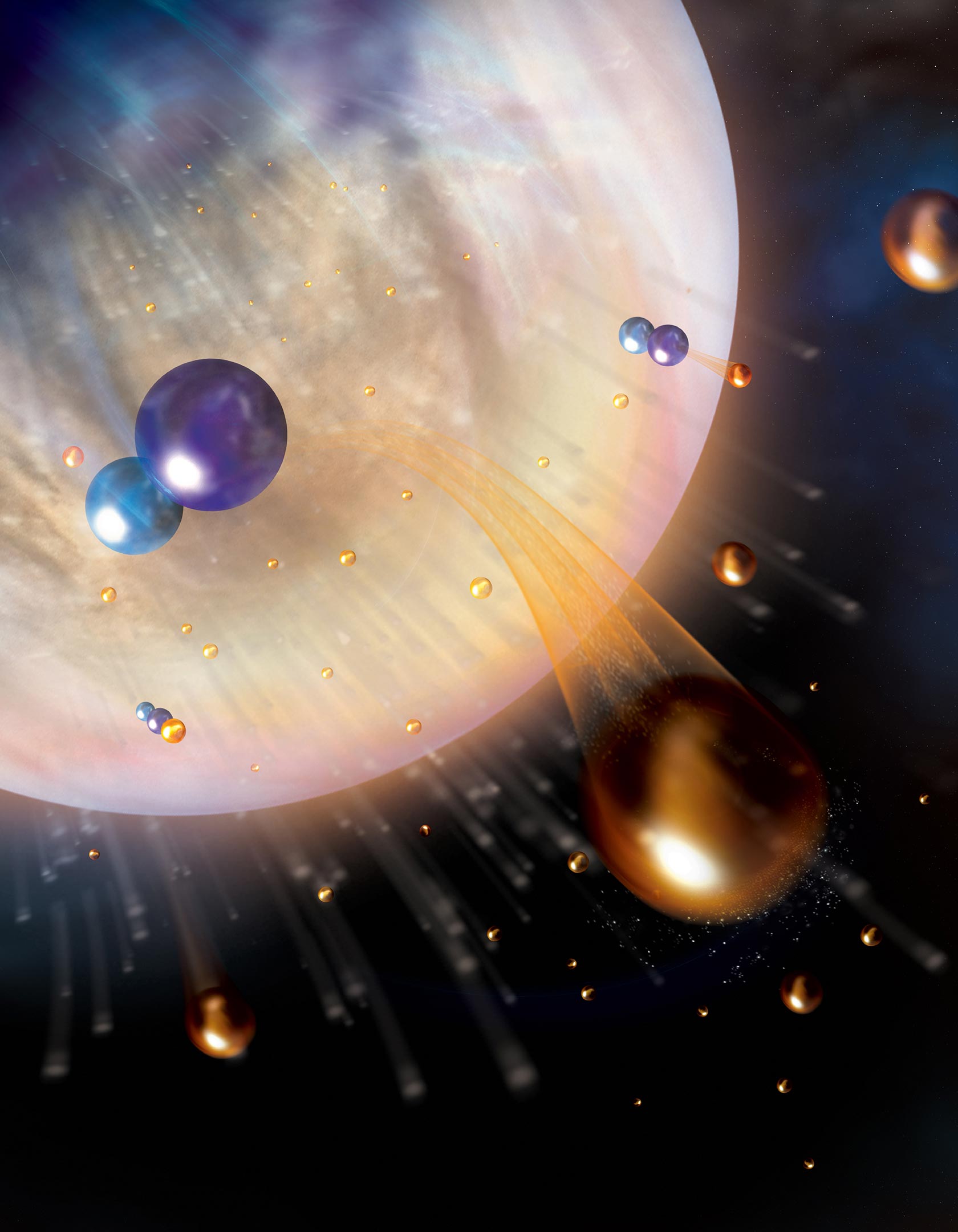
Researchers have discovered that Venus loses significantly more water than previously thought due to a process called “dissociative recombination,” where hydrogen atoms escape into space.
Planetary scientists at the University of Colorado Boulder have discovered how Venus, Earth’s scalding and uninhabitable neighbor, became so dry.
The new study fills in a big gap in what the researchers call “the water story on Venus.” Using computer simulations, the team found that hydrogen atoms in the planet’s atmosphere go whizzing into space through a process known as “dissociative recombination”—causing Venus to lose roughly twice as much water every day compared to previous estimates.
The team published their findings May 6 in the journal Nature.
The results could help to explain what happens to water in a host of planets across the galaxy.
“Water is really important for life,” said Eryn Cangi, a research scientist at the Laboratory for Atmospheric and Space Physics (LASP) and co-lead author of the new paper. “We need to understand the conditions that support liquid water in the universe, and that may have produced the very dry state of Venus today.”
Venus, she added, is positively parched. If you took all the water on Earth and spread it over the planet like jam on toast, you’d get a liquid layer roughly 3 kilometers (1.9 miles) deep. If you did the same thing on Venus, where all the water is trapped in the air, you’d wind up with only 3 centimeters (1.2 inches), barely enough to get your toes wet.
“Venus has 100,000 times less water than the Earth, even though it’s basically the same size and mass,” said Michael Chaffin, co-lead author of the study and a research scientist at LASP.
In the current study, the researchers used computer models to understand Venus as a gigantic chemistry laboratory, zooming in on the diverse reactions that occur in the planet’s swirling atmosphere. The group reports that a molecule called HCO+ (an ion made up of one atom each of hydrogen, carbon and oxygen) high in Venus’ atmosphere may be the culprit behind the planet’s escaping water.
For Cangi, co-lead author of the research, the findings reveal new hints about why Venus, which probably once looked almost identical to Earth, is all but unrecognizable today.
“We’re trying to figure out what little changes occurred on each planet to drive them into these vastly different states,” said Cangi, who earned her doctorate in astrophysical and planetary sciences at CU Boulder in 2023.
Spilling the Water
Venus, she noted, wasn’t always such a desert.
Scientists suspect that billions of years ago during the formation of Venus, the planet received about as much water as Earth. At some point, catastrophe struck. Clouds of carbon dioxide in Venus’ atmosphere kicked off the most powerful greenhouse effect in the solar system, eventually raising temperatures at the surface to a roasting 900 degrees Fahrenheit. In the process, all of Venus’ water evaporated into steam, and most drifted away into space.
But that ancient evaporation can’t explain why Venus is as dry as it is today, or how it continues to lose water to space.
“As an analogy, say I dumped out the water in my water bottle. There would still be a few droplets left,” Chaffin said.
On Venus, however, almost all of those remaining drops also disappeared. The culprit, according to the new work, is elusive HCO+.
Missions to Venus
Chaffin and Cangi explained that in planetary upper atmospheres, water mixes with carbon dioxide to form this molecule. In previous research, the researchers reported that HCO+ may be responsible for Mars losing a big chunk of its water.
Here’s how it works on Venus: HCO+ is produced constantly in the atmosphere, but individual ions don’t survive for long. Electrons in the atmosphere find these ions, and recombine to split the ions in two. In the process, hydrogen atoms zip away and may even escape into space entirely—robbing Venus of one of the two components of water.
In the new study, the group calculated that the only way to explain Venus’ dry state was if the planet hosted larger than expected volumes of HCO+ in its atmosphere. There is one twist to the team’s findings. Scientists have never observed HCO+ around Venus. Chaffin and Cangi suggest that’s because they’ve never had the instruments to properly look.
While dozens of missions have visited Mars in recent decades, far fewer spacecraft have traveled to the second planet from the sun. None have carried instruments capable of detecting the HCO+ that powers the team’s newly discovered escape route.
“One of the surprising conclusions of this work is that HCO+ should actually be among the most abundant ions in the Venus atmosphere,” Chaffin said.
In recent years, however, a growing number of scientists have set their sights on Venus. NASA’s planned Deep Atmosphere Venus Investigation of Noble gases, Chemistry, and Imaging (DAVINCI) mission, for example, will drop a probe through the planet’s atmosphere all the way to the surface. It’s scheduled to launch by the end of the decade.
DAVINCI won’t be able to detect HCO+, either, but the researchers are hopeful that a future mission might—revealing another key piece of the story of water on Venus.
“There haven’t been many missions to Venus,” Cangi said. “But newly planned missions will leverage decades of collective experience and a flourishing interest in Venus to explore the extremes of planetary atmospheres, evolution, and habitability.”
Reference: “Venus water loss is dominated by HCO+ dissociative recombination” by M. S. Chaffin, E. M. Cangi, B. S. Gregory, R. V. Yelle, J. Deighan, R. D. Elliott and H. Gröller, 6 May 2024, Nature.
DOI: 10.1038/s41586-024-07261-y
Never miss a breakthrough: Join the SciTechDaily newsletter.
Follow us on Google and Google News.