
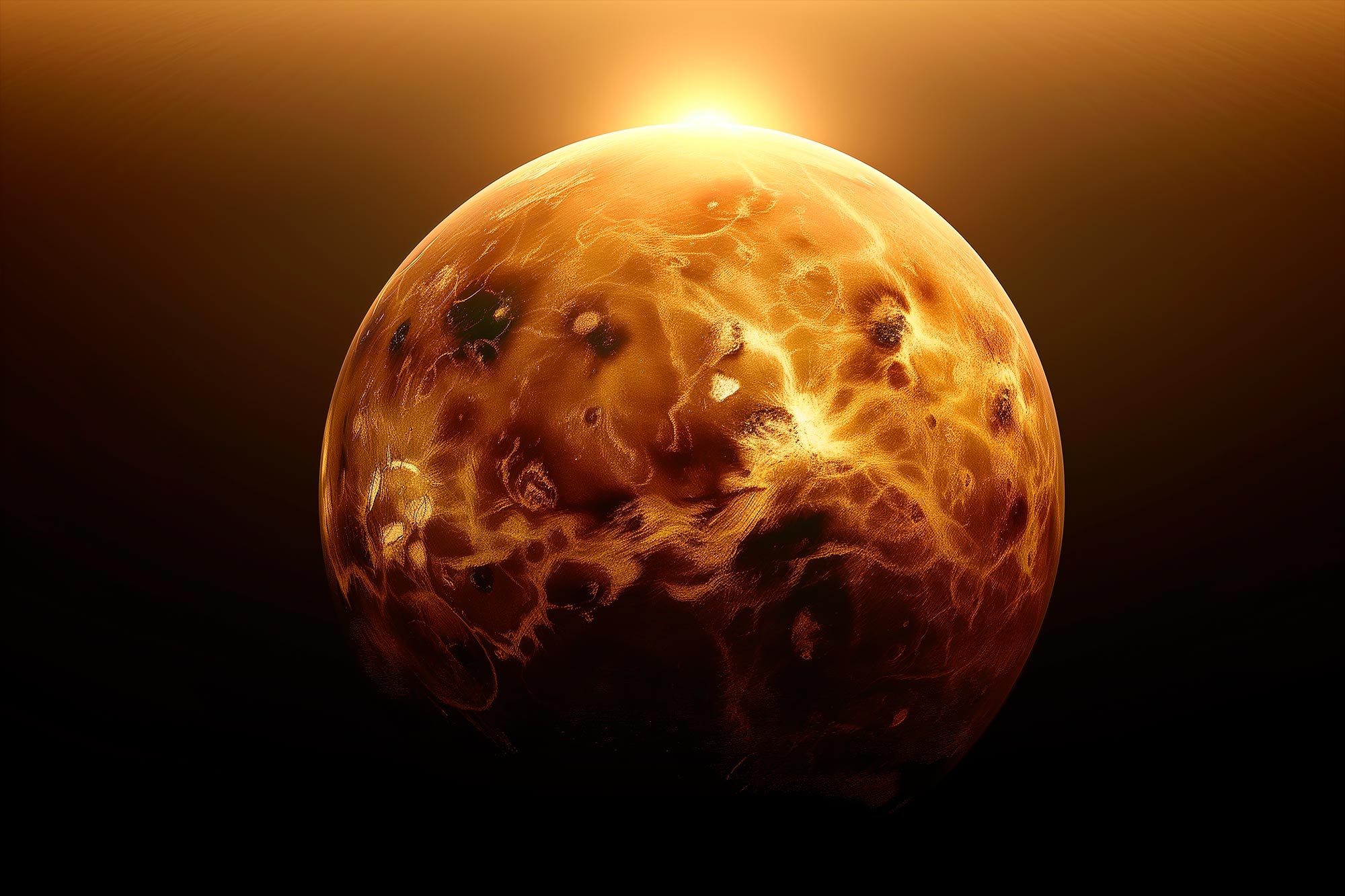
Recent findings from the Venus Express mission reveal unexpected water molecule concentrations in Venus’ atmosphere, suggesting it once harbored Earth-like water volumes.
The study explores how solar radiation has increased the HDO/H2O ratio, providing insights into Venus’ climatic history and its implications for planetary habitability.
Discovering Water Variants on Venus
Thanks to observations by the Solar Occultation in the Infrared (SOIR) instrument on the Venus Express space probe of the European Space Agency (ESA), researchers have discovered an unexpected increase in the abundances of two water molecule variants – H2O and HDO – and their ratio HDO/H2O in Venus’ mesosphere. This phenomenon challenges our understanding of Venus’ water history and the potential that it was once habitable in the past.
Venus: Earth’s Twin with a Twist
Currently, Venus is a dry, hostile planet. Venus has pressures nearly 100 times higher than Earth and temperatures around 460°C (860°F). Its atmosphere, covered by thick clouds of sulphuric acid and water droplets, is extremely dry. Most water is found below and within these cloud layers. However, Venus may have once supported just as much water as Earth.
“Venus is often called Earth’s twin due to its similar size,” remarks Hiroki Karyu, a researcher at Tohoku University, “Despite the similarities between the two planets, it has evolved differently. Unlike Earth, Venus has extreme surface conditions.”
Unraveling Venus’ Watery Past
Investigating the abundances of H2O and its deuterated counterpart HDO (isotopologues) reveals insights into Venus’ water history. It is generally accepted that Venus and Earth initially had a similar HDO/H2O ratio. However, the ratio observed in Venus’ bulk atmosphere (below 70 km) is 120 times higher, indicating significant deuterium enrichment over time.
This enrichment is primarily due to solar radiation breaking down water isotopologues in the upper atmosphere, producing hydrogen (H) and deuterium (D) atoms. Since H atoms escape into space more readily due to their lower mass, the HDO/H2O ratio gradually increases.
Mechanisms of Water Variation in Venus’ Atmosphere
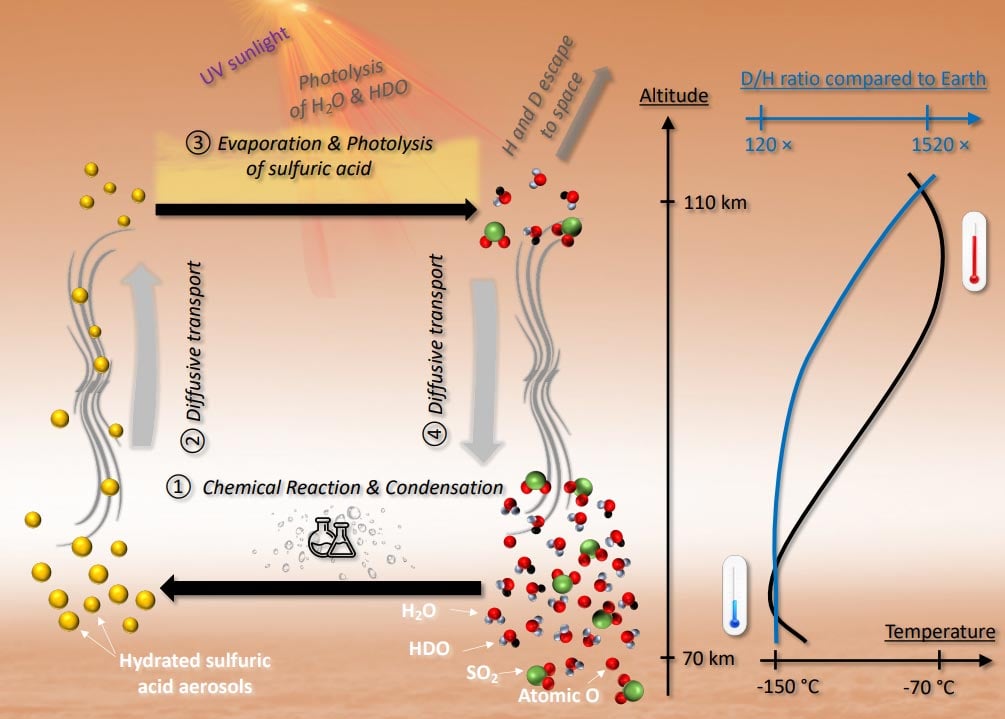
To figure out how much H and D are escaping into space, it is crucial to measure the water isotopologue amounts at heights where sunlight can break them down, which occurs above the clouds at altitudes larger than ~70 km. The study found two surprising results: the concentrations of H2O and HDO increase with altitude between 70 and 110 km, and the HDO/H2O ratio rises significantly by an order of magnitude over this range, reaching levels over 1500 times higher than in Earth’s oceans.
A proposed mechanism to explain these findings involves the behavior of hydrated sulphuric acid (H2SO4) aerosols. These aerosols form just above the clouds, where temperatures drop below the sulfurated water dew point, leading to the formation of deuterium-enriched aerosols. These particles rise to higher altitudes, where increased temperatures cause them to evaporate, releasing more significant fraction of HDO compared to H2O. The vapor then is transported downwards, restarting the cycle.
Implications for Planetary Habitability
The study emphasizes two key points. First, variations in altitude play a crucial role in locating the D and H reservoirs. Second, the increased HDO/H2O ratio ultimately increases deuterium release, impacting long-term evolution of the D/H ratio.
These findings encourage the incorporation of altitude-dependent processes into models to make accurate predictions about D/H evolution. Understanding the evolution of Venus’ habitability and water history will help us understand the factors that make a planet become inhabitable, so that we know how to avoid letting the Earth follow in its’ twin’s footsteps.
These results were published in the Proceedings of the National Academy of Sciences on August 12, 2024.
Reference: “Unexpected increase of the deuterium to hydrogen ratio in the Venus mesosphere” by Arnaud Mahieux, Sébastien Viscardy, Roger Vincent Yelle, Hiroki Karyu, Sarah Chamberlain, Séverine Robert, Arianna Piccialli, Loïc Trompet, Justin Tyler Erwin, Soma Ubukata, Hiromu Nakagawa, Shungo Koyama, Romain Maggiolo, Nuno Pereira, Gaël Cessateur, Yannick Willame and Ann Carine Vandaele, 12 August 2024, Proceedings of the National Academy of Sciences.
DOI: 10.1073/pnas.2401638121
Never miss a breakthrough: Join the SciTechDaily newsletter.
Follow us on Google and Google News.