
Close Menu
    Facebook X (Twitter) Instagram
    SciTechDaily
    • Biology
    • Chemistry
    • Earth
    • Health
    • Physics
    • Science
    • Space
    • Technology
    Facebook X (Twitter) Pinterest YouTube RSS
    SciTechDaily
    Home»Space»Harvard Astronomers Discover NEOs That Are Dormant, Short-Period Comets
    Space

    Harvard Astronomers Discover NEOs That Are Dormant, Short-Period Comets

    By Harvard-Smithsonian Center for AstrophysicsOctober 10, 2015No Comments3 Mins Read
    Facebook Twitter Pinterest Telegram LinkedIn WhatsApp Email Reddit
    Share
    Facebook Twitter LinkedIn Pinterest Telegram Email Reddit
    Researchers Discover NEOs That Are Dormant, Short-Period Comets
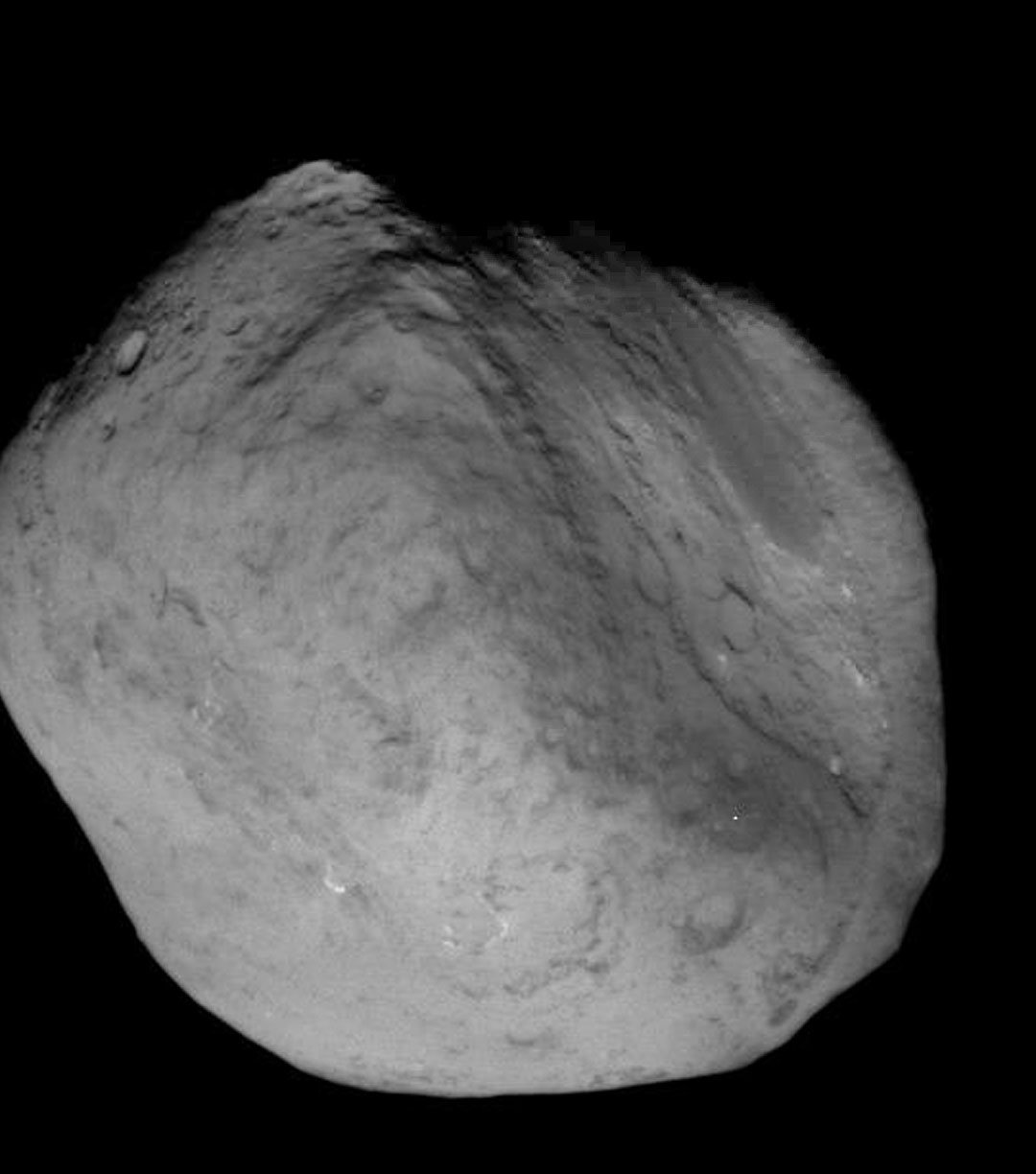
    An image of the asteroid Tempel 1 taken during the Deep Impact visit. Tempel 1 is about five kilometers across. NASA/JPL-Caltech/UMd

    In a new study, scientists from the Harvard-Smithsonian Center for Astrophysics reveal that between about 0.3 and 3% of the moderately bright NEOs are actually likely to be dormant, short-term period comets.

    Near Earth Objects (NEOs) are asteroids or comets whose orbits sometimes bring them close to the Earth, thereby posing a potential threat. The asteroid that struck Chelyabinsk last year was a NEO about 40 meters (130 feet) in diameter. While it is relatively easy to detect a NEO in visible light by watching its movement across the sky from night to night, determining its size and its potential hazard is more difficult because its optical brightness results from both its size and its reflectivity. CfA astronomers have for several years been using the IRAC infrared camera on Spitzer to measure the infrared light emitted by NEOs and, combined with optical measurements, to deduce their probable dimensions.

    NEOs are thought to originate from collisional fragments of objects in the asteroid belt beyond the orbit of Mars, with over 10,000 known today. Short–period comets can also be NEOs, but unlike asteroids, they most likely originated in the Kuiper belt, a reservoir of icy bodies outside the orbit of Neptune. The orbits of these bodies are disturbed as a result of gravitational perturbations with the giant planets, and some end up as NEOs, developing cometary tails when they approach the Sun and become active. After a while, their volatiles evaporate and these comets become dormant. As a result, it is very likely that the NEO population being studied includes a significant number of extinct comets.

    CfA astronomers Joe Hora, Giovanni Fazio, and Howard Smith, and their colleagues reported two years ago on the discovery that the NEO Don Quixote is actually an extinct comet – they were able to find its faint cometary tail in infrared images. Now they and their colleagues have completed a statistical analysis of the full near infrared catalog of NEOs, searching for possible short-period comets by using a combination of their orbital parameters and their surface albedos as inferred from their near infrared properties. The scientists found that between about 0.3 and 3% of the moderately bright NEOs are actually likely to be dormant, short-term period comets. They identify twenty-three specific ones as dormant comets. They also conclude that about one hundred large NEOs, with diameters larger than a kilometer, are probably also dormant short-period comets.

    Reference: “Explore NEOs VIII: Dormant Short-Period Comets in the Near-Earth Asteroid Population” by M. Mommert, A. W. Harris, M. Mueller, J. L. Hora, D. E. Trilling, W. F. Bottke, C. A. Thomas, M. Delbo, J. P. Emery, G. Fazio and H. A. Smith, 9 September 2015, The Astrophysical Journal.
    DOI: 10.1088/0004-6256/150/4/106
    arXiv: 1508.04116

    Never miss a breakthrough: Join the SciTechDaily newsletter.
    Follow us on Google and Google News.

    Astronomy Astrophysics Comet Harvard-Smithsonian Center for Astrophysics NEO
    Share. Facebook Twitter Pinterest LinkedIn Email Reddit

    Related Articles

    Interstellar Comets Like Borisov – Incredible Rogue Visitors or More Common Than We Think?

    What Really Killed the Dinosaurs? Harvard Researchers Say It Was a Comet – And They Believe They Know Where It Came From

    Comet-Like Activity Discovered in Near-Earth Object Don Quixote

    Two Planets Separated by Less Than 5 Earth Moon Distances

    Study Challenges Prevailing Ideas About How Supermassive Black Holes Grow

    Calculations Show the Ideal Time to Study the Cosmos

    Using Infrared Images from Hubble & Spitzer, Scientists Discover 25 Distant Galaxies

    Supernova Shock Wave Breaks Through a Cocoon of Gas

    Origins of Type Ia Supernovae

    Leave A Reply Cancel Reply

    • Facebook
    • Twitter
    • Pinterest
    • YouTube

    Don't Miss a Discovery

    Subscribe for the Latest in Science & Tech!

    Trending News

    This Experimental Drug Repaired the Gut and Reversed Severe Fatty Liver Disease

    Physicists Just Turned a Black Hole Energy Theory Into Reality

    Stanford Scientists Solve a 252-Million-Year-Old Mass Extinction Mystery

    The Ancient Survival Mechanism Making Weight Loss So Difficult

    Just 3,000 Steps a Day May Help Protect the Brain From Alzheimer’s

    “Weird Clams” Reveal a New Invasion Along the U.S. Northeast Coast

    Archaeologists Decapitated Tutankhamun and Glued His Body Back Together

    New Black Hole Theory Solves a 50-Year-Old Problem

    Follow SciTechDaily
    • Facebook
    • Twitter
    • YouTube
    • Pinterest
    • Newsletter
    • RSS
    SciTech News
    • Biology News
    • Chemistry News
    • Earth News
    • Health News
    • Physics News
    • Science News
    • Space News
    • Technology News
    Recent Posts
    • One Asteroid Collision May Have Rocked Earth, Mars, and the Moon
    • Scientists Restore the Sense of Touch With Electrical Brain Stimulation
    • New Study Reveals Herpesvirus Infection May Accelerate Alzheimer’s Disease
    • Microplastics Found in 84% of Serious Heart Attack Patients
    • The Oldest Known Right-Handed Animal May Have Lived 550 Million Years Ago
    Copyright © 1998 - 2026 SciTechDaily. All Rights Reserved.
    • Science News
    • About
    • Contact
    • Editorial Board
    • Privacy Policy
    • Terms of Use

    Type above and press Enter to search. Press Esc to cancel.