
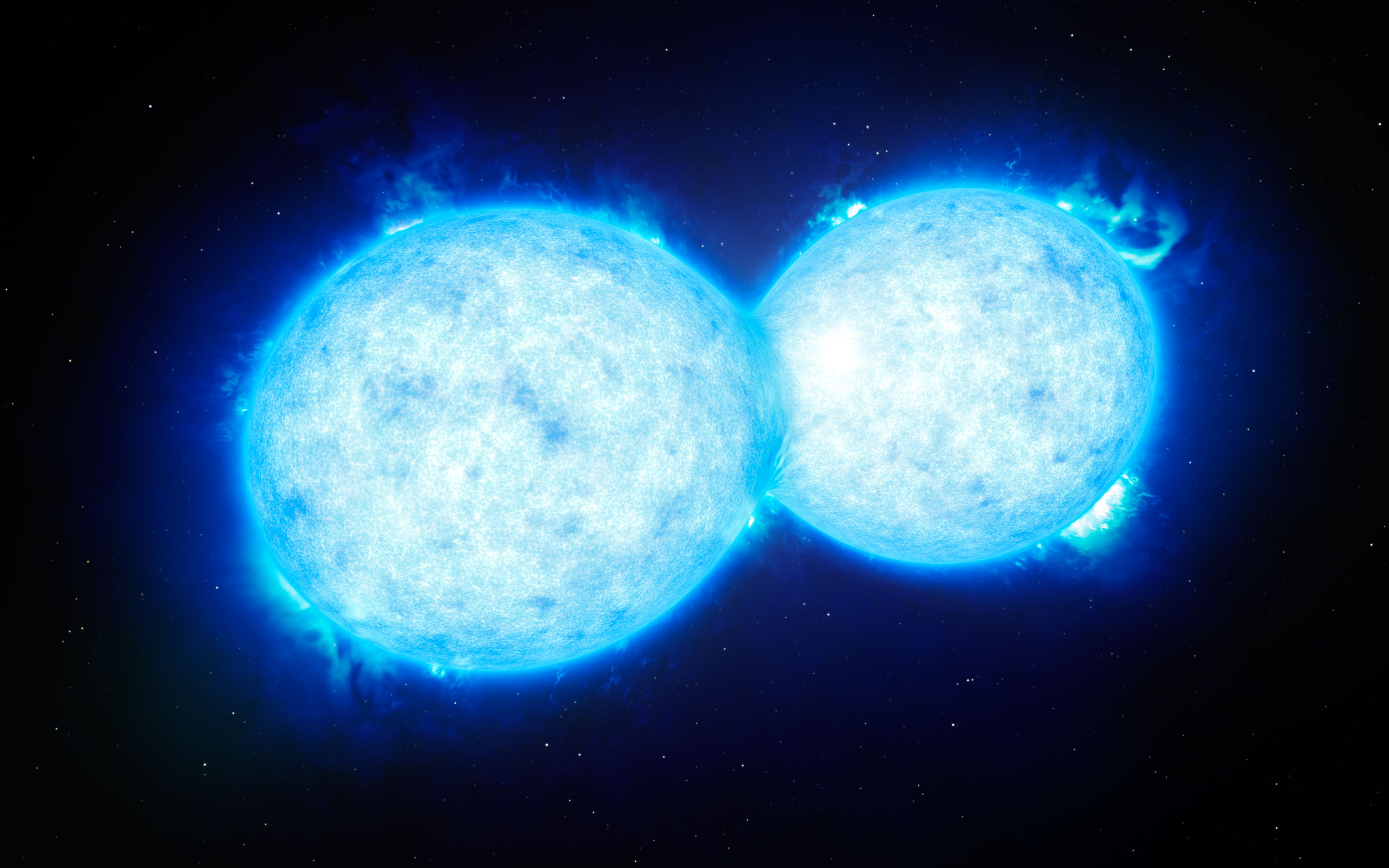
A team of astronomers has discovered the hottest and most massive double star system to date where the two components are in contact and sharing material. This intriguing system could be heading for a dramatic end, either with the formation of a single giant star or as a future binary black hole.
The double star system VFTS 352 is located about 160,000 light-years away in the Tarantula Nebula. This remarkable region is the most active nursery of new stars in the nearby Universe and new observations from ESO’s VLT have revealed that this pair of young stars is among the most extreme and strangest yet found.
VFTS 352 is composed of two very hot, bright, and massive stars that orbit each other in little more than a day. The centers of the stars are separated by just 12 million kilometers (7.5 million miles). In fact, the stars are so close that their surfaces overlap and a bridge has formed between them. VFTS 352 is not only the most massive known in this tiny class of “overcontact binaries” — it has a combined mass of about 57 times that of the Sun — but it also contains the hottest components — with surface temperatures above 40,000 degrees Celsius (72,000 degrees Fahrenheit).
Extreme stars like the two components of VFTS 352, play a key role in the evolution of galaxies and are thought to be the main producers of elements such as oxygen. Such double stars are also linked to exotic behavior such as that shown by “vampire stars”, where a smaller companion star sucks matter from the surface of its larger neighbor.
This animated artist’s impression shows VFTS 352 — the hottest and most massive double star system to date where the two components are in contact and sharing material.
In the case of VFTS 352, however, both stars in the system are of almost identical size. Material is, therefore, not sucked from one to another, but instead may be shared. The component stars of VFTS 352 are estimated to be sharing about 30 percent of their material.
Such a system is very rare because this phase in the life of the stars is short, making it difficult to catch them in the act. Because the stars are so close together, astronomers think that strong tidal forces lead to enhanced mixing of the material in the stellar interiors.
“The VFTS 352 is the best case yet found for a hot and massive double star that may show this kind of internal mixing,” explains lead author Leonardo A. Almeida of the University of São Paulo, Brazil. “As such it’s a fascinating and important discovery.”
Astronomers predict that VFTS 352 will face a cataclysmic fate in one of two ways. The first potential outcome is the merging of the two stars, which would likely produce a rapidly rotating, and possibly magnetic, gigantic single star. “If it keeps spinning rapidly it might end its life in one of the most energetic explosions in the Universe, known as a long-duration gamma-ray burst,” says the lead scientist of the project, Hugues Sana, of the University of Leuven in Belgium.
This fulldome animated artist’s impression shows VFTS 352 — the hottest and most massive double star system to date where the two components are in contact and sharing material.
The second possibility is explained by the lead theoretical astrophysicist in the team, Selma de Mink of University of Amsterdam: “If the stars are mixed well enough, they both remain compact and the VFTS 352 system may avoid merging. This would lead the objects down a new evolutionary path that is completely different from classic stellar evolution predictions. In the case of VFTS 352, the components would likely end their lives in supernova explosions, forming a close binary system of black holes. Such a remarkable object would be an intense source of gravitational waves.”
Proving the existence of this second evolutionary path would be an observational breakthrough in the field of stellar astrophysics. But, regardless of how VFTS 352 meets its demise, this system has already provided astronomers with valuable new insights into the poorly understood evolutionary processes of massive overcontact binary star systems.
Reference: “Discovery of the massive overcontact binary VFTS 352: Evidence for enhanced internal mixing” by L.A. Almeida, H. Sana, S.E. de Mink, F. Tramper, I. Soszyński, N. Langer, R.H. Barbá, M. Cantiello, A. Damineli, A. de Koter, M. Garcia, G. Gräfener, A. Herrero, I. Howarth, J. Maíz Apellániz, C. Norman, O.H. Ramírez-Agudelo and J.S. Vink, 13 October 2015, The Astrophysical Journal.
DOI: 10.1088/0004-637X/812/2/102
Never miss a breakthrough: Join the SciTechDaily newsletter.
Follow us on Google and Google News.
1 Comment
The other possibility, is that instead of heading for destruction, this is the birth of a binary pair. Most star systems, are after all, binary pairs, and they had to form somehow.
If the real physics is that new matter is constantly being generated inside stars and planets, then the star birthing process would not be caused only by the accretion of gases, but also by the growth and splitting of stellar cores. After a Supernova, the core remnants of stars could become the basis of planet growth.
The Earth-Moon system is evidence for this hypothesis. Instead of the Moon’s orbit getting smaller from entropy, the Moon continually moves away from the Earth due to the growth of mass in both bodies. All the solid surface bodies in our solar system show signs of internal growth in the form of large surface stretch marks and cracks. The Moon is even suspected of having formed from the Earth, itself.