
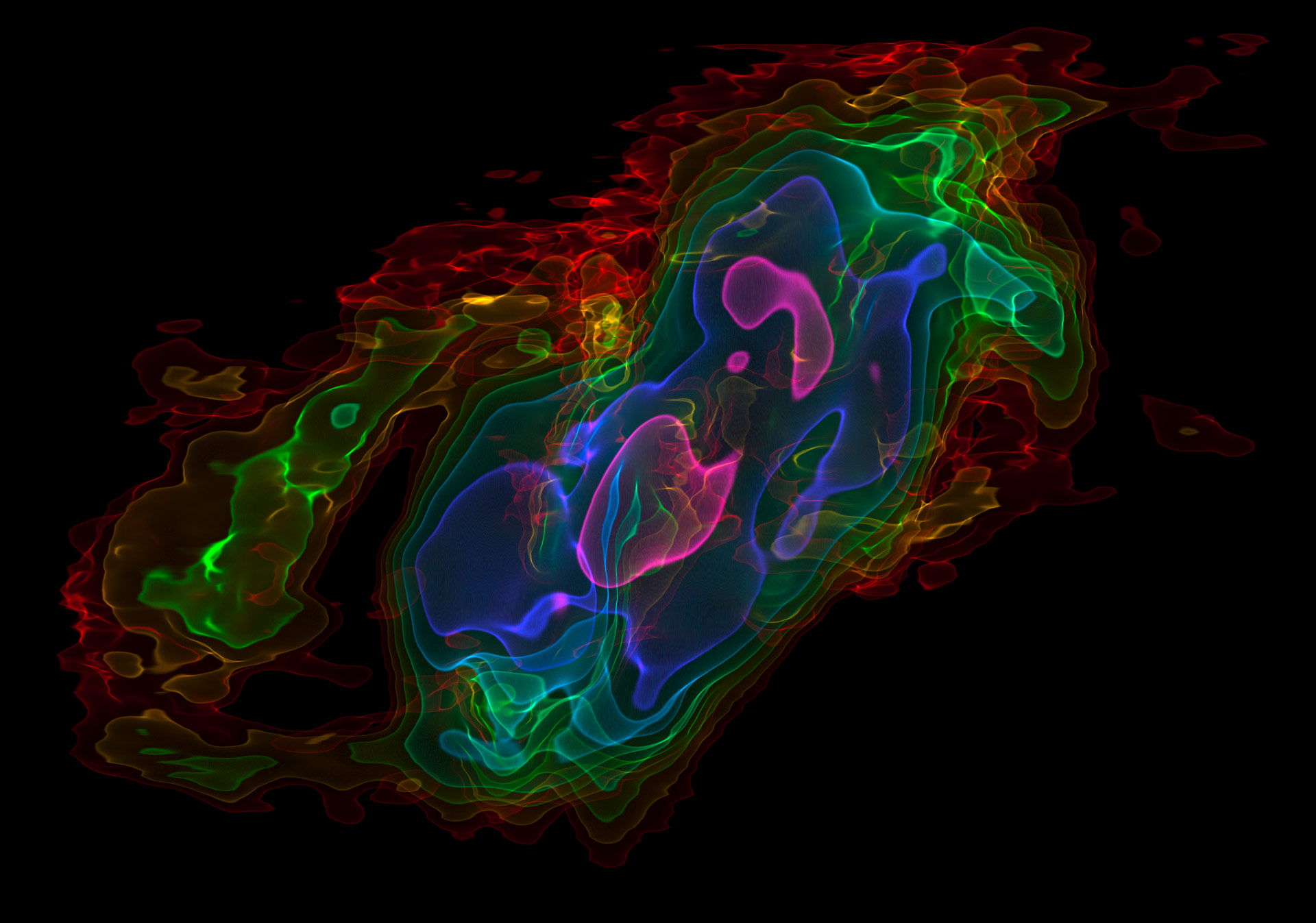
Using data from the ALMA telescope, astronomers shed new light on galaxy formation, finding evidence that some growing galaxies spew out more gas than they take in.
New observations from the ALMA telescope in Chile have given astronomers the best view yet of how vigorous star formation can blast gas out of a galaxy and starve future generations of stars of the fuel they need to form and grow. The dramatic images show enormous outflows of molecular gas ejected by star-forming regions in the nearby Sculptor Galaxy. These new results help to explain the strange paucity of very massive galaxies in the Universe. The study was published in the journal Nature on July 25, 2013.
Galaxies — systems like our own Milky Way that contain up to hundreds of billions of stars — are the basic building blocks of the cosmos. One ambitious goal of contemporary astronomy is to understand the ways in which galaxies grow and evolve, a key question being star formation: what determines the number of new stars that will form in a galaxy?
The Sculptor Galaxy, also known as NGC 253, is a spiral galaxy located in the southern constellation of Sculptor. At a distance of around 11.5 million light-years from our Solar System it is one of our closer intergalactic neighbors, and one of the closest starburst galaxies [1] visible from the southern hemisphere. Using the Atacama Large Millimeter/submillimeter Array (ALMA) astronomers have discovered billowing columns of cold, dense gas fleeing from the center of the galactic disc.
This video shows a three-dimensional visualization of ALMA observations of cold carbon monoxide gas in the nearby starburst galaxy NGC 253 (The Sculptor Galaxy). The vertical axis shows velocity and the horizontal one distance across different parts of the central regions of the galaxy as the viewpoint rotates. The colors represent the intensity of the emission detected by ALMA, with pink being the strongest and red the weakest. Credit: ALMA (ESO/NAOJ/NRAO)/Erik Rosolowsky
“With ALMA’s superb resolution and sensitivity, we can clearly see for the first time massive concentrations of cold gas being jettisoned by expanding shells of intense pressure created by young stars,” said Alberto Bolatto of the University of Maryland, USA lead author of the paper. “The amount of gas we measure gives us very good evidence that some growing galaxies spew out more gas than they take in. We may be seeing a present-day example of a very common occurrence in the early Universe.”
These results may help to explain why astronomers have found surprisingly few high-mass galaxies throughout the cosmos. Computer models show that older, redder galaxies should have considerably more mass and a larger number of stars than we currently observe. It seems that the galactic winds or outflow of gas are so strong that they deprive the galaxy of the fuel for the formation of the next generation of stars [2].
“These features trace an arc that is almost perfectly aligned with the edges of the previously observed hot, ionized gas outflow,” noted Fabian Walter, a lead investigator at the Max Planck Institute for Astronomy in Heidelberg, Germany, and a co-author of the paper. “We can now see the step-by-step progression of starburst to outflow.”
The researchers determined that vast quantities of molecular gas — nearly ten times the mass of our Sun each year and possibly much more — were being ejected from the galaxy at velocities between 150,000 and almost 1,000,000 kilometers per hour [3]. The total amount of gas ejected would add up to more gas than actually went into forming the galaxy’s stars in the same time. At this rate, the galaxy could run out of gas in as few as 60 million years.
“For me, this is a prime example of how new instruments shape the future of astronomy. We have been studying the starburst region of NGC 253 and other nearby starburst galaxies for almost ten years. But before ALMA, we had no chance to see such details,” says Walter. The study used an early configuration of ALMA with only 16 antennas. “It’s exciting to think what the complete ALMA with 66 antennas will show for this kind of outflow!” Walter adds.
More studies with the full ALMA array will help determine the ultimate fate of the gas carried away by the wind, which will reveal whether the starburst-driven winds are recycling or truly removing star-forming material.
Notes
[1] Starburst galaxies are producing stars at an exceptionally high rate. As NGC 253 is one of the closest such extreme objects it is an ideal target to study the effect of such growth frenzy on the galaxy hosting it.
[2] Previous observations had shown hotter, but much less dense, gas streaming away from NGC 253’s star-forming regions, but alone this would have little, if any, impact on the fate of the galaxy and its ability to form future generations of stars. This new ALMA data show the much more dense molecular gas getting its initial “kick” from the formation of new stars and then being swept along with the thin, hot gas on its way to the galactic halo.
[3] Although the velocities are high, they may not be high enough for the gas to be ejected from the galaxy. It would get trapped in the galactic halo for many millions of years, and could eventually rain back on the disk, causing new episodes of star formation.
Reference: “Suppression of star formation in the galaxy NGC 253 by a starburst-driven molecular wind” by Alberto D. Bolatto, Steven R. Warren, Adam K. Leroy, Fabian Walter, Sylvain Veilleux, Eve C. Ostriker, Jürgen Ott, Martin Zwaan, David B. Fisher, Axel Weiss, Erik Rosolowsky and Jacqueline Hodge, 24 July 2013, Nature.
DOI: 10.1038/nature12351
arXiv:1307.6259
Never miss a breakthrough: Join the SciTechDaily newsletter.
Follow us on Google and Google News.
2 Comments
So this cold molecular gas we are told surrounds all galaxies is an output from the galaxy itself, not a wrap from the cosmos?
This could be a new signal for the existence of new paradigm dark matter black holes located outside the galaxy.