
Close Menu
    Facebook X (Twitter) Instagram
    SciTechDaily
    • Biology
    • Chemistry
    • Earth
    • Health
    • Physics
    • Science
    • Space
    • Technology
    Facebook X (Twitter) Pinterest YouTube RSS
    SciTechDaily
    Home»Biology»New Species of Galapagos Giant Tortoise Identified
    Biology

    New Species of Galapagos Giant Tortoise Identified

    By Bill Hathaway, Yale UniversityOctober 23, 2015No Comments2 Mins Read
    Facebook Twitter Pinterest Telegram LinkedIn WhatsApp Email Reddit
    Share
    Facebook Twitter LinkedIn Pinterest Telegram Email Reddit
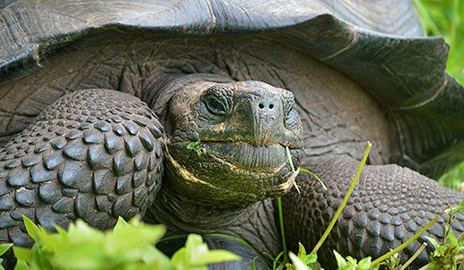
    New Galapagos Giant Tortoise Species
    Eastern Santa Cruz tortoise. (Photo credit: Washington Tapia)

    A team of researchers from Yale University have discovered a new species of giant tortoise in the Galapagos.

    A few hundred giant tortoises living on one side of Santa Cruz Island in the Galapagos actually are a separate species from a second, larger population living less than 10 kilometers (6 miles) away, a new Yale-led genetic analysis has revealed.

    The recognition of the Eastern Santa Cruz tortoise as a distinct species provides new insight into the history of these evolutionary icons that live on the island chain that inspired Charles Darwin.

    While the larger western population on the island numbers about 2,000 and lives mostly in a protected national park, the smaller number of Eastern Santa Cruz tortoises may need more protection, said Adalgisa “Gisella” Caccone, senior research scientist in the Department of Ecology and Evolutionary Biology and senior author of the research published in the journal PLOS ONE.

    “Naming a new species elevates its status and enables more resources to be devoted to protecting its range,” Caccone said.

    Researchers had noted differences in the shells, or carapaces, of the two populations of giant tortoises but had assumed these were simply variations within the same species. However, a close genetic analysis revealed they were in fact as genetically distinct as species living on different islands.

    “The story tells us something about patterns of divergence in the giant tortoises in the Galapagos and how colonization of the archipelago did not follow a simple linear model,” Caccone said.

    The study was conducted by an international group, which included researchers from the University of Crete, British Columbia, and researchers from several U.S.-based universities and foundations.

    Reference: “Description of a New Galapagos Giant Tortoise Species (Chelonoidis; Testudines: Testudinidae) from Cerro Fatal on Santa Cruz Island” by Nikos Poulakakis, Danielle L. Edwards, Ylenia Chiari, Ryan C. Garrick, Michael A. Russello, Edgar Benavides, Gregory J. Watkins-Colwell, Scott Glaberman, Washington Tapia, James P. Gibbs, Linda J. Cayot and Adalgisa Caccone, 21 October 2015, PLOS One.
    DOI: 10.1371/journal.pone.0138779

    Never miss a breakthrough: Join the SciTechDaily newsletter.
    Follow us on Google and Google News.

    Galapagos Islands Tortoise Wildlife Yale University
    Share. Facebook Twitter Pinterest LinkedIn Email Reddit

    Related Articles

    Yale Researchers Discover a Lonely Giant Tortoise – Whose Species Was Last Seen Over 100 Years Ago

    Slow but Deadly: Watch This Tortoise Hunt a Baby Bird

    3D Models Reveal How Tortoises Get Back Onto Their Feet

    Lesula, A New Species of Monkey

    Researchers Study Regulatory Gene’s Role in Sperm Quality Control

    Trip to Rainforest Yields Organisms Capable of Degrading Polyurethane

    Bonobo Great Apes Are Domesticating Themselves

    Altered Microbes that Cause Obesity & Chronic Liver Disease May be Infectious

    Ecuador Rainforest Fungus Survives on Polyurethane without Oxygen

    Leave A Reply Cancel Reply

    • Facebook
    • Twitter
    • Pinterest
    • YouTube

    Don't Miss a Discovery

    Subscribe for the Latest in Science & Tech!

    Trending News

    A SpaceX Falcon 9 Rocket Hit the Moon and Blasted Open a 60-Foot Crater

    Study Reveals Your Organs May Be Aging at Very Different Speeds

    Scientists Finally Solve a 20-Year Mystery About Diamond Melting

    Ultra-Processed Foods Linked to 30% Higher Prostate Cancer Risk

    More Screen Time, Better Thinking? An 8-Year Study Finds a Surprising Link

    Cleaner Cars May Be Hiding a New Pollution Problem

    Common Plant Chemical Linked to Widespread Organ Damage in Aquatic Animals

    Dogs and Humans May Share a Surprising Biological Secret to Longevity

    Follow SciTechDaily
    • Facebook
    • Twitter
    • YouTube
    • Pinterest
    • Newsletter
    • RSS
    SciTech News
    • Biology News
    • Chemistry News
    • Earth News
    • Health News
    • Physics News
    • Science News
    • Space News
    • Technology News
    Recent Posts
    • A Billion Years Before the Grand Canyon, a Giant Cliff May Have Stretched Across America
    • Longer Breastfeeding Linked to Fewer ADHD Symptoms in Children
    • The Immune Systems of 110-Year-Olds Are Hiding a Remarkable Secret
    • Common Osteoarthritis Treatment Fails a Major Test
    • Tiny Stars Are Making the Early Universe Much Harder to Explain
    Copyright © 1998 - 2026 SciTechDaily. All Rights Reserved.
    • Science News
    • About
    • Contact
    • Editorial Board
    • Privacy Policy
    • Terms of Use

    Type above and press Enter to search. Press Esc to cancel.