
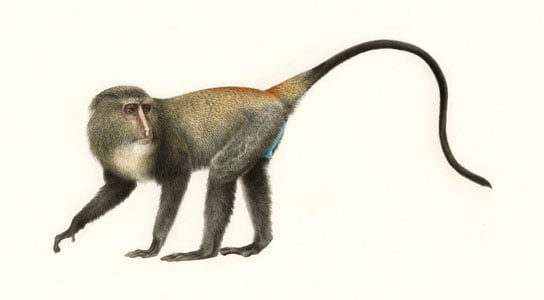
A newly published study describes Lesula (Cercopithecus lomamiensis), a recently discovered monkey species living in a remote part of the Democratic Republic of Congo.
Researchers affiliated with Yale’s Peabody Museum of Natural History have published the first detailed scientific account of a recently discovered monkey species living in a remote part of the Democratic Republic of Congo (DRC). It is only the second new species of African monkey discovered since the mid-1980s.
The slender, medium-sized primate — called a Lesula (luh-SOO-la) and roughly similar to a vervet monkey — represents a rare discovery of a previously undocumented mammal, and helps establish the sparsely settled central Congo as an important source of biodiversity, researchers said. They describe the animal in detail in the September 12 issue of the journal PLOS ONE.
“This was a totally unexpected find, and we knew we had something unusual and possibly unknown when we first saw the animal. But it was not until we had the genetic and morphological analyses of our collaborating team that we knew we really had a new species,” said John and Terese Hart, conservation biologists with the Lukuru Wildlife Research Foundation and curatorial affiliates of the Peabody.
The Harts and members of their field teams were the first scientists to encounter a Lesula in 2007. They saw a captive in a remote village, and subsequently observed it in the wild.
The Lesula (Cercopithecus lomamiensis) seems to have escaped previous scientific notice because of its remote habitat, largely unexplored by professional biologists until recently. The Lesula is known to live exclusively within only 17,000 square kilometers (6,600 square miles) of mature evergreen forests in DRC’s eastern central basin, between the middle Lomami and upper Tshuapa rivers.
“Major discoveries like this are still possible, mainly thanks to dedicated field biologists like the Harts,” said Eric Sargis, professor of anthropology at Yale and a co-author of the paper. “And if we’re finding new species of primates, then who knows how many new species of small mammals or lizards or insects, just to name a few, might be out there. There’s certainly a lot of undiscovered biodiversity in this region.”
At least three other anthropoid primates are exclusive to the region, according to the researchers — the Lomami River red colobus, the Lomami River blue monkey, and the Kasuku River Wolf’s monkey. Like all of Congo’s remaining large mammals, these species are threatened by uncontrolled commercial bush meat hunting and habitat loss.
“The challenge now is to make the Lesula an iconic species that carries the message for conservation for all of Congo’s endangered fauna,” said John Hart.
After their first coincidental encounter with the captive Lesula, the Harts and their research team observed it in the wild, documented its behavior and ecology, and ultimately determined its distinctiveness through genetic and anatomical studies. The latter were conducted at the Peabody by Sargis and co-author Chris Gilbert, a former Yale Institute for Biospheric Studies Gaylord Donnelley Environmental Postdoctoral Fellow and now a professor at Hunter College-CUNY.
The typical Lesula has a naked face and muzzle and a mane of long, grizzled blond hair. Some have a cream-colored vertical nose stripe. The monkey appears to eat fruits and vegetation primarily, and to live both on the ground and in trees. In their paper, researchers describe the Lesula and its sister species, Cercopithecus hamlyni, as “shy, quiet and generally occur[ing] in small groups.”
Through the Harts, the Peabody has acquired several Lesula specimens that were essential for the genetic and anatomical studies, said Sargis, who also is curator of the Peabody’s mammalogy collections. All specimens were collected after death, either at the hands of local hunters or, in one case, by crowned eagles.
Reference: “Lesula: A New Species of Cercopithecus Monkey Endemic to the Democratic Republic of Congo and Implications for Conservation of Congo’s Central Basin” by John A. Hart, Kate M. Detwiler, Christopher C. Gilbert, Andrew S. Burrell, James L. Fuller, Maurice Emetshu, Terese B. Hart, Ashley Vosper, Eric J. Sargis and Anthony J. Tosi, 12 September 2012, PLOS ONE.
DOI: 10.1371/journal.pone.0044271
Other authors of the paper are Kate M. Detwiler of Florida Atlantic University; Andrew S. Burrell of New York University; James L. Fuller of Columbia University; Maurice Emetshu of the Lukuru Wildlife Research Foundation; Ashley Vosper of the Center de Formation et Conservation Forestière; and Anthony J. Tosi of New York University.
The research was supported by the Arcus Foundation, U.S. Fish and Wildlife Service, a grant from Edith McBean, Abraham Foundation, Margot Marsh Biodiversity Foundation Grant, and Yale Institute for Biospheric Studies.
Never miss a breakthrough: Join the SciTechDaily newsletter.
Follow us on Google and Google News.