
Close Menu
    Facebook X (Twitter) Instagram
    SciTechDaily
    • Biology
    • Chemistry
    • Earth
    • Health
    • Physics
    • Science
    • Space
    • Technology
    Facebook X (Twitter) Pinterest YouTube RSS
    SciTechDaily
    Home»Space»New Horizons Spacecraft Reveals Possible Ice Volcano on Pluto
    Space

    New Horizons Spacecraft Reveals Possible Ice Volcano on Pluto

    By NASAJanuary 15, 20161 Comment2 Mins Read
    Facebook Twitter Pinterest Telegram LinkedIn WhatsApp Email Reddit
    Share
    Facebook Twitter LinkedIn Pinterest Telegram Email Reddit
    New Horizons Discovers Possible Ice Volcano on Pluto
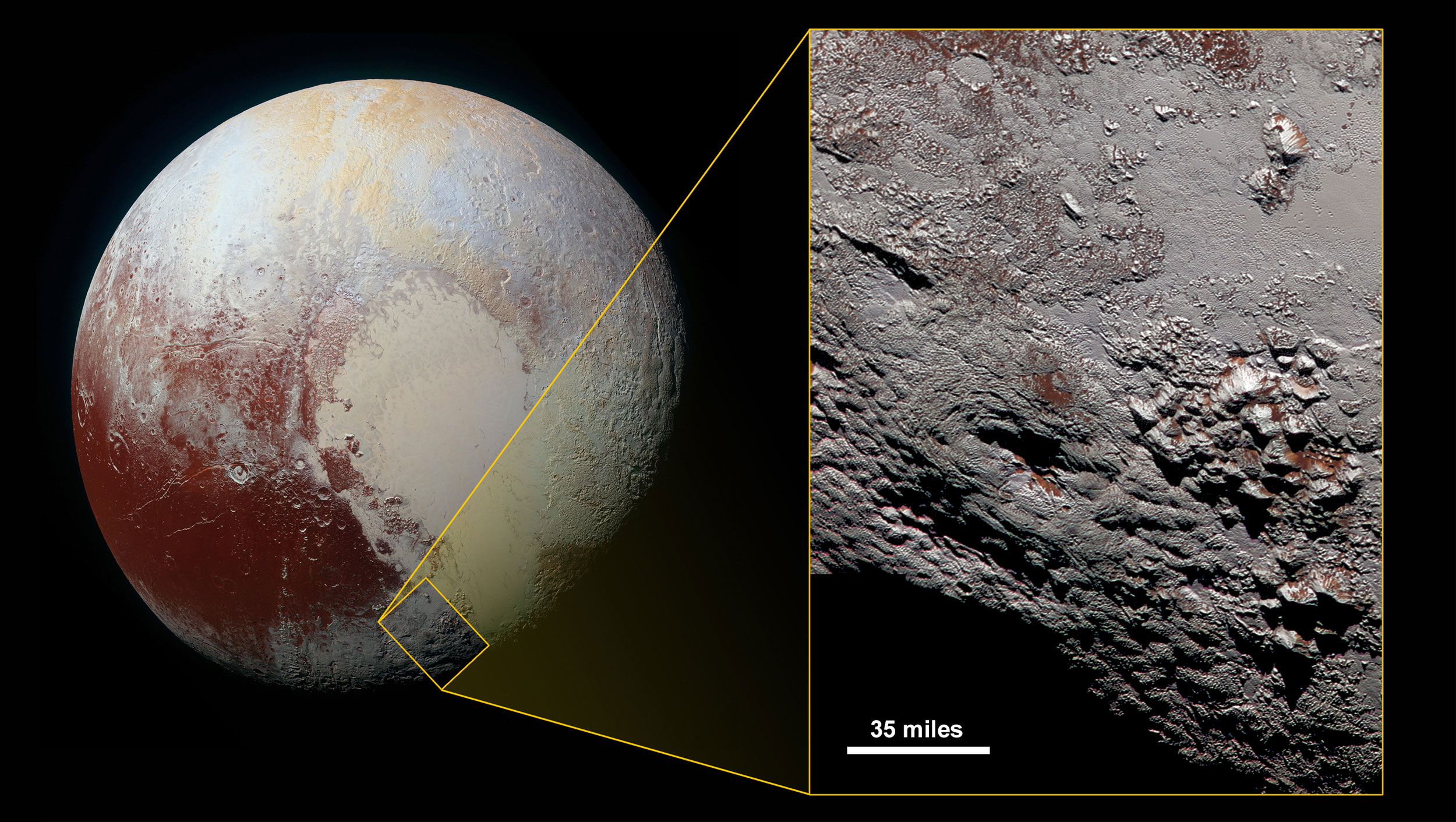
    Wright Mons in Color. This composite image of a possible ice volcano on Pluto includes pictures taken by the New Horizons spacecraft’s Long Range Reconnaissance Imager (LORRI) on July 14, 2015, from a range of about 30,000 miles (48,000 kilometers), showing features as small as 1,500 feet (450 meters) across. Sprinkled across the LORRI mosaic is enhanced color data from the Ralph/Multispectral Visible Imaging Camera (MVIC), from a range of 21,000 miles (34,000 kilometers) and at a resolution of about 2,100 feet (650 meters) per pixel. The entire scene is 140 miles (230 kilometers) across. Credit: NASA/JHUAPL/SwRI

    A new image from the New Horizons Spacecraft reveals more of Pluto’s surface features.

    Scientists with NASA’s New Horizons mission have assembled this highest-resolution color view of one of two potential cryovolcanoes spotted on the surface of Pluto by the New Horizons spacecraft in July 2015.

    This feature, known as Wright Mons, was informally named by the New Horizons team in honor of the Wright brothers. At about 90 miles (150 kilometers) across and 2.5 miles (4 kilometers) high, this feature is enormous. If it is in fact a volcano, as suspected, it would be the largest such feature discovered in the outer solar system.

    Mission scientists are intrigued by the sparse distribution of red material in the image and wonder why it is not more widespread. Also perplexing is that there is only one identified impact crater on Wright Mons itself, telling scientists that the surface (as well as some of the crust underneath) was created relatively recently. This in turn may indicate that Wright Mons was volcanically active late in Pluto’s history.
    New Horizons Finds Possible Ice Volcano on Pluto
    Credit: NASA/JHUAPL/SwRI

    Never miss a breakthrough: Join the SciTechDaily newsletter.
    Follow us on Google and Google News.

    Astronomy New Horizons Planetary Science Pluto
    Share. Facebook Twitter Pinterest LinkedIn Email Reddit

    Related Articles

    Surface Features Detected on Pluto, Possible Polar Cap

    New Horizons Spacecraft Views Pluto and Charon Rotation

    NASA’s New Horizons Nears Historic Encounter with Pluto

    New Horizons Spots Small Moons Orbiting Pluto

    New Horizons Returns New Images of Pluto

    New Horizons Begins First Stages of Pluto Encounter

    New Horizons Spacecraft Awakens for Encounter with Pluto System

    New ScienceCast Video Previews What New Horizons May See on Pluto

    New ScienceCast Video – Countdown to Pluto

    1 Comment

    1. Madanagopal.V.C. on January 15, 2016 10:14 am

      Ice volcanoes on Pluto which is a very distant very cold planet is indication of sublimation of gases from ice to gas which bubbles out the surface. Ordinary volcanoes spreads the lava evenly in a circular smooth pattern. This phenomena should be universal on all the very distant planets which are cold and also on the comets where the sublimation of ice will make the rocks very much pot-holed since they are not supposed to get targeted by asteroids on them. Thank You.

      Reply
    Leave A Reply Cancel Reply

    • Facebook
    • Twitter
    • Pinterest
    • YouTube

    Don't Miss a Discovery

    Subscribe for the Latest in Science & Tech!

    Trending News

    New Molecule Restores the Brain’s Natural Defenses Against Alzheimer’s

    Could Creatine Boost More Than Muscles? It May Also Help Depression

    Scientists Discover a Natural Molecule That Could Help Prevent Vision Loss

    Scientists Thought Royal Jelly Made Queen Bees. They Were Wrong

    One Tiny Change May Explain How Viruses Jump From Bats to Humans

    The Secret to Healthy Aging May Be More Protein and More Exercise

    These 567-Million-Year-Old Fossils Are Rewriting the Story of Life on Earth

    The Spider-Like Creatures Helping Scientists Decode the Origins of Fatherhood

    Follow SciTechDaily
    • Facebook
    • Twitter
    • YouTube
    • Pinterest
    • Newsletter
    • RSS
    SciTech News
    • Biology News
    • Chemistry News
    • Earth News
    • Health News
    • Physics News
    • Science News
    • Space News
    • Technology News
    Recent Posts
    • Rethinking Movement Disorders: Scientists Uncover a Surprising Disconnect Deep Inside the Brain
    • Groundbreaking Study Challenges 40 Years of Beliefs About Mad Cow Disease
    • One Sugar Tells Your Brain You’re Full. Another Barely Does
    • One of Arizona’s Largest Reservoirs Is Less Than 1% Full After Snowpack Collapse
    • Scientists Detect Hundreds of Iceberg Earthquakes at Antarctica’s Crumbling Doomsday Glacier
    Copyright © 1998 - 2026 SciTechDaily. All Rights Reserved.
    • Science News
    • About
    • Contact
    • Editorial Board
    • Privacy Policy
    • Terms of Use

    Type above and press Enter to search. Press Esc to cancel.