
Close Menu
    Facebook X (Twitter) Instagram
    SciTechDaily
    • Biology
    • Chemistry
    • Earth
    • Health
    • Physics
    • Science
    • Space
    • Technology
    Facebook X (Twitter) Pinterest YouTube RSS
    SciTechDaily
    Home»Space»Hubble Image of the Week – Galaxy NGC 5408
    Space

    Hubble Image of the Week – Galaxy NGC 5408

    By SciTechDailyJanuary 18, 20161 Comment2 Mins Read
    Facebook Twitter Pinterest Telegram LinkedIn WhatsApp Email Reddit
    Share
    Facebook Twitter LinkedIn Pinterest Telegram Email Reddit
    Hubble Views NGC 5408
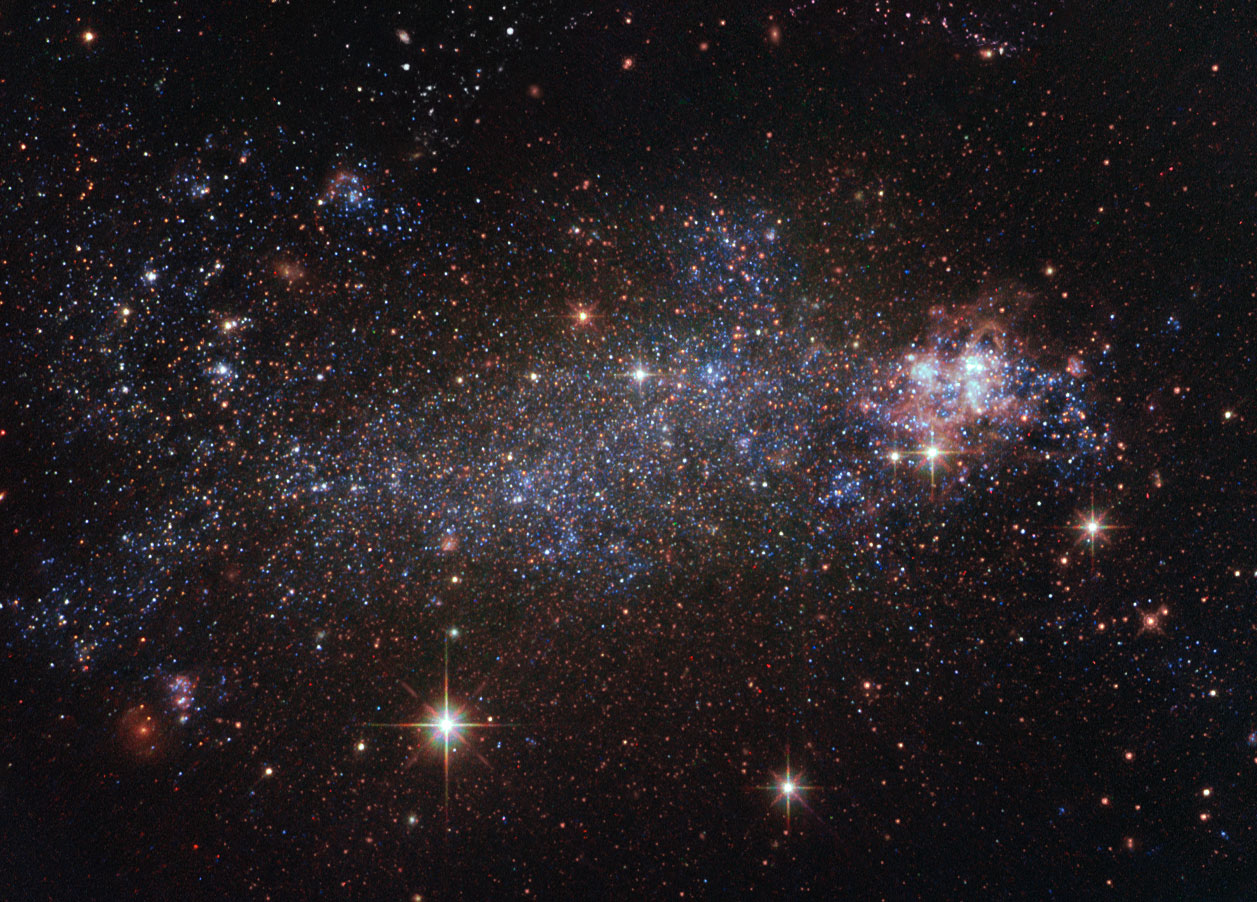
    NGC 5408 is located 16 million light-years away in the constellation of Centaurus (The Centaur). Credit: ESA/Hubble & NASA, Acknowledgment: Judy Schmidt

    This newly released Hubble image shows galaxy NGC 5408, which is located 16 million light-years away.

    Most galaxies possess a majestic spiral or elliptical structure. About a quarter of galaxies, though, defy such conventional, rounded aesthetics, instead sporting a messy, indefinable shape. Known as irregular galaxies, this group includes NGC 5408, the galaxy that has been snapped here by the NASA/ESA Hubble Space Telescope.

    English polymath John Herschel recorded the existence of NGC 5408 in June 1834. Astronomers had long mistaken NGC 5408 for a planetary nebula, an expelled cloud of material from an aging star. Instead, bucking labels, NGC 5408 turned out to be an entire galaxy, located about 16 million light-years from Earth in the constellation of Centaurus (The Centaur).

    In yet another sign of NGC 5408 breaking convention, the galaxy is associated with an object known as an ultraluminous X-ray source, dubbed NGC 5408 X-1, one of the best studied of its class. These rare objects beam out prodigious amounts of energetic X-rays. Astrophysicists believe these sources to be strong candidates for intermediate-mass black holes. This hypothetical type of black hole has significantly less mass than the supermassive black holes found in galactic centers, which can have billions of times the mass of the Sun, but have a good deal more mass than the black holes formed when giant stars collapse.

    A version of this image was entered into the Hubble’s Hidden Treasures image processing competition by contestant Judy Schmidt.

    Never miss a breakthrough: Join the SciTechDaily newsletter.
    Follow us on Google and Google News.

    Astronomy Hubble Space Telescope NASA
    Share. Facebook Twitter Pinterest LinkedIn Email Reddit

    Related Articles

    Hubble Reveals a Star Disk Three Times Hotter Than the Sun’s Surface

    A Star’s Unexpected Heatwave: FU Orionis Challenges Astrophysics Models

    NASA’s Hubble Reveals How the LMC Defied Galactic Destruction

    Legendary Star’s Smooth Disk Mystifies Astronomers, Challenges Planet Formation Theories

    Cosmic Horror Unveiled: NASA Reveals “Blood-Soaked Eyes” Staring From Deep Space [Video]

    Spanning 248 Billion Miles: Stunning Hubble Timelapse Captures a Star’s Violent Eruptions

    Jupiter’s Great Red Spot Enigma: Unexplained Oscillations Baffle Astronomers

    Unlocking Uranus: NASA’s Dual Observations Pave the Way to Discovering New Worlds

    Astronomers Baffled by Black Hole Jets Igniting Star Explosions

    1 Comment

    1. Thomas on January 19, 2016 8:54 am

      IT looks like the result of a swing by from an other galaxy, seen in computer simulations, and the second galaxy is some million light-years away

      Reply
    Leave A Reply Cancel Reply

    • Facebook
    • Twitter
    • Pinterest
    • YouTube

    Don't Miss a Discovery

    Subscribe for the Latest in Science & Tech!

    Trending News

    Researchers Warn Widely Prescribed Blood Pressure Drugs Could Be Harming Diabetic Kidneys

    James Webb Spots Something Strange Between Day and Night on an Alien Planet

    How Ancient People Moved a 6-Ton Stone 700 Kilometers to Stonehenge

    The Unexpected Gut Health Risk of Cutting Out Sugar

    Popular Weight-Loss Drugs Like Ozempic Linked to Lower Breast Cancer Risk

    AI Learned the Rules of the Universe and That Became a Problem

    Scientists Found a Hidden Brain Signal That Predicts Social Behavior

    Even GPT-5 Failed This Human Attention Test

    Follow SciTechDaily
    • Facebook
    • Twitter
    • YouTube
    • Pinterest
    • Newsletter
    • RSS
    SciTech News
    • Biology News
    • Chemistry News
    • Earth News
    • Health News
    • Physics News
    • Science News
    • Space News
    • Technology News
    Recent Posts
    • Breakthrough Fentanyl Vaccine Could Neutralize Designer Drugs and Prevent Overdoses
    • Researchers Expected Ozempic Weight Loss to Boost Exercise. It Didn’t
    • Hidden Damage From Youth May Explode Into Disease Later in Life
    • Scientists Say a New Universe Could Form Inside a Dying Star
    • Climate Models May Be Wrong About How Trees Store Carbon
    Copyright © 1998 - 2026 SciTechDaily. All Rights Reserved.
    • Science News
    • About
    • Contact
    • Editorial Board
    • Privacy Policy
    • Terms of Use

    Type above and press Enter to search. Press Esc to cancel.