
Close Menu
    Facebook X (Twitter) Instagram
    SciTechDaily
    • Biology
    • Chemistry
    • Earth
    • Health
    • Physics
    • Science
    • Space
    • Technology
    Facebook X (Twitter) Pinterest YouTube RSS
    SciTechDaily
    Home»Space»Three Datasets Produce a Unique New View of MACS J0717
    Space

    Three Datasets Produce a Unique New View of MACS J0717

    By SciTechDailyMarch 14, 2016No Comments2 Mins Read
    Facebook Twitter Pinterest Telegram LinkedIn WhatsApp Email Reddit
    Share
    Facebook Twitter LinkedIn Pinterest Telegram Email Reddit
    Hubble Image of MACS-J0717
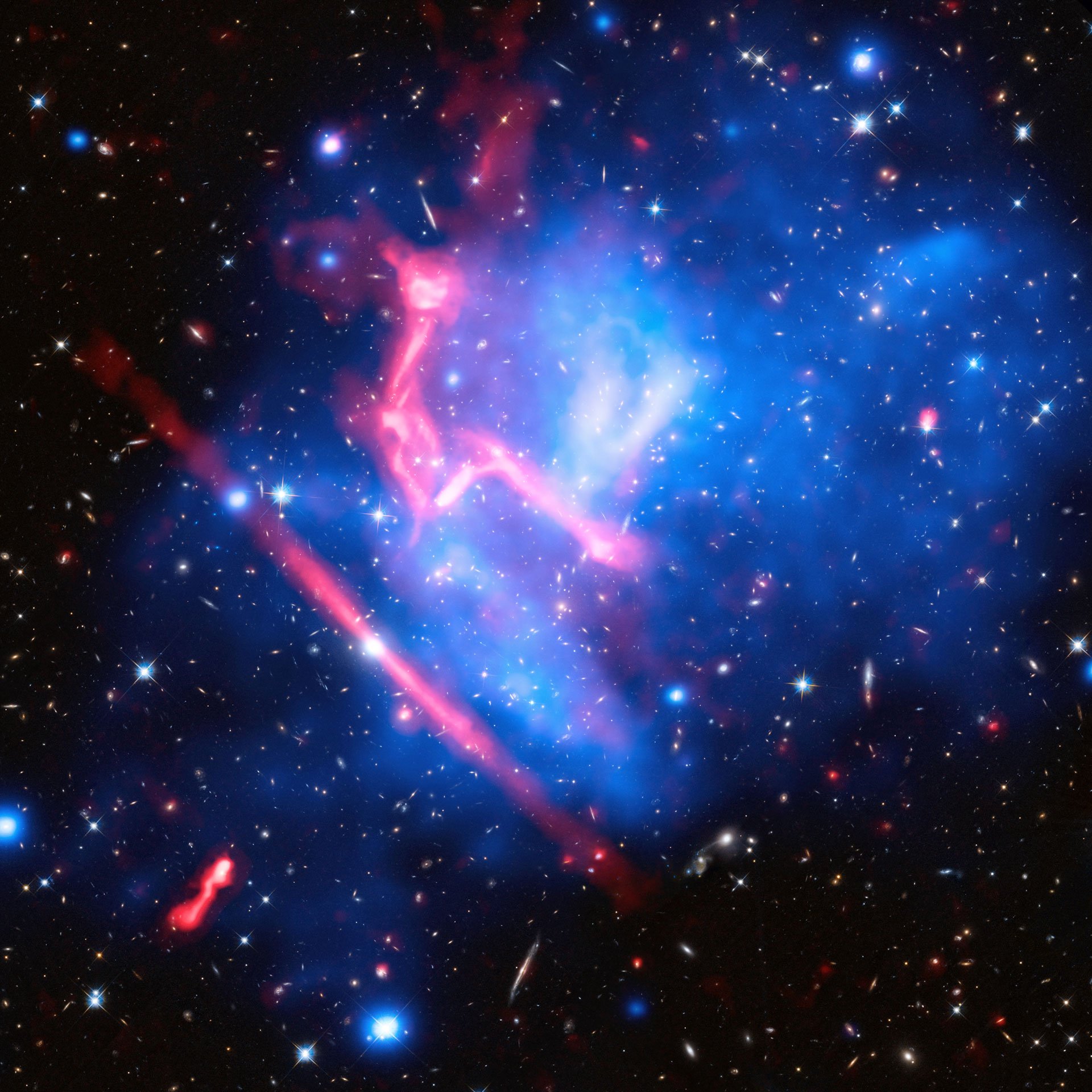
    MACS-J0717 is located about 5.4 billion light-years away from Earth, in the constellation of Auriga (The Charioteer). It is one of the most complex galaxy clusters known; rather than being a single cluster, it is actually the result of four galaxy clusters colliding. Credit: NASA, ESA, CXC, NRAO/AUI/NSF, STScI, and R. van Weeren (Harvard-Smithsonian Center for Astrophysics) Acknowledgment: NASA, ESA, and J. Lotz (STScI), and the HFF team

    Using the Hubble Space Telescope, the NASA Chandra X-ray Observatory and the NRAO Jansky Very Large Array, astronomers have created a unique view of MACS J0717.5+3745.

    In October of 2013 Hubble kicked off the Frontier Fields program, a three-year series of observations aiming to produce the deepest ever views of the Universe. The project’s targets comprise six massive galaxy clusters, enormous collections of hundreds or even thousands of galaxies. These structures are the largest gravitationally-bound objects in the cosmos.

    One of the Frontier Fields targets is shown in this new image: MACS J0717.5+3745, or MACS J0717 for short. MACS J0717 is located about 5.4 billion light-years away from Earth, in the constellation of Auriga (The Charioteer). It is one of the most complex galaxy clusters known; rather than being a single cluster, it is actually the result of four galaxy clusters colliding.

    This image is a combination of observations from the NASA/ESA Hubble Space Telescope (showing the galaxies and stars), the NASA Chandra X-ray Observatory (diffuse emission in blue), and the NRAO Jansky Very Large Array (diffuse emission in pink). The Hubble data were collected as part of the Frontier Fields program mentioned above.

    Together, the three datasets produce a unique new view of MACS J0717. The Hubble data reveal galaxies both within the cluster and far behind it, and the Chandra observations show bright pockets of scorching gas — heated to millions of degrees. The data collected by the Jansky Very Large Array trace the radio emission within the cluster, enormous shock waves — similar to sonic booms — that were triggered by the violent merger.

    Never miss a breakthrough: Join the SciTechDaily newsletter.
    Follow us on Google and Google News.

    Astronomy Chandra X-ray Observatory Hubble Space Telescope Karl G. Jansky Very Large Array
    Share. Facebook Twitter Pinterest LinkedIn Email Reddit

    Related Articles

    Astronomers Combine Telescope Data to Further Research on Galaxy Clusters

    Chandra Reveals a New Composite Image of NGC 4258

    New Image Reveals Colliding Galaxy Clusters

    Hubble Views Spiral Galaxy ESO 137-001

    NASA to Look Deeper Into the Universe than Ever Before

    Astronomers Find Evidence for Densest Nearby Galaxy

    A Closer Look at Planetary Nebula NGC 2392

    Astronomers View Superheated Gas Swirling Around a Black Hole

    Hubble Observes Rare Blue Stars in Andromeda’s Core

    Leave A Reply Cancel Reply

    • Facebook
    • Twitter
    • Pinterest
    • YouTube

    Don't Miss a Discovery

    Subscribe for the Latest in Science & Tech!

    Trending News

    Giant Crocodylians Ruled South America’s Ancient Food Chain

    Breakthrough in a Bizarre Galaxy Could Help Unlock the Mystery of Dark Matter

    Just 4 Minutes of Daily Strength Training Can Quadruple Fitness in Older Adults

    Almost All Plant-Based Meat Alternatives Contain Mycotoxins, Study Finds

    Astronomers Detect a Record-Breaking “Cosmic Laser” From 8 Billion Light-Years Away

    A 47-Year-Old Scientist Tracked Himself for Months – His Biological Age Fell to 32

    Construction Crew Uncovers Giant 20-Meter Dinosaur in Brazil

    30 Years of Hurricane Data Reveal 4 Warning Signs Before Storms Strengthen

    Follow SciTechDaily
    • Facebook
    • Twitter
    • YouTube
    • Pinterest
    • Newsletter
    • RSS
    SciTech News
    • Biology News
    • Chemistry News
    • Earth News
    • Health News
    • Physics News
    • Science News
    • Space News
    • Technology News
    Recent Posts
    • Scientists Find a Clue to Making Brain Stimulation More Reliable
    • A Hidden Gut Reaction May Explain Why Vegetables Are So Good for You
    • New “Invisible” Cell Therapy Could Provide Side-Effect-Free Diabetes Treatment
    • Researchers Solve Two Major Problems Holding Back SiC Electronics
    • Physicists Hunted a Mysterious Particle – and Found Two Unexpected Structures Instead
    Copyright © 1998 - 2026 SciTechDaily. All Rights Reserved.
    • Science News
    • About
    • Contact
    • Editorial Board
    • Privacy Policy
    • Terms of Use

    Type above and press Enter to search. Press Esc to cancel.