
New research from NASA indicates that giant tsunamis played a fundamental role in forming Martian coastal terrain, removing much of the controversy that for decades shrouded the hypothesis that oceans existed early in Mars’ history.
“Imagine a huge wall of red water the size of a high-rise building moving towards you at the speed of a jetliner,” said J. Alexis P. Rodriguez, former NASA Postdoctoral Program fellow at NASA’s Ames Research Center in California’s Silicon Valley, and senior research scientist at the Planetary Science Institute in Tucson, Arizona. “That could be a fair way to picture it in your mind.”
It is now widely accepted by the Mars research community that approximately 3.4 billion years ago, an extremely cold and dry desert existed at the surface of Mars, while enormous subsurface aquifers overlain by ice-rich permafrost retained most of the water on the Red Planet. Researchers think that, at that time in the planet’s history, several large aquifers catastrophically ruptured, carving large outflow channels and flooding Mars’ northern plains to form an ocean. However, an apparent lack of definite shoreline features made this uncertain. This new research shows that the shorelines exist below the present surface and were modified and buried by two mega-tsunami events.
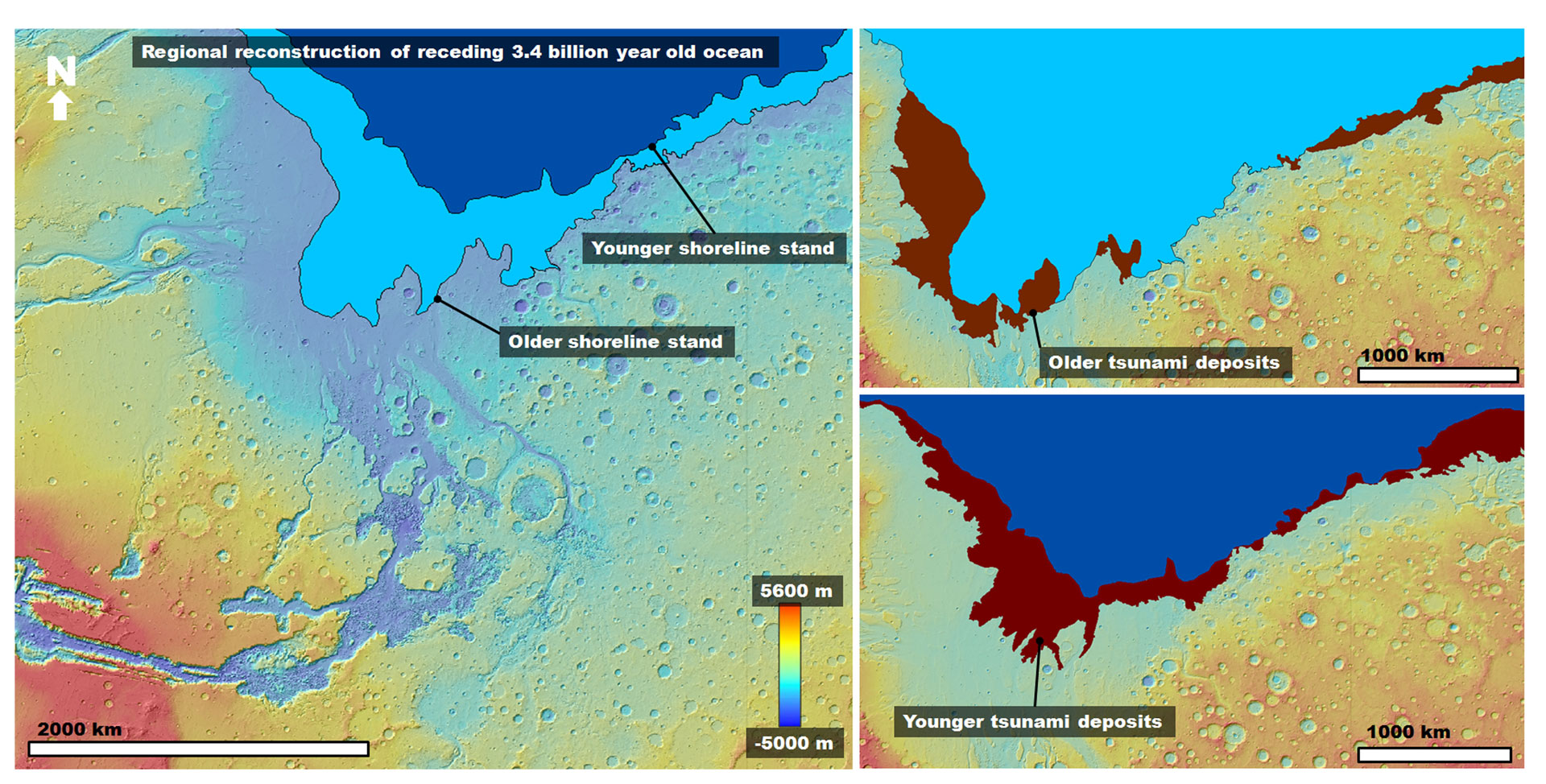
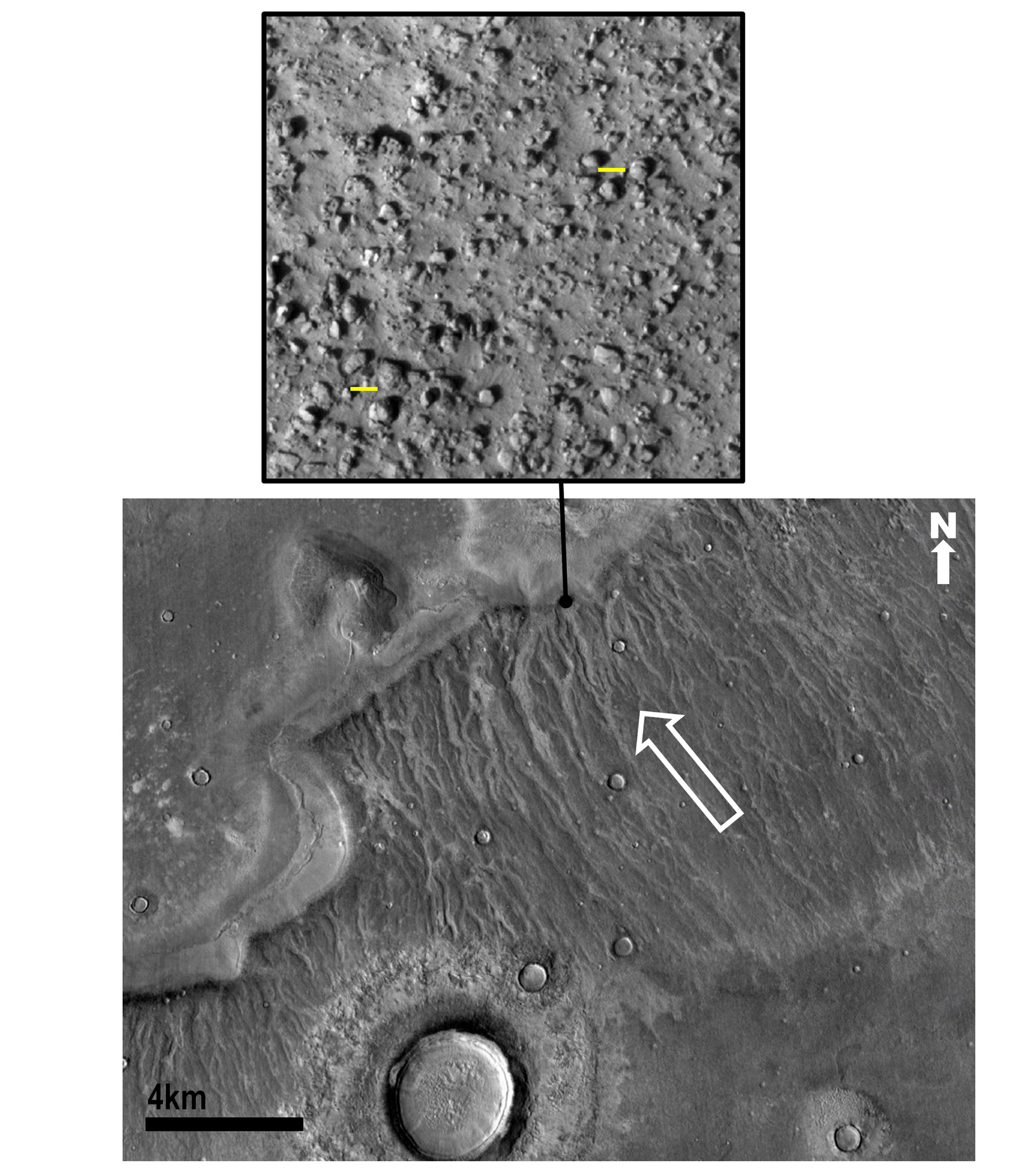
“We were surprised to find that the older and younger tsunami deposits look so different,” said Rodriguez. “The older tsunami washed ashore and deposited enormous volumes of debris, and evidence for the water hurtling back into the ocean is represented in widespread ‘backwash.’”
Following the formation of the ocean, and in the absence of widespread river systems that could have refilled it, its coastline receded to a lower elevation. The research documents two mega-tsunami events – giant waves that may have formed as a result of impacts slamming into Mars’ ocean.
“We think that after the ocean shoreline receded to a lower elevation – which likely resulted during a period of extreme climatic cooling lasting several million years – the younger tsunami occurred with enormous waves freezing as it washed over the frozen Martian landscape. The waves froze rapidly, even before they had a chance to flow back into the ocean,” Rodriguez said.
A key implication of the study is that the tsunami deposits can be used to reconstruct the evolution of the Martian climate during the lifetime of the ocean, and the younger deposits likely contain ice remnants from the ancient ocean itself. From a bystander’s viewpoint, if Mars was also covered by red dust then, as it is today, the ocean might have looked red while the particles settled to the bottom.
“The tsunami deposits likely contain rocks and sediments from the ocean floor that were picked up and transported landward by the enormous waves,” said Virginia Gulick, senior research scientist at the SETI Institute and NASA Ames, and a co-author on the paper. “Tsunami deposits are similar to flood deposits except that they are moving in the reverse – landward – direction.”
The researchers believe the ocean floor might have provided habitable environments if the ocean persisted long enough. ”On Earth, tsunami deposits contain a significant mud or fine-grained component; on Mars, this finer-grained component could have preserved physical or chemical evidence of past microbial activity, if it existed,” said Gulick. “If there were habitable environments, then biosignatures also could have been preserved in the large boulders visible in the older flow deposits.”
The research was conducted using visible and thermal images, combined with digital topography from Mars Odyssey, the Mars Reconnaissance Orbiter (MRO), and the Mars Global Surveyor. The research team was supported by the NASA Postdoctoral Program, NASA’s Planetary Geology and Geophysics Program, NASA’s MRO HiRISE, and the NASA Astrobiology Institute.
Never miss a breakthrough: Join the SciTechDaily newsletter.
Follow us on Google and Google News.