
Close Menu
    Facebook X (Twitter) Instagram
    SciTechDaily
    • Biology
    • Chemistry
    • Earth
    • Health
    • Physics
    • Science
    • Space
    • Technology
    Facebook X (Twitter) Pinterest YouTube RSS
    SciTechDaily
    Home»Space»Cassini Views a Disruption in Saturn’s Narrow F Ring
    Space

    Cassini Views a Disruption in Saturn’s Narrow F Ring

    By SciTechDailyJune 13, 20163 Comments2 Mins Read
    Facebook Twitter Pinterest Telegram LinkedIn WhatsApp Email Reddit
    Share
    Facebook Twitter LinkedIn Pinterest Telegram Email Reddit
    Cassini Views a Disruption in Saturn's F Ring
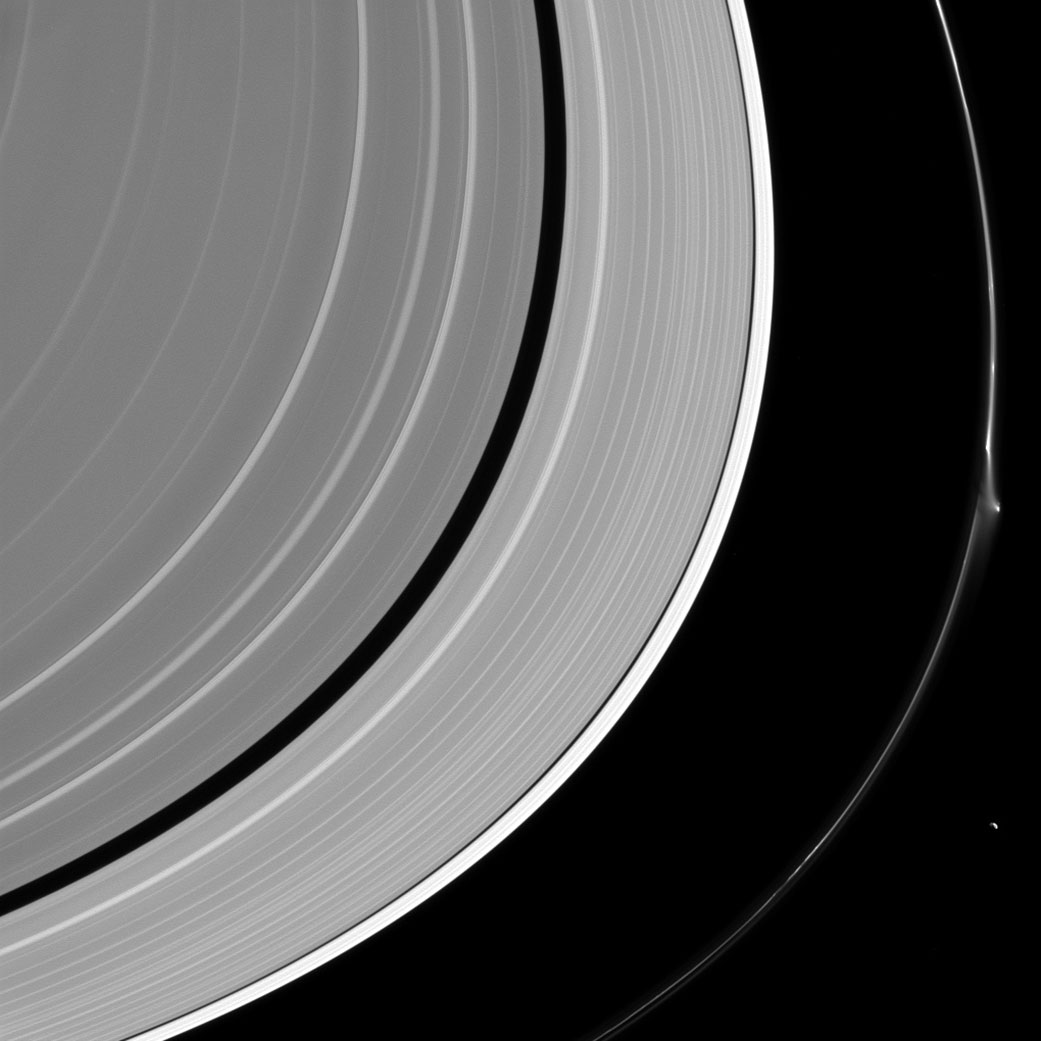
    A bright disruption in Saturn’s narrow F ring suggests it may have been disturbed recently. More likely, it was created by the interaction of a small object embedded in the ring itself and material in the core of the ring. Credit: NASA/JPL-Caltech/Space Science Institute

    NASA’s Cassini Spacecraft captures a small disruption in Saturn’s F ring; which was likely caused by the interaction of a small object embedded in the ring itself and material in the core of the ring.

    A bright disruption in Saturn’s narrow F ring suggests it may have been disturbed recently. This feature was most likely not caused by Pandora (50 miles or 81 kilometers across) which lurks nearby, at the lower right. More likely, it was created by the interaction of a small object embedded in the ring itself and material in the core of the ring. Scientists sometimes refer to these features as “jets.”

    Because these bodies are small and embedded in the F ring itself, they are difficult to spot at the resolution available to NASA’s Cassini spacecraft. Instead, their handiwork reveals their presence, and scientists use the Cassini spacecraft to study these stealthy sculptors of the F ring.

    This view looks toward the sunlit side of the rings from about 15 degrees above the ring plane. The image was taken in visible light with the Cassini spacecraft narrow-angle camera on April 8, 2016.

    The view was acquired at a distance of approximately 1.4 million miles (2.2 million kilometers) from Saturn and at a Sun-Saturn-spacecraft, or phase, angle of 105 degrees. The image scale is 8 miles (13 kilometers) per pixel.

    Never miss a breakthrough: Join the SciTechDaily newsletter.
    Follow us on Google and Google News.

    Astronomy Cassini-Huygens Mission Planetary Science Saturn
    Share. Facebook Twitter Pinterest LinkedIn Email Reddit

    Related Articles

    New Study Details the Changes in Saturn’s F Ring

    Cassini Reveals Possible New Moon Forming Around Saturn

    NASA Detects Ocean Inside Saturn’s Moon Enceladus

    Cassini Reveals Clues about Saturn’s Moon Titan

    Massive Saturn Storm Churns Up Water Ice from Great Depths

    Cassini Views a Spinning Vortex at Saturn’s North Pole

    Cassini Observes Meteors Colliding With Saturn’s Rings

    NASA’s Cassini Catches a Glimpse of Venus From Saturn Orbit

    Storm Spawns the Largest Tropospheric Vortex Ever Seen on Saturn

    3 Comments

    1. Mykl on June 13, 2016 12:47 pm

      What’s the missing unit in the phrase “from about 15 above the ring plane”? What’s so hard about the writers (editors?) always proofreading SciTech Daily’s articles? (And why don’t they ever respond to readers’ comments?)

      Oh, and how can the perturbing “small object” be embedded in the F ring itself when it appears to be clearly outside of the ring?

      Reply
      • Staff on June 13, 2016 5:11 pm

        The typo was in the press release from NASA…they haven’t specified what the missing unit is in that phrase. Sorry

        “This feature was mostly likely not caused by Pandora (50 miles or 81 kilometers across) which lurks nearby, at lower right. More likely, it was created by the interaction of a small object embedded in the ring itself and material in the core of the ring.”

        Reply
      • KSH on June 14, 2016 8:30 pm

        I read it to mean 15 degrees. I would assume 0 degrees would be the ring plane (equator). 15 degrees would be 15 degrees latitude w.r.t. Saturn looking straight down at the rings.

        Reply
    Leave A Reply Cancel Reply

    • Facebook
    • Twitter
    • Pinterest
    • YouTube

    Don't Miss a Discovery

    Subscribe for the Latest in Science & Tech!

    Trending News

    The Universe Is Expanding Too Fast and Scientists Can’t Explain Why

    “Like Liquid Metal”: Scientists Create Strange Shape-Shifting Material

    Early Warning Signals of Esophageal Cancer May Be Hiding in Plain Sight

    Common Blood Pressure Drug Shows Surprising Power Against Deadly Antibiotic-Resistant Superbug

    Scientists Uncover Dangerous Connection Between Serotonin and Heart Valve Disease

    Scientists Discover a “Protector” Protein That Could Help Reverse Hair Loss

    Bone-Strengthening Discovery Could Reverse Osteoporosis

    Scientists Uncover Hidden Trigger Behind Stem Cell Aging

    Follow SciTechDaily
    • Facebook
    • Twitter
    • YouTube
    • Pinterest
    • Newsletter
    • RSS
    SciTech News
    • Biology News
    • Chemistry News
    • Earth News
    • Health News
    • Physics News
    • Science News
    • Space News
    • Technology News
    Recent Posts
    • Scientists Overcome Major Quantum Bottleneck, Potentially Transforming Teleportation and Computing
    • Quantum Physics’ Strangest Problem May Hold the Key to Time Itself
    • Scientists Create “Liquid Gears” That Spin Without Touching
    • The Simple Habit That Could Help Prevent Cancer
    • Forgotten Medicinal Plant Shows Promise in Fighting Dangerous Superbugs
    Copyright © 1998 - 2026 SciTechDaily. All Rights Reserved.
    • Science News
    • About
    • Contact
    • Editorial Board
    • Privacy Policy
    • Terms of Use

    Type above and press Enter to search. Press Esc to cancel.