
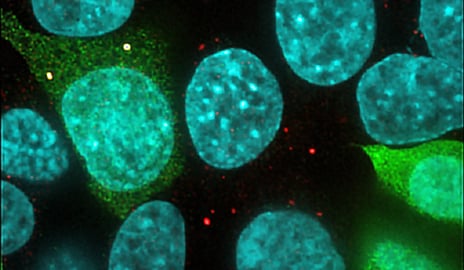
Using a technique that has revealed more than 400 new proteins too tiny to be found by other means, scientists from Yale University have helped identify a novel, functional “microprotein” encoded in the human genome.
One of those microproteins, called NoBody, is a molecular workhorse involved in sweeping out unneeded genetic material inside cells. Its discovery may signal the existence of additional microproteins involved in a host of key biological mechanisms and diseases, the researchers said.
“The broadest significance of this work is that even in a well-studied biological process, a microprotein has been right there under our noses, undetected, all this time,” said Sarah Slavoff, co-senior author of a study published December 5 in the journal Nature Chemical Biology.
Slavoff is an assistant professor of chemistry and molecular biophysics and biochemistry at Yale. She is a member of the Chemical Biology Institute at Yale’s West Campus.
The study’s first author is Nadia D’Lima, a researcher in Slavoff’s lab. Alan Saghatelian of the Salk Institute for Biological Studies is the study’s other co-senior author.
“Despite how much we know about the human genome, there are still blind spots in the genome discovery algorithms,” Saghatelian said. “You can sequence the whole human genome and never know a protein, like this one, was there because it’s too short and falls below the usual length requirement for gene assignment algorithms.”
In previous work, the researchers began their search for microproteins by examining myeloid leukemia cells and removing the larger proteins. They used an analytical chemistry technique, liquid chromatography-mass spectroscopy proteomics, to find the amino acid sequences of every remaining protein.
Next, the researchers developed a computational method to build a database of all possible microproteins in the sample. From this database, Slavoff and her colleagues found more than 400 new microproteins.
The study focused on a microprotein called NoBody, which stands for non-annotated P-body dissociating polypeptide. The researchers found that NoBody is a key ingredient in cells for recycling mRNA — genetic blueprints for producing proteins — after those proteins have been created.
Slavoff said the finding hints that microproteins may play important roles in many biological processes, as well as disease. There are many neurological diseases, for example, that feature groupings of proteins.
Additional authors of the study included Lauren Winkler of Yale, Jiao Ma and Qian Chu of the Salk Institute, Ken H. Loh of the Massachusetts Institute of Technology, Elizabeth O. Corpuz and Jens Lykke-Anderson of the University of California-San Diego, and Bogdan A Budnik of Harvard.
The research was funded by a George E. Hewitt Foundation for Medical Research postdoctoral fellowship, the National Institutes of Health, the Leona M. and Harry B. Helmsley Charitable Trust, and Dr. Frederik Paulsen Chair/Ferring Pharmaceuticals.
Reference: “Peptidomic discovery of short open reading frame–encoded peptides in human cells” by Sarah A Slavoff, Andrew J Mitchell, Adam G Schwaid, Moran N Cabili, Jiao Ma, Joshua Z Levin, Amir D Karger, Bogdan A Budnik, John L Rinn and Alan Saghatelian, 18 November 2016, Nature Chemical Biology.
DOI: 10.1038/nchembio.1120
Never miss a breakthrough: Join the SciTechDaily newsletter.
Follow us on Google and Google News.
1 Comment
Cells are the protein factories. Nobody knows complete list of proteins they make which is embedded in DNA spiral.’Nobody’ microprotein is doing the scavengers job just like its larger version like Lysosome. Thank You.