
Close Menu
    Facebook X (Twitter) Instagram
    SciTechDaily
    • Biology
    • Chemistry
    • Earth
    • Health
    • Physics
    • Science
    • Space
    • Technology
    Facebook X (Twitter) Pinterest YouTube RSS
    SciTechDaily
    Home»Chemistry»Scientists Grow “Gold Quantum Needles” for Sharper Biomedical Imaging
    Chemistry

    Scientists Grow “Gold Quantum Needles” for Sharper Biomedical Imaging

    By School of Science, The University of TokyoSeptember 11, 2025No Comments3 Mins Read
    Facebook Twitter Pinterest Telegram LinkedIn WhatsApp Email Reddit
    Share
    Facebook Twitter LinkedIn Pinterest Telegram Email Reddit
    Structural Evolution of Gold Nanoclusters
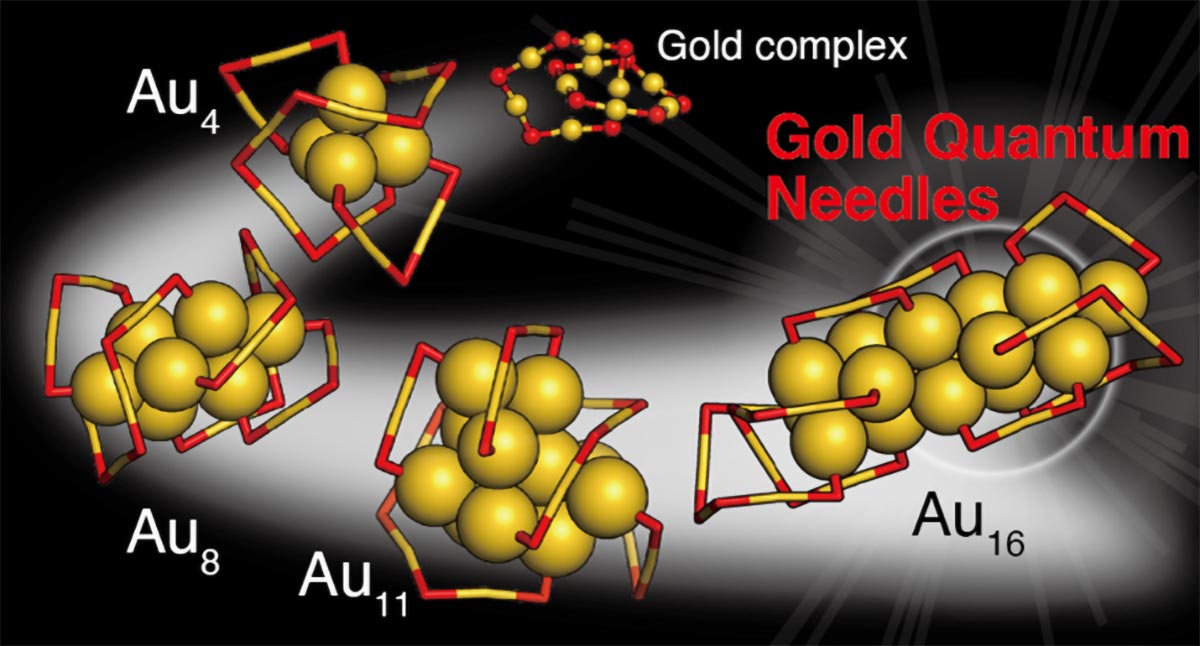
    Structural evolution of gold nanoclusters: From anisotropic nucleation to growth into gold quantum needles. The structures were determined by X-ray crystallography. Organic residues of the surface ligands were omitted for clarity. Color code: Au (gold): yellow; S: red. Credit: Takano et al 2025

    Potential applications range from biomedical imaging to the conversion of light energy.

    University of Tokyo researchers Shinjiro Takano, Yuya Hamasaki, and Tatsuya Tsukuda have directly imaged how the geometric arrangement of atoms in gold nanoclusters develops at the very earliest stages of growth.

    Under the same conditions, the team also “grew” an unexpected elongated nanocluster structure that they named “gold quantum needles.” Because these “needles” respond strongly to near-infrared light, they could enable much sharper biomedical imaging and more effective light-energy conversion. The findings were reported in the Journal of the American Chemical Society.

    Gold may evoke luxury, yet at the nanoscale, it is a vital material in modern technology because it forms unusual structures with distinct properties. Gold nanoclusters with fewer than 100 atoms are typically produced by reducing, that is, adding electrons, gold precursor ions in the presence of protective ligands. Despite this, achieving precise control over size, shape, and composition remains difficult.

    Opening the “Black Box” of Cluster Formation

    “Over the past years,” says Tsukuda, the principal investigator, “much effort has been devoted to understanding the correlation between the structure and physicochemical properties of the nanoclusters. However, the formation process is regarded as a black box. We initiated this project with the belief that understanding the initial stages of cluster formation will lead to the development of new, targeted synthesis methods for desired structures.”

    The researchers thus set out to determine the geometric structures of gold nanoclusters at the initial stages of their formation. They used slightly unusual synthesis conditions to trap the nanoclusters in the very first stages of growth. Single-crystal X-ray diffraction analysis, an X-ray for chemical compounds, if you will, revealed that gold nanoclusters grew anisotropically, at a different rate in different directions.

    The Discovery of Gold Quantum Needles

    Moreover, the analysis revealed an entirely new structure: pencil-shaped nanoclusters composed of triangular trimers and tetrahedral tetramers. The researchers named them “gold quantum needles” because the electrons confined in these nanoclusters demonstrated quantized behavior, a quantum phenomenon in which electrons can take only specific potential energies.

    “We could retroactively explain the formation processes of a series of small gold nanoclusters under our unusual synthetic conditions,” Tsukuda explains. “However, the formation of needles with a base of a triangle of three gold atoms instead of a nearly spherical cluster is a serendipitous finding that was far beyond our imagination.”

    The structural snapshots the researchers acquired of the stepwise growth of gold nanoclusters greatly contribute to our understanding of the formation mechanism. However, Tsukuda is already thinking about the next steps.

    “We would like to explore synthesizing other, unique nanoclusters by refining the synthesis conditions further. We would also like to collaborate with other experts to promote the application of gold quantum needles, leveraging their exceptional optical properties.”

    Reference: “X-ray Crystallographic Visualization of a Nucleation and Anisotropic Growth in Thiolate-Protected Gold Clusters: Toward Targeted Synthesis of Gold Quantum Needles” by Shinjiro Takano, Yuya Hamasaki and Tatsuya Tsukuda, 4 September 2025, Journal of the American Chemical Society.
    DOI: 10.1021/jacs.5c11089

    Never miss a breakthrough: Join the SciTechDaily newsletter.
    Follow us on Google and Google News.

    Biotechnology Materials Science Nanotechnology University of Tokyo
    Share. Facebook Twitter Pinterest LinkedIn Email Reddit

    Related Articles

    Superbug Killer: New Nanotech Destroys Bacteria and Fungal Cells, While Leaving Human Cells Unharmed

    Moiré Than Meets the Eye: Carbon Nanotubes Self-Assemble Into Complex Structures for Materials Research

    Chemists Invent Shape-Shifting Nanomaterial With Intriguing Biomedical Potential

    Scientists Discover Structural Change in Manganese Steel

    Researchers Develop a Better Method for Making Perovskite Solar Cells

    Copper Foam Provides a New Way to Turn CO2 into Useful Chemicals

    Researchers Grow Single-Walled Carbon Nanotubes with Identical Electronic Properties

    Researchers Identify a New Form of Carbon: Grossly Warped ‘Nanographene’

    Scientists Examine Platinum-Based Catalyst Design

    Leave A Reply Cancel Reply

    • Facebook
    • Twitter
    • Pinterest
    • YouTube

    Don't Miss a Discovery

    Subscribe for the Latest in Science & Tech!

    Trending News

    NASA’s Voyager 1 Is About to Become the First Spacecraft One Light-Day From Earth

    A Woman Who Lived 30,000 Years Ago Is Changing What We Know About Ice Age Europe

    A Rare Radioactive Element Reveals a Hidden Secret About the Heaviest Atoms

    Breakthrough Cancer Treatment Wipes Out Deadly Brain Tumors in Every Mouse Tested

    Something Remarkable Is Happening to Dogs Living Near Chernobyl’s Nuclear Plant

    Hubble Uncovers a Mysterious 93-Billion-Mile Structure Hiding in a Nearby Star System

    Earth’s Oceans Were Slowly Suffocating Millions of Years Before a Devastating Mass Extinction

    Why Are Men Twice As Likely To Develop Parkinson’s? Scientists Discover a Hidden Clue in the Brain

    Follow SciTechDaily
    • Facebook
    • Twitter
    • YouTube
    • Pinterest
    • Newsletter
    • RSS
    SciTech News
    • Biology News
    • Chemistry News
    • Earth News
    • Health News
    • Physics News
    • Science News
    • Space News
    • Technology News
    Recent Posts
    • Scientists Engineer Rice That Fights Back Against a Devastating Crop Disease
    • Deep-Sea Scientists Capture Extraordinary 4K Footage of a Fish With a See-Through Head
    • Scientists Find That Older Brains React Very Differently to a Night of Poor Sleep
    • A Hidden Substance in Drinking Water May Be Linked to Heart Problems in Children
    • Scientists Find a Clever Way to Read Quantum Information Without Destroying It
    Copyright © 1998 - 2026 SciTechDaily. All Rights Reserved.
    • Science News
    • About
    • Contact
    • Editorial Board
    • Privacy Policy
    • Terms of Use

    Type above and press Enter to search. Press Esc to cancel.