
Close Menu
    Facebook X (Twitter) Instagram
    SciTechDaily
    • Biology
    • Chemistry
    • Earth
    • Health
    • Physics
    • Science
    • Space
    • Technology
    Facebook X (Twitter) Pinterest YouTube RSS
    SciTechDaily
    Home»Chemistry»Moiré Than Meets the Eye: Carbon Nanotubes Self-Assemble Into Complex Structures for Materials Research
    Chemistry

    Moiré Than Meets the Eye: Carbon Nanotubes Self-Assemble Into Complex Structures for Materials Research

    By University of TokyoMarch 10, 2021No Comments3 Mins Read
    Facebook Twitter Pinterest Telegram LinkedIn WhatsApp Email Reddit
    Share
    Facebook Twitter LinkedIn Pinterest Telegram Email Reddit
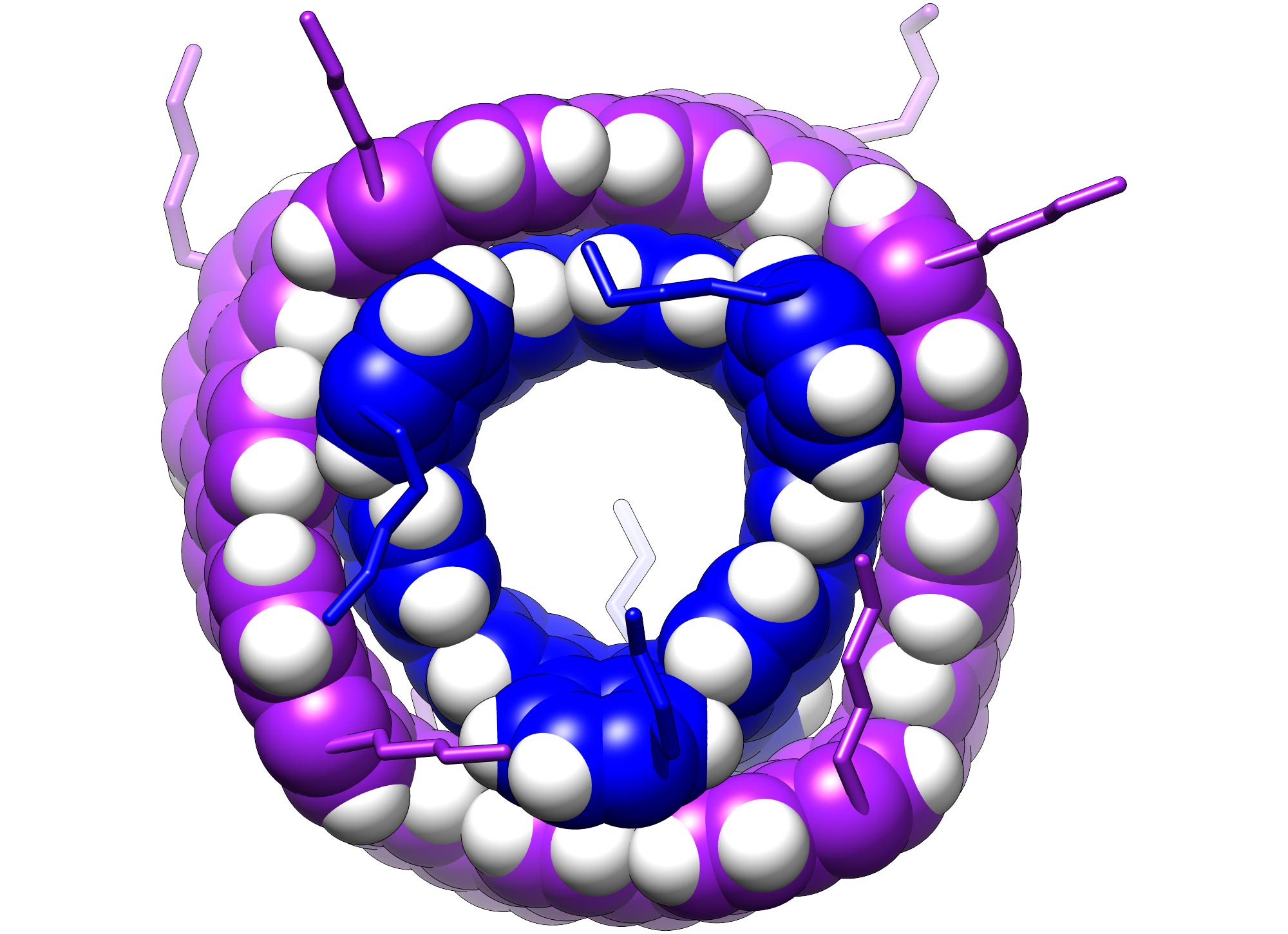
    Carbon Bilayer Crystal Structure
    The crystal structure of a carbon bilayer. The purple outer layer and blue inner layer each have a similar arrangement of carbon atoms but are rotated relative to each other by just a few degrees. Credit: © 2021 Isobe et al.

    New moiré-patterned carbon nanotubes may revolutionize materials science and superconductivity.

    Material behaviors depend on many things including not just the composition of the material but also the arrangement of its molecular parts. For the first time, researchers have found a way to coax carbon nanotubes into creating moiré patterns. Such structures could be useful in materials research, in particular in the field of superconducting materials.

    Professor Hiroyuki Isobe from the Department of Chemistry at the University of Tokyo, and his team create nanoscopic material structures, primarily from carbon. Their aim is to explore new ways to create carbon nanostructures and to find useful applications for them. The most recent breakthrough from their lab is a new form of carbon nanotube with a very specific arrangement of atoms that has attracted much attention in the field of nanomaterials.

    “We successfully created different kinds of atom-thick carbon nanotubes which self-assemble into complex structures,” said Isobe. “These nanotubes are made from rolled up sheets of carbon atoms arranged hexagonally. We made wide ones and narrow ones which fit inside them. This means the resulting complex tube structure has a double-layered wall. The hexagonal patterns of these layers are offset such that the two layers together create what is known as a moiré pattern. And this is significant for materials researchers.”


    When repeating patterns overlap and are rotated, they create these mesmerizing arrangements called moiré patterns. Here hexagonal grids are rotated in either direction. Credit: The University of Tokyo/Rohan Mehra

    You may see moiré patterns in your everyday life. When repeating patterns overlay one another a new resultant pattern emerges. If you then move one of the layers, or if you move relative to the layers, this resultant pattern will change slightly. For example, if you look at a screen door through a mesh curtain, or if you hold two sieves together. In the case of the team’s moiré patterns, they are made when one hexagonal grid of carbon atoms is rotated slightly relative to another similar hexagonal grid.

    Potential Applications in Chemistry and Superconductivity

    These patterns aren’t just for show, they can imbue materials with functional properties. Two areas that might especially benefit from the properties created here are synthetic chemistry, as the moiré carbon bilayer tubes could be challenging yet attractive targets of molecular self-assembly, and superconducting materials, which could lead to a generational leap in electrical devices which require far less power to run and would be far more capable than current devices.

    Reference: “Stereoselectivity in spontaneous assembly of rolled incommensurate carbon bilayers” by Taisuke Matsuno, Yutaro Ohtomo, Maki Someya and Hiroyuki Isobe, 10 March 2021, Nature Communications.
    DOI: 10.1038/s41467-021-21889-8

    This study is partly supported by JST ERATO (JPMJER1301), KAKENHI (19H05376, 20H05672, 20K15239) and the Asahi Glass Foundation.

    Never miss a breakthrough: Join the SciTechDaily newsletter.
    Follow us on Google and Google News.

    Materials Science Nanotechnology Nanotubes University of Tokyo
    Share. Facebook Twitter Pinterest LinkedIn Email Reddit

    Related Articles

    Scientists Grow “Gold Quantum Needles” for Sharper Biomedical Imaging

    Researchers Grow Single-Walled Carbon Nanotubes with Identical Electronic Properties

    Scientists Develop a New Nanobiocomposite Material

    Researchers Identify a New Form of Carbon: Grossly Warped ‘Nanographene’

    Scientists Control Chirality in Carbon Nanotubes

    Spray-on Mixture Combines Carbon Nanotubes With Ceramic

    MIT Team Uses Carbon Nanotubes to Draw Gas Sensors

    Scientists Examine Platinum-Based Catalyst Design

    Artificial System Models Light-Capturing Method Used by Deep-Sea Bacteria

    Leave A Reply Cancel Reply

    • Facebook
    • Twitter
    • Pinterest
    • YouTube

    Don't Miss a Discovery

    Subscribe for the Latest in Science & Tech!

    Trending News

    Your Blood Pressure Reading Could Be Wrong Because of One Simple Mistake

    Astronomers Stunned by Ancient Galaxy With No Spin

    Physicists May Be on the Verge of Discovering “New Physics” at CERN

    Scientists Solve 320-Million-Year Mystery of Reptile Skin Armor

    Scientists Say This Daily Walking Habit May Be the Secret to Keeping Weight Off After Dieting

    New Therapy Rewires the Brain To Restore Joy in Depression Patients

    Giant Squid Detected off Western Australia in Stunning Deep-Sea Discovery

    Popular Sugar-Free Sweetener Linked to Liver Disease, Study Warns

    Follow SciTechDaily
    • Facebook
    • Twitter
    • YouTube
    • Pinterest
    • Newsletter
    • RSS
    SciTech News
    • Biology News
    • Chemistry News
    • Earth News
    • Health News
    • Physics News
    • Science News
    • Space News
    • Technology News
    Recent Posts
    • Scientists Revive Ancient Chemistry Trick To Engineer Next-Generation Glass
    • Scientists Use AI To Supercharge Ultrafast Laser Simulations by More Than 250x
    • Scientists Just Found a Surprising Way To Destroy “Forever Chemicals”
    • Popular Supplement Ingredient Linked to Shorter Lifespan in Men
    • Scientists May Have Found a Way To Repair Nerve Damage in Multiple Sclerosis
    Copyright © 1998 - 2026 SciTechDaily. All Rights Reserved.
    • Science News
    • About
    • Contact
    • Editorial Board
    • Privacy Policy
    • Terms of Use

    Type above and press Enter to search. Press Esc to cancel.