
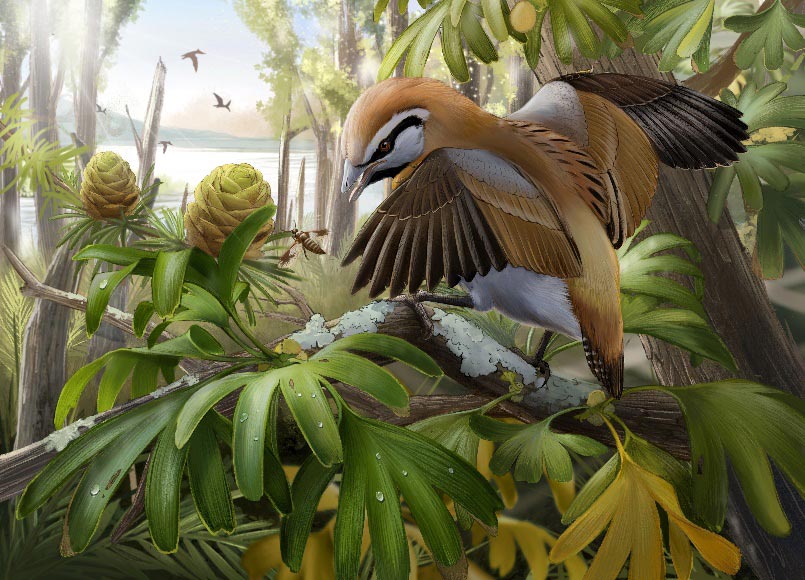
A 120-million-year-old bird fossil shows the earliest long tongue adaptation.
A new fossil skeleton of an extinct species of bird from northeastern China that lived alongside dinosaurs 120 million years ago unexpectedly preserves a bony tongue that is nearly as long as its head.
The skull is very well preserved, showing that it had a relatively short snout and small teeth, with extremely long and curved bones for the tongue (called the hyoid apparatus).
Scientists from the Institute of Vertebrate Paleontology and Paleoanthropology (IVPP) of the Chinese Academy of Sciences and the University of Texas at Austin have named this bird Brevirostruavis macrohyoideus, which means “bird with a short snout and big tongue.”
Their discovery was published in Journal of Anatomy on December 1, 2021.
The Anatomy of a Bird Tongue
We learn quickly as children to stick out our tongues, but most reptiles and birds do not have large muscular tongues like humans. Birds instead have a set of rod-shaped elements made of bone and cartilage comprising the hyoid apparatus that sits in the floor of their mouth.
In birds with larger tongues like ducks and parrots, they use their tongue to move food around in their mouth, get food into their mouth, and help to swallow food. Some birds today like hummingbirds and woodpeckers have a bony tongue as long or longer than their skulls.
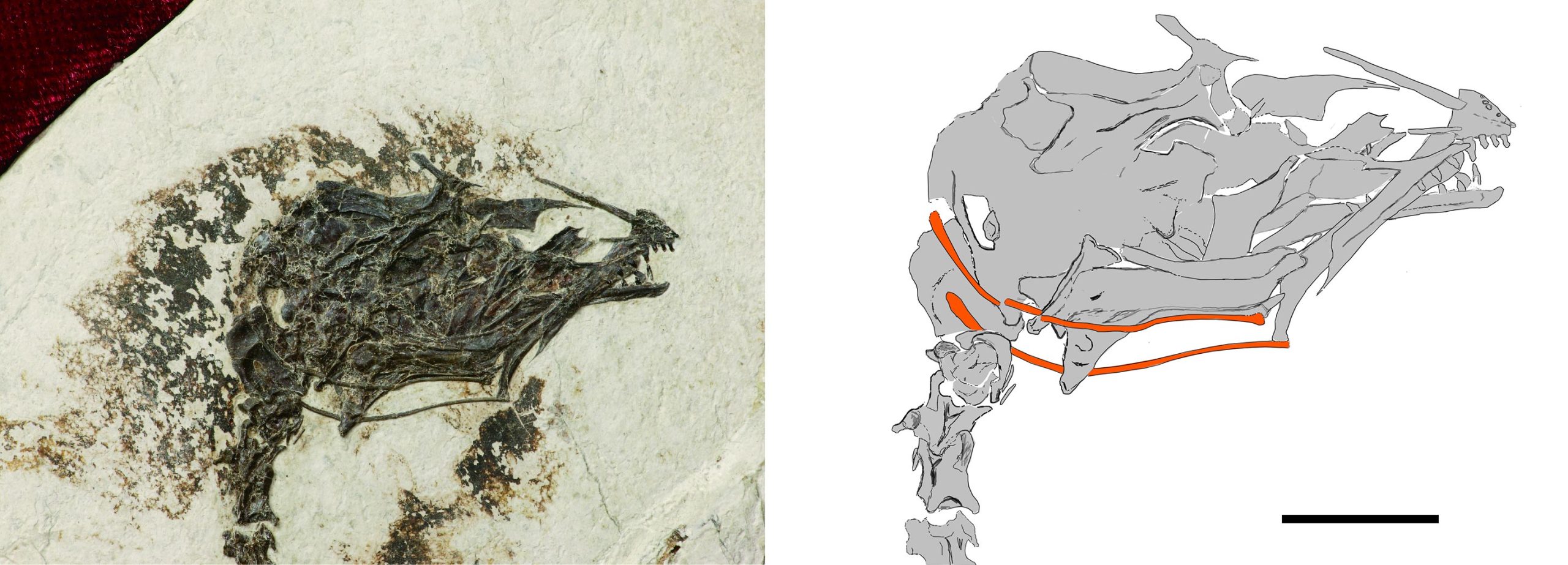
This extinct short-snouted, big-tongued bird is the earliest example of a bird being able to stick its tongue out. Of course, this feature makes one wonder why this bird would be sticking its tongue out. The scientists hypothesized that the bird might have used this feature for catching insects in the same way that living woodpeckers use their tongues to get insects out of holes in bark, wood, and tree branches. Alternatively, the bird might have been feeding on pollen or nectar-like liquids from plants in the forest where it lived. No stomach contents were found with this skeleton.
Enantiornithines: The “Opposite” Birds
This short-snouted, big-tongued bird is part of an extinct group of birds called enantiornithines or “opposite” birds. They were the most successful group of birds during the Cretaceous Period (between 66 and 145 million years ago), with fossils found around the world.
“We see a lot of variation in the size and shape of the skulls of enantiornithine birds and that probably reflects the great diversity of the foods they ate and how they caught their food. Now with this fossil, we see that it’s not just their skulls, but their tongues that also vary,” said Dr. WANG Min, co-author of the study.
Evolutionary Constraints and Adaptations
The researchers previously showed that these early birds had fairly rigid skulls like their dinosaur relatives. This feature set some evolutionary and functional restrictions on early birds. “Perhaps the only way for them to fundamentally change through evolution how they caught their food and what food they ate was to shorten their skull in this case and to make the tongue bones much longer,” said lead author Dr. LI Zhiheng.
The long, curved hyoid apparatus in the fossil bird is made of bones called ceratobranchials. Living birds also have such bones in their hyoid, but it is the epibranchial bones, absent in early birds, that are very long in birds like woodpeckers.
“Animals experiment evolutionarily with what they have available. This bird evolved a long tongue using the bones it inherited from its dinosaur ancestors, and living birds evolved longer tongues with the bones that they have. This situation demonstrates the power of evolution, with birds using two different evolutionary pathways to solve the same problem of making a long tongue to stick out of their mouths,” said co-author Dr. Thomas Stidham.
Reference: “Novel evolution of a hyper-elongated tongue in a Cretaceous enantiornithine from China and the evolution of the hyolingual apparatus and feeding in birds” by Zhiheng Li, Min Wang, Thomas A. Stidham, Zhonghe Zhou and Julia Clarke, 1 December 2021, Journal of Anatomy.
DOI: 10.1111/joa.13588
Never miss a breakthrough: Join the SciTechDaily newsletter.
Follow us on Google and Google News.