
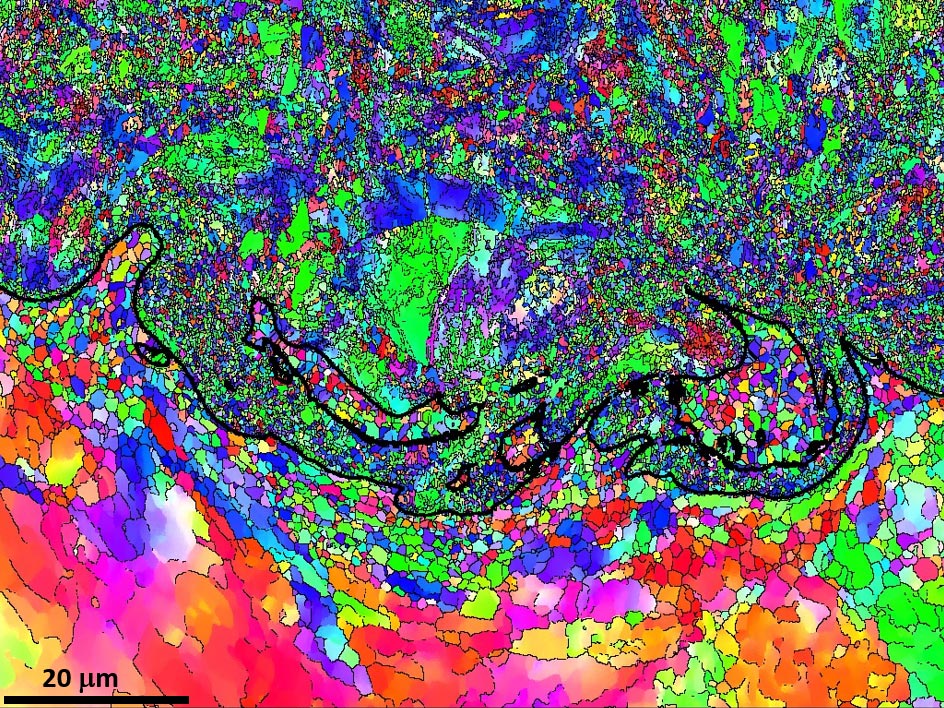
Researchers found that vortex structures in Cold Spray coatings form due to particle rebound under low efficiency. This insight could improve adhesion and optimize the CS process for industrial use.
An international team of researchers has solved a puzzling phenomenon whereby strangely beautiful, vortex-like structures appear between materials deposited onto engineering components used in multiple settings – from space shuttles to household items and everyday transport vehicles.
The discovery may ultimately improve the efficiency of the “Cold Spray” (CS) deposition process from which these structures are formed – a not-insignificant consideration from a financial perspective, or from a functional one given that some of the materials created by CS are pushed to the limit in outer space.
The discovery is featured on the front cover of the international journal, Materials & Design.
Cold Spray (CS) and Deposition Efficiency (DE)
CS enables the formation of coatings, typically metallic, over a substrate material. The technique is highly useful as it does not require engineers to reach the melting temperature of materials to combine the coatings and substrates.
Particles (or metal powder) with a typical diameter about ½ the size of a human hair are propelled at supersonic speeds via an accelerating gas over a substrate surface.
Plastic deformation is key in this process; each tiny particle deforms on impact and triggers a complex bonding process that results in substrate adhesion and in particle-particle adhesion after a first deposition layer is formed.
However, not all the particles adhere. The deposition efficiency (DE) measures the ratio of deposition vs rebound. For example, a DE of 50% means only 50% of the particles incoming flux have adhered to the coating zone.
Inefficiency in the process is a major hurdle given that it is an expensive technique, so increasing efficiency (and driving down costs) is a key research focus.
The Vortex-Like Structures
For quite some time engineers have been observing strange, vortex-like structures at the interface location, between the coatings and the substrates. They are much smaller than the particles, which presented a puzzle: what are they and how do they form?
What’s more, these structures don’t always appear and, when they do, they show up in a rather random fashion.
Rocco Lupoi, Assistant Professor in Trinity College Dublin’s School of Engineering, who is the work leader, teamed up with close colleagues and experts in China, the US, Czech Republic and with the Advanced Microscopy Laboratory (AML) in Trinity to solve the puzzle.
He said:
“We discovered that the interface vortices only form when the CS process is not working very well, and thus has low DE values. Under low deposition efficiency, most of the sprayed particles rebound after their impact. By causing severe plastic deformation of the first-layer coating and substrate this results in a ‘hammer effect’, which leads to the formation of the vortices.
“This formation also depends on the coating-substrate material combination where the coating materials must have sufficiently high density to generate enough energy for creating large plastic deformation of the first-layer coating and substrate. Additionally, the substrate materials cannot be too hard so that plastic deformation can be induced onto it.
Toward Better Performance and Bond Strength
“Potentially, our discovery may help to improve the adhesion between the cold-sprayed coatings and the substrates. To benefit from this, while maintaining reasonable process economy, one could first create an intermixing interface through low-DE deposition, followed by production of the coating using optimized processing parameters.”
Shuo Yin, Assistant Professor in Trinity’s School of Engineering, who is the first author in the paper and the lead scientist in this work added:
“This was a great multi-disciplinary effort and has shed some light into a phenomenon that had puzzled the community for some time. The CS process does not function via the melting of the feedstock material, which is advantageous because it means there are limited to no-heat-affected zones, microstructural changes, or distortions to worry about on the end products.”
“Despite progress, CS remains a process under development, so part of our work is focused on improving the deposition performance, coating quality, and substrate-coating bond strength. We hope this discovery opens the door to further improvements on that front.”
Reference: “Formation conditions of vortex-like intermixing interfaces in cold spray” by Shuo Yin, Jan Cizek, Jan Cupera, Mostafa Hassani, Xiaotao Luo, Richard Jenkins, Yingchun Xie, Wenya Li and RoccoLupoi, 30 December 2020, Materials & Design.
DOI: 10.1016/j.matdes.2020.109444
Never miss a breakthrough: Join the SciTechDaily newsletter.
Follow us on Google and Google News.