
Close Menu
    Facebook X (Twitter) Instagram
    SciTechDaily
    • Biology
    • Chemistry
    • Earth
    • Health
    • Physics
    • Science
    • Space
    • Technology
    Facebook X (Twitter) Pinterest YouTube RSS
    SciTechDaily
    Home»Space»Astronomers Identify Massive 10 Billion Year Old Brown Dwarf
    Space

    Astronomers Identify Massive 10 Billion Year Old Brown Dwarf

    By Royal Astronomical SocietyMarch 24, 20171 Comment3 Mins Read
    Facebook Twitter Pinterest Telegram LinkedIn WhatsApp Email Reddit
    Share
    Facebook Twitter LinkedIn Pinterest Telegram Email Reddit
    Astronomers Identify Massive Brown Dwarf
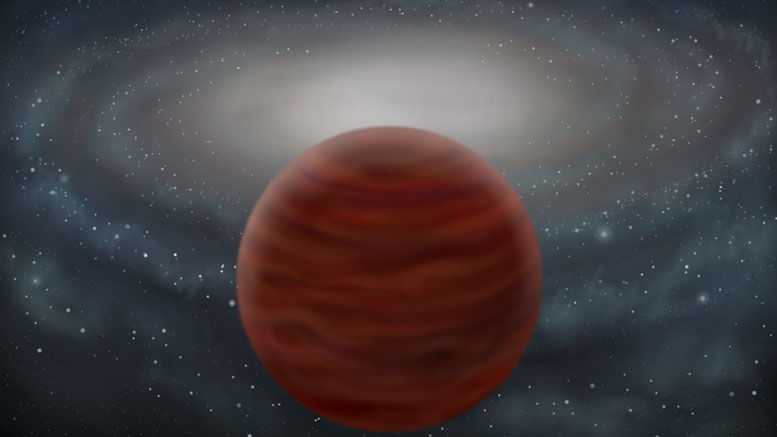
    An artist’s impression of the new pure and massive brown dwarf. Credit: John Pinfield.

    Astronomers have identified a brown dwarf that was formed about 10 billion years ago and is made of gas that is around 250 times purer than the Sun.

    An international team of astronomers has identified a record breaking brown dwarf (a star too small for nuclear fusion) with the ‘purest’ composition and the highest mass yet known. The object, known as SDSS J0104+1535, is a member of the so-called halo – the outermost reaches – of our Galaxy, made up of the most ancient stars. The scientists report the discovery in Monthly Notices of the Royal Astronomical Society.

    Brown dwarfs are midway between planets and fully-fledged stars. Their mass is too small for full nuclear fusion of hydrogen to helium (with a consequent release of energy) to take place, but they are usually significantly more massive than planets.

    SDSS J0104+1535 is located 750 light-years away in the constellation of Pisces and is made of gas that is around 250 times purer than the Sun, consisting of more than 99.99% hydrogen and helium. It is estimated to have formed about 10 billion years ago with measurements also suggesting it has a mass equivalent to 90 times that of Jupiter, making it the most massive brown dwarf found to date.

    It was previously not known if brown dwarfs could form from such primordial gas, and the discovery points the way to a larger undiscovered population of extremely pure brown dwarfs from our Galaxy’s ancient past.

    The research team was led by Dr. ZengHua Zhang of the Institute of Astrophysics in the Canary Islands. He said: “We really didn’t expect to see brown dwarfs that are this pure. Having found one though often suggests a much larger hitherto undiscovered population – I’d be very surprised if there aren’t many more similar objects out there waiting to be found.”

    SDSS J0104+1535 has been classified as an L-type ultra-subdwarf using its optical and near-infrared spectrum, measured using the European Southern Observatory’s Very Large Telescope (VLT). This classification was based on a scheme very recently established by Dr. Zhang.

    Reference: “Primeval very low-mass stars and brown dwarfs – II. The most metal-poor substellar object” by Z. H. Zhang 张曾华, D. Homeier, D. J. Pinfield, N. Lodieu, H. R. A. Jones, F. Allard and Ya. V. Pavlenko, 22 February 2017, MNRAS.
    DOI: 10.1093/mnras/stx350
    arXiv

    Never miss a breakthrough: Join the SciTechDaily newsletter.
    Follow us on Google and Google News.

    Astronomy Brown Dwarf Cosmology Popular Royal Astronomical Society
    Share. Facebook Twitter Pinterest LinkedIn Email Reddit

    Related Articles

    Astronomers Discover Asteroid Captured from Another Star System

    Backyard Worlds Planet 9 Citizen Science Project Discovers a Brown Dwarf

    Planet 2MASS J2126 is 1 Trillion Kilometers Away from Its Parent Star

    Two Massive Stars with Magnetic Fields Discovered in Binary System Epsilon Lupi

    Astronomers Discover Two Ancient Brown Dwarfs Moving at Speeds of 100-200 Kilometers Per Second

    Evidence Suggests Black Holes Can “Change Gears”

    Ultra-Cool Brown Dwarf Is 35 Times More Massive Than Jupiter

    New Model May Rule Out the Presence of Dark Matter

    The Bolshoi Simulation: Boxing the Universe

    1 Comment

    1. Red on March 26, 2017 7:32 pm

      This is cool!

      Reply
    Leave A Reply Cancel Reply

    • Facebook
    • Twitter
    • Pinterest
    • YouTube

    Don't Miss a Discovery

    Subscribe for the Latest in Science & Tech!

    Trending News

    Scientists Built a Programmable Chip That Can Slow Light on Command

    The Backyard “Silly Sprinkler” That Cracked One of Physics’ Biggest Puzzles

    This Common Sleep Habit Could Be Making You Gain Weight

    Mathematician Offers New Solution to a Fundamental Cosmic Paradox

    Scientists Turn Plastic Waste Into Clean Hydrogen Fuel

    Long COVID Brain Scans Reveal Damage to Dopamine Neurons

    Scientists Warn a Silent Oxygen Crisis Is Spreading Through Earth’s Waters

    James Webb Telescope Discovers Hidden Giant Planet in Famous Star System

    Follow SciTechDaily
    • Facebook
    • Twitter
    • YouTube
    • Pinterest
    • Newsletter
    • RSS
    SciTech News
    • Biology News
    • Chemistry News
    • Earth News
    • Health News
    • Physics News
    • Science News
    • Space News
    • Technology News
    Recent Posts
    • NASA Astronaut Comes Home After 3,856 Orbits of Earth
    • A Rare and Deadly Cancer May Have an Unexpected New Vulnerability
    • Sleep Disorders Don’t Just Exhaust You. New Research Shows They Change Your Brain
    • THC-CBD Treatment Dramatically Reduces Agitation in Dementia Trial
    • Rare 8,000-Year-Old Rock Shelter Captures a Turning Point in Human History
    Copyright © 1998 - 2026 SciTechDaily. All Rights Reserved.
    • Science News
    • About
    • Contact
    • Editorial Board
    • Privacy Policy
    • Terms of Use

    Type above and press Enter to search. Press Esc to cancel.