
Close Menu
    Facebook X (Twitter) Instagram
    SciTechDaily
    • Biology
    • Chemistry
    • Earth
    • Health
    • Physics
    • Science
    • Space
    • Technology
    Facebook X (Twitter) Pinterest YouTube RSS
    SciTechDaily
    Home»Space»Cassini Sees the Slim Crescent of Saturn’s Moon Enceladus
    Space

    Cassini Sees the Slim Crescent of Saturn’s Moon Enceladus

    By SciTechDailyMay 23, 2017No Comments2 Mins Read
    Facebook Twitter Pinterest Telegram LinkedIn WhatsApp Email Reddit
    Share
    Facebook Twitter LinkedIn Pinterest Telegram Email Reddit
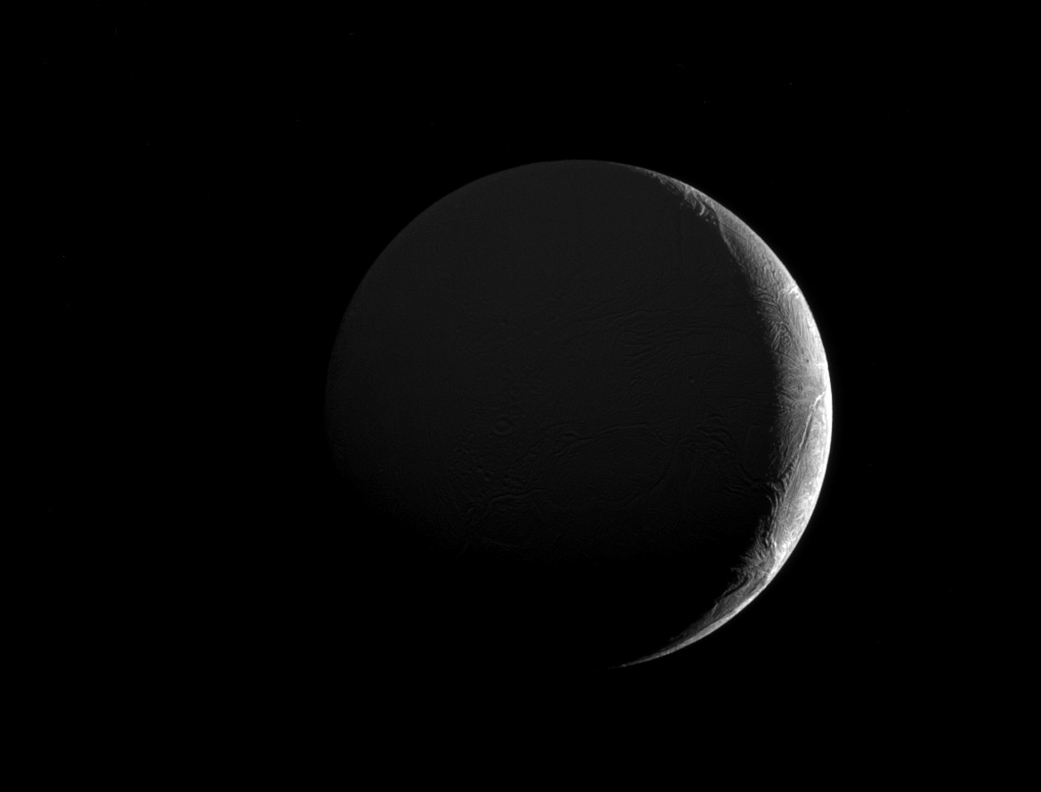
    Cassini Views the Slim Crescent of Saturn's Moon Enceladus
    Enceladus is dimly illuminated in the image above by sunlight reflected off Saturn. Credit: NASA/JPL-Caltech/Space Science Institute

    This newly released image from the Cassini Spacecraft shows the low angle of sunlight along the slim crescent of Saturn’s moon Enceladus, highlighting the many fractures and furrows on its icy surface.

    This view looks toward the Saturn-facing hemisphere of Enceladus, which is dimly illuminated in the image above by sunlight reflected off Saturn. North on Enceladus is up and rotated 14 degrees to the left. The image was taken in visible light with the Cassini spacecraft narrow-angle camera on December 26, 2016.

    The view was obtained at a distance of approximately 104,000 miles (168,000 kilometers) from Enceladus. Image scale is 3,303 feet (1 kilometer) per pixel.

    Cassini is currently executing its set of 22 Grand Finale Proximal orbits, which have a period of 6.4 days, in a plane inclined 62.4 degrees from the planet’s equatorial plane. Each orbit stretches out to an apoapsis altitude of about 1,272,000 km from Saturn, where the spacecraft’s planet-relative speed is around 6,000 km/hr. At periapsis, the distance shrinks to about 2,500 km above Saturn’s visible atmosphere (by comparison, Saturn is about 120,660 km in diameter), and the speed is around 123,000 km/hr.

    The most recent spacecraft tracking and telemetry data were obtained on May 10 using one of the 34-meter diameter DSN stations in Australia. The spacecraft continues to be in an excellent state of health with all of its subsystems operating normally except for the instrument issues described at http://saturn.jpl.nasa.gov/anomalies.

    The countdown clock in Mission Control shows 122 days until the end of the Mission.

    The Cassini mission is a cooperative project of NASA, ESA (the European Space Agency) and the Italian Space Agency. The Jet Propulsion Laboratory, a division of the California Institute of Technology in Pasadena, manages the mission for NASA’s Science Mission Directorate, Washington. The Cassini orbiter and its two onboard cameras were designed, developed and assembled at JPL. The imaging operations center is based at the Space Science Institute in Boulder, Colorado.

    Never miss a breakthrough: Join the SciTechDaily newsletter.
    Follow us on Google and Google News.

    Astronomy Cassini-Huygens Mission Enceladus Planetary Science
    Share. Facebook Twitter Pinterest LinkedIn Email Reddit

    Related Articles

    ScienceCasts Video: Close Encounter with Enceladus

    Cassini’s Deepest-Ever Dive Through the Enceladus Plume

    NASA Prepares for Historic Flyby of Icy Saturn Moon Enceladus

    NASA’s Cassini Reveals New Views of Saturn’s Moon Enceladus

    Cassini Spacecraft to Begin Flyby of Saturn’s Moon Enceladus

    Cassini Reveals Global Ocean in Saturn’s Moon Enceladus

    Activity on Enceladus Could Be ‘Curtain Eruptions’

    Astronomers Track Icy Tendrils Reaching into Saturn’s E Ring

    NASA Detects Ocean Inside Saturn’s Moon Enceladus

    Leave A Reply Cancel Reply

    • Facebook
    • Twitter
    • Pinterest
    • YouTube

    Don't Miss a Discovery

    Subscribe for the Latest in Science & Tech!

    Trending News

    Giant Crocodylians Ruled South America’s Ancient Food Chain

    Breakthrough in a Bizarre Galaxy Could Help Unlock the Mystery of Dark Matter

    Just 4 Minutes of Daily Strength Training Can Quadruple Fitness in Older Adults

    Almost All Plant-Based Meat Alternatives Contain Mycotoxins, Study Finds

    Astronomers Detect a Record-Breaking “Cosmic Laser” From 8 Billion Light-Years Away

    A 47-Year-Old Scientist Tracked Himself for Months – His Biological Age Fell to 32

    Construction Crew Uncovers Giant 20-Meter Dinosaur in Brazil

    30 Years of Hurricane Data Reveal 4 Warning Signs Before Storms Strengthen

    Follow SciTechDaily
    • Facebook
    • Twitter
    • YouTube
    • Pinterest
    • Newsletter
    • RSS
    SciTech News
    • Biology News
    • Chemistry News
    • Earth News
    • Health News
    • Physics News
    • Science News
    • Space News
    • Technology News
    Recent Posts
    • World’s Largest Trial of Robotic Knee Surgery Delivers a Surprising Result
    • Scientists Develop an Implant That Could Help the Body Clock Recover From Jet Lag Faster
    • Adults Taking More Vitamin D Scored 13% Higher on a Cognitive Test
    • A 20-Year Study Finds Preschool Can Influence Success for Years
    • 55-Million-Year-Old Penguin Fossils Preserve Clues to a Warmer Antarctica
    Copyright © 1998 - 2026 SciTechDaily. All Rights Reserved.
    • Science News
    • About
    • Contact
    • Editorial Board
    • Privacy Policy
    • Terms of Use

    Type above and press Enter to search. Press Esc to cancel.