

The colossal Antarctic iceberg A-23A, after years of drifting, now appears stuck near South Georgia Island.
Once lodged in the Southern Weddell Sea for decades, it broke free and made a slow but steady journey north—only to potentially meet its demise in the shallows. Scientists are closely watching as it either breaks apart like past ice giants or manages to escape the island’s grip.
A Titanic Iceberg Meets Its Match
Antarctic iceberg A-23A, the largest iceberg on Earth, appears to have run aground near South Georgia Island. As of early March 2025, satellite images show little movement in the massive 3,460-square-kilometer (1,240-square-mile) iceberg, which had been drifting across the Scotia Sea before reaching the island’s waters.
South Georgia is the largest of nine islands in the South Georgia and South Sandwich Islands, a British overseas territory. Though it has no permanent human population, scientists conduct research there, and tourists visit its historical sites. The region is home to a rich ecosystem, including seals, penguins, and tiny phytoplankton. It also lies along “iceberg alley,” a well-traveled route for Antarctic icebergs drifting north.
A Melting Giant’s Final Act
A-23A’s movement slowed significantly around February 25, 2025, according to Christopher Shuman, a retired glaciologist from the University of Maryland, Baltimore County. Shuman, who has tracked the iceberg’s path using satellite imagery, noted that it broke free from the seafloor in the early 2020s after being stuck in the Southern Weddell Sea for decades. Now, it sits more than 2,000 kilometers (1,200 miles) north of its origin at Antarctica’s Filchner Ice Shelf, where it originally calved in 1986.
The map above shows the iceberg’s location on March 4, 2025, with respect to the remote island and its underwater shelf. Its position is based on an image (below) acquired by the MODIS (Moderate Resolution Imaging Spectroradiometer) on NASA’s Aqua satellite.
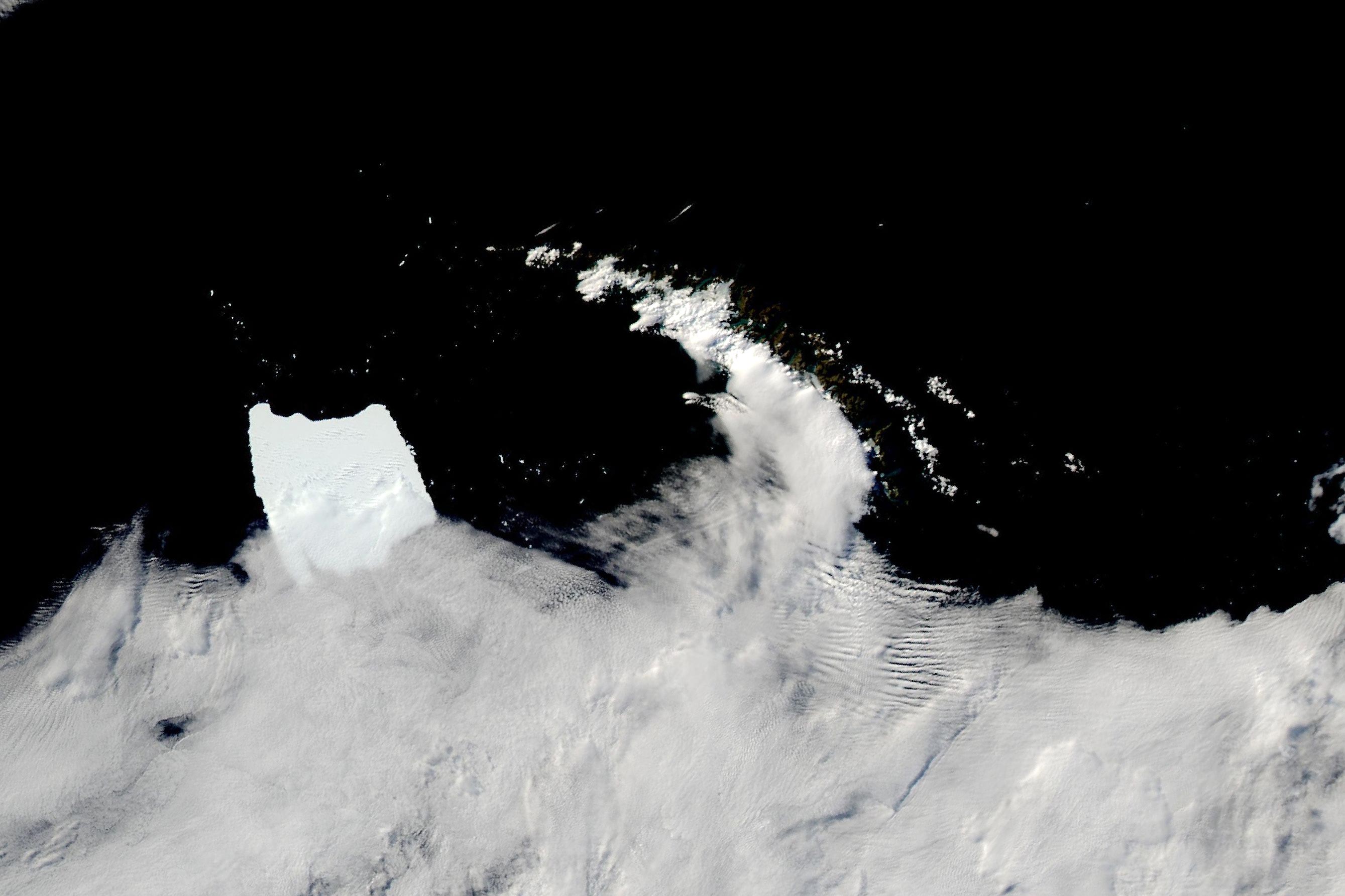
Josh Willis, an oceanographer at NASA’s Jet Propulsion Laboratory, agrees that currents appear to have carried A-23A into the same shallow shelf region previously encountered by some notable icebergs. The last large iceberg to approach South Georgia was A-68A, a trillion-ton behemoth that encountered the island’s shallow shelf in December 2020. That berg quickly broke into two main pieces that continued to fracture and eventually disintegrate in the northern Scotia Sea around South Georgia.
Scientists later discovered that melting from the bottom of A-68A added 152 billion metric tons of fresh water to the ocean during its three-month stay near the island. Iceberg meltwater can potentially affect the local ocean environment. It can also add nutrients to the water that foster biological production.
Already, many ice fragments have broken from A-23A’s margins. Though these pieces appear small in the image above and are not large enough to be named by the U.S. National Ice Center, they could still affect the flora and fauna along the island’s shoreline.
It remains to be seen what becomes of the remainder of the berg’s main mass. When icebergs make it this far north, they eventually succumb to the warmer waters, winds, and currents that make this ocean area a challenge for all seafarers.
“I think the big question now is whether the strong current will trap it there as it melts and breaks up or whether it will spin around to the south of the island like previous bergs,” Willis said. “Time will tell.”
NASA Earth Observatory images by Wanmei Liang, using MODIS data from NASA EOSDIS LANCE and GIBS/Worldview, ocean bathymetry data and digital elevation data from the British Oceanographic Data Center’s General Bathymetric Chart of the Oceans (GEBCO) and the British Antarctic Survey.
Never miss a breakthrough: Join the SciTechDaily newsletter.
Follow us on Google and Google News.
2 Comments
Oh, THAT Georgia.