
Ernest Shackleton’s crew endured months on the desolate Elephant Island after losing Endurance in 1915, surviving harsh conditions until Shackleton’s successful rescue mission. Today, Elephant Island remains largely uninhabited, with a seasonal research station and a monument honoring the endurance and survival of Shackleton’s crew.
When British explorer Ernest Shackleton and the crew of HMS Endurance lost their ship to crushing pack ice in the Weddell Sea in 1915, their chances of survival seemed dim. The 28 men spent months drifting on ice floes and traversing the Southern Ocean in small lifeboats until they finally spotted land. The hunk of rock and ice was not the welcoming refuge they hoped for, but it was enough.
Shackleton and the crew of the Imperial Trans-Antarctic expedition landed on the mountainous, ice-covered island today known as Elephant Island. Some say Elephant Island got its name from the sighting of elephant seals along its shores; others suggest it comes from its appearance as an elephant head. But Shackleton’s captain claimed it was a nickname given by the crew: “Hell-of-an-Island.”
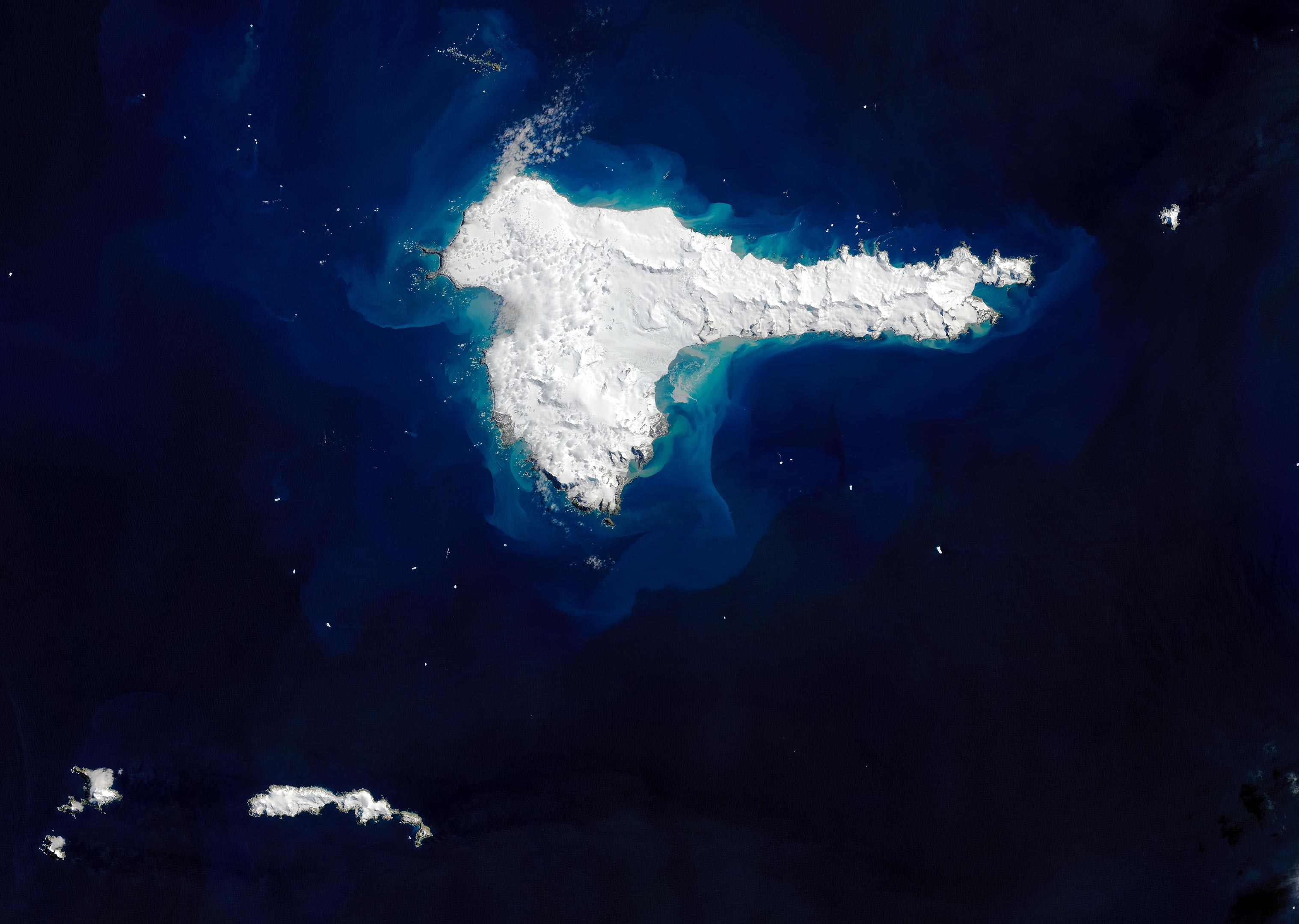
The image above shows a rare, cloud-free view of the remote island on December 13, 2020, as captured by the Operational Land Imager (OLI) on Landsat 8. The highest points, Mount Pendragon (970 meters or 3,200 feet) and Mount Elder (945 meters or 3,100 feet), are located on the southern side. In the center, Endurance Glacier collects most of the ice flowing in the southeast direction.
Geology and Environment of Elephant Island
Elephant Island is located about 250 kilometers (150 miles) northeast of the tip of the Antarctic Peninsula. Geologically, the island is part of the Scotia Plate, which was formed from continental fragments that once formed a land bridge between South America and Antarctica. The rocky island is comprised of green and blue phyllites, blueschists, and greenschists along the coast and in ridges.
Elephant Island has few plants or animals, save for some seals and Gentoo and chinstrap penguins. Although it is in a prime location for observing whales, the island is not well visited and has remained relatively under-studied due to its remoteness and difficult terrain.
Shackleton and his crew initially landed on the eastern coast at Cape Valentine, but falling rocks and the proximity to the sea made it difficult to set up safe campsites. In fact, much of the island’s coastline consists of cliffs with steep slopes rising more than 100 meters (330 feet) in places. Crew member Frank Wild scouted more stable ground to the west, with lower elevation but also more glaciers. The team set up camp, naming the site Point Wild.
Shackleton’s Risky Voyage for Rescue
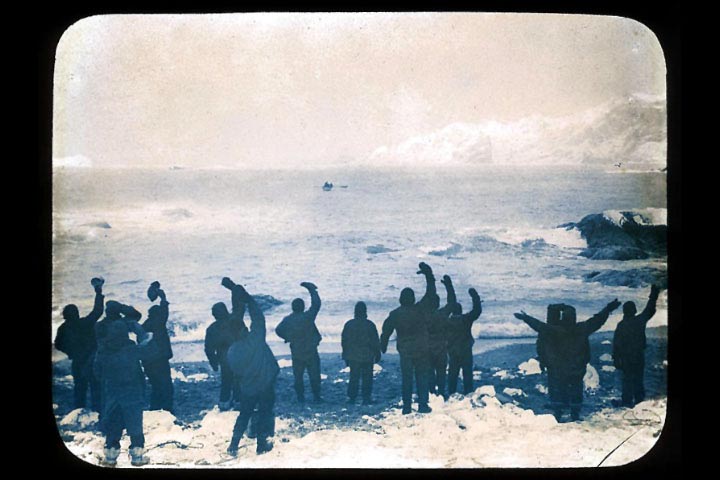
Shackleton realized their chances of getting rescued from Elephant Island by passing ships were low, so he and five crewmates took a lifeboat to look for help, leaving Wild in charge. The image above shows the crew waving goodbye on April 24, 1916.
The remaining crew built makeshift huts by resting their two remaining lifeboats upside down on rocks. To combat the perpetual darkness, they made lamps out of sardine tins, used surgical bandages for wicks, and burned seal blubber oil. Four and a half months later, Shackleton and crew returned with a ship and rescued all 22 men. King George V recognized Wild’s leadership as “instrumental in maintaining their courage and hope.”
Today, the island hosts one small research station occupied during the summer. At Point Wild, a monument of several plaques and a bust of Wild was erected to honor the crew and their experience on the island.
NASA Earth Observatory image by Joshua Stevens, using Landsat data from the U.S. Geological Survey. Photograph by Frank Hurley (photographer on HMS Endurance) and in the public domain via the State Library of New South Wales.
Correction Notice: An earlier version of the headline incorrectly stated that Elephant Island is where HMS Endurance was lost to pack ice. This was an editing error and the body of the article is correct that the ship was crushed by pack ice and sank in the Weddell Sea.
Never miss a breakthrough: Join the SciTechDaily newsletter.
Follow us on Google and Google News.
7 Comments
Shackleton!!! Yeah! His escape from disaster ranks him a number1 leader in my book.
The great IRISH explorer, Ernest Shackleton. He was Irish, not British.
“Elephant Island: Where Ernest Shackleton and the Crew of HMS Endurance Lost Their Ship to Crushing Pack Ice “— completely false. Don’t you have anyone competent enough to review this material for accuracy? The Endurance was lost many hundreds of km from Elephant Island.
Study your history and get back to us.
https://www.coolantarctica.com/Antarctica%20fact%20file/History/Ernest_Shackleton_map_time_line.php
Thank you for pointing out this error. The headline has now been corrected.
The article itself was/is correct, and indeed the first sentence says how they “lost their ship to crushing pack ice in the Weddell Sea.”
A mistake was made during editing where a longer version of the original headline was trimmed down improperly resulting in the misstatement. This mistake was entirely on my end, and does not reflect on the author of the article.
Shackleton had trouble getting a ship to go back to rescue his crew and finally a Chilean captain agreed to go on the perilous journey, and is now a national hero. Most thought it was just a body recovery trip by that time. Luis Pardo.
The bust at Point Wild is NOT of Frank Wild but that of the captain of the ship, Yelcho, which rescued the men. His name was Piloto Luis Pardo and it was erected by a Chilean Antarctic expedition in his honor. Get your facts straight please. There are many people out there who clearly know better than whoever wrote this article with its several errors. FYI, the bow of the ship can be seen in Chile’s Puerto Williams on the Beagle Channel.
I have earnest Appleton’s original sketches he made during his trip 10 his trip to Antarctica along with original pictures. I acquired them from my family Whom I believe were patrons on that trip. If you would like to see them for a story I’d be happy to share them