
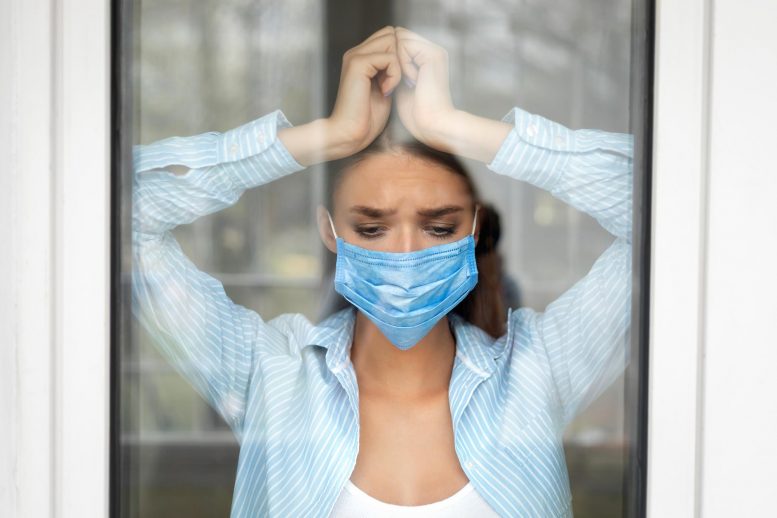
Tackling mental health disorders among survivors of COVID-19 should be a priority, say researchers.
A study published by The BMJ recently finds that COVID-19 is associated with an increased risk of mental health disorders, including anxiety, depression, substance use, and sleep disorders, up to one year after initial infection.
The findings suggest that tackling mental health disorders among survivors of COVID-19 should be a priority.
Some studies have suggested that people with COVID-19 might be at increased risk of anxiety and depression, but they included only a small selection of mental health outcomes and tracked patients over a maximum of six months.
Comprehensive Analysis of Mental Health Outcomes
A comprehensive assessment of the mental health manifestations in people with COVID-19 at one year has not yet been undertaken.
To address this, researchers used data from the US Department of Veterans Affairs national healthcare databases to estimate the risks of mental health outcomes in people who survived at least 30 days after a positive polymerase chain reaction (PCR) test result between March 2020 and January 2021.
They identified data for 153,848 individuals and matched them to two control groups without COVID-19: 5,637,840 contemporary controls and 5,859,251 historical controls who predated the pandemic.
Participants were mostly white men with an average age of 63 years.
The COVID-19 group was further divided into those who were or were not admitted to the hospital during the acute phase of infection, and information was collected on potentially influential factors including age, race, sex, lifestyle, and medical history.
Mental Health Disorders in COVID-19 Survivors
The researchers then followed all three groups for one year to estimate the risks of a set of prespecified mental health outcomes, including anxiety, depression and stress disorders, substance use disorders, neurocognitive decline, and sleep disorders.
Compared with the non-infected control group, people with COVID-19 showed a 60% higher risk of any mental health diagnosis or prescription at one year (equivalent to an additional 64 per 1,000 people).
When the researchers examined mental health disorders separately, they found that COVID-19 was associated with an additional 24 per 1,000 people with sleep disorders at one year, 15 per 1,000 with depressive disorders, 11 per 1,000 with neurocognitive decline, and 4 per 1,000 with any (non-opioid) substance use disorders.
Similar results were found when the COVID-19 group was compared with the historical control group.
The risks were highest in people admitted to hospital during the initial (acute) phase of COVID-19, but were evident even among those who were not admitted to hospital.
Elevated Risk Compared to Other Conditions
People with COVID-19 also showed higher risks of mental health disorders than people with seasonal influenza, while people admitted to hospital for COVID-19 showed increased risks of mental health disorders compared with those admitted to hospital for any other reason.
This is an observational study, so it can’t establish cause, and the researchers acknowledge that some misclassification bias may have occurred. What’s more, the study included mostly older white men, so results may not apply to other groups.
Nevertheless, they say their findings suggest that people who survive the acute phase of COVID-19 are at increased risk of an array of incident mental health disorders, and that tackling mental health disorders among survivors of COVID-19 should be a priority.
We now have a clearer picture of the mental health impacts of the COVID-19 pandemic, says Scott Weich, professor of mental health at the University of Sheffield, in a linked editorial.
Drawing on results from previous studies, he explains that for the general population, COVID and lockdown caused transient distress (related to threat) and those who contracted COVID-19 were at moderately increased risk of anxiety and depression, for the first 6 months or so (though the risk was greatest in month 1).
“Taking stock, it could be argued that much of the research concerned with the mental health impacts of COVID-19 represents more hindsight than insight,” he adds. And he says we now need to focus on advancing our understanding of the causes of mental ill health or undertaking research that evaluates treatments for mental disorders more generally.
For more on this research:
- COVID-19 Survivors Face Increased Mental Health Risks Up to a Year Later
- Menacing Fallout From COVID-19: Dangerous and Enduring Consequences Include Mental Health Disorders
Reference: “Risks of mental health outcomes in people with covid-19: cohort study” by Yan Xie, Evan Xu and Ziyad Al-Aly, 16 February 2022, The BMJ.
DOI: 10.1136/bmj-2021-068993
Never miss a breakthrough: Join the SciTechDaily newsletter.
Follow us on Google and Google News.